Cash in the bank, no book on the desk: Meghalaya’s new SSA policy
Meghalaya has replaced free textbooks with a Rs 250 bank transfer. Follow the money from the State's account to a child's desk, and the scheme falls apart at almost every step.
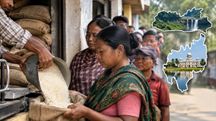
 Representative Image

- Nov 24, 2026,
- Updated Nov 24, 2026, 12:26 PM IST

- Aadhaar and operational bank-account requirements may block many eligible families
- The order caps payments at two schoolgoing children per recipient
- Bihar abandoned a similar model after book purchases remained low
A child in a government school in Meghalaya used to need to do one thing to get her textbooks: simply turn up to collect. From now on, the parent must do ten things.
On September 28, 2026, the Samagra Shiksha in East Khasi Hills ordered that the Text Book Grant be paid "only through DBT mode". The same model is being rolled out across the State, covering 5,19,816 children. Instead of books, parents will receive Rs 250 for each child in Classes I to V and Rs 400 in Classes VI to VIII, and are left to do the rest. Walk through what "the rest" involves, and the policy collapses under its own weight. Needless to explain, there is no method to the madness.
First, the parent needs an Aadhaar number. One resident of Meghalaya in six still does not have one; in April 2025, coverage in West Khasi Hills and South Garo Hills was barely two in three. Second, a working bank account seeded to that Aadhaar. Across the North East, about a quarter of Jan Dhan accounts were inoperative at the end of 2025. Third, the parent must be recognised as the parent, or as the "closest guardian", a term the order never defines. Fourth, the family must have no more than two children in school, because the order caps transfers at two per person in a state whose rural fertility rate is 3.3. The third child simply disappears from the list.
Fifth, the money has to arrive. In August, the Department's own scholarship payments failed for students who were told to link their Aadhaar and wait for the next cycle. Sixth, the parent has to reach it; in 2021 the Chief Minister himself said more than 45 per cent of villages lacked access to banking. Seventh, the parent must know what to buy, from a list the order says is still "to be notified". Eighth, the parent must find the books, which come from publishers in Shillong, Guwahati, Noida and New Delhi, not from a village shop in South Garo Hills. Ninth, the parent must pay for them, and for the journey. With the State's minimum wage for unskilled labour at Rs 541 a day, a single day lost travelling to town costs more than twice a primary-school child's entire grant. Tenth, the parent must prove the purchase, with a signed declaration and a receipt kept "wherever available", to a teacher who must check within 45 to 60 days, in a window that runs into the winter vacation.
None of these hurdles is insurmountable on its own. That is precisely the trap. Hurdles multiply. These are illustrations, not measurements, but reality has already supplied the measurement. Bihar tried textbook DBT under the same Samagra Shiksha scheme from 2017. Its own 2018 survey found that only 18 per cent of children had bought books with the money. Bihar scrapped textbook DBT in 2022 and went back to handing out books.
Apply Bihar's figure to Meghalaya, about 4.26 lakh children would begin the year without textbooks. Even a one-in-ten failure rate would leave some 52,000. The Department has published no estimate of its own, which suggests it has not made one.
The timing compounds the problem. The grant is labelled for the financial year 2026-27, but Meghalaya's school year runs from February to December, and the order never says which session the money is for. If, as the timing suggests, it is for 2027, families will receive cash four months before any book is needed, before the book list exists, and just ahead of Christmas. Because the order pays children by their current class, roughly 65,000 children now in Class V would receive the Rs 250 primary rate, though they will need Class VI books. Some 56,000 now in Class VIII would be paid for elementary books they will no longer use. And about 77,000 children due to enter Class I next year would get nothing at all. These are rough estimates from the Project Approval Board's own figures; the Department holds the precise numbers.
The children bearing this risk are the ones who can least afford it. In the national PARAKH assessment of 2024, Meghalaya scored below the national average in every one of the nine grade and subject combinations tested, with the gap widening to 13 points in Grade 6 Language. Its primary dropout rate in 2024-25 was 4.2 per cent, against 0.3 per cent nationally. More than half of rural children now attend private schools, so those left in government and aided schools come overwhelmingly from the poorest homes. Even a hopeful sign is at risk: ASER 2024 found foundational reading in the State's rural government schools above the national government-school average. A system that is beginning to recover is the last place to make textbooks uncertain.
It must be said that direct supply is not flawless. A CAG audit of Odisha found textbooks delayed by more than a year in some schools. But when supply fails, the State knows which school is short and can send books. When a transfer fails, the failure is scattered across thousands of households, invisible until it is too late.
Which brings us to accountability. Vijay Kumar Mantri, Commissioner and Secretary of Education since June 2024, presides over a department whose headline numbers have improved. Its Performance Grading Index score has reportedly risen from 417.9 to 525.71, and its SSLC pass rate jumped from 55.80 to 87.10 per cent in a year. Yet its process keeps drawing objections.
A notification on teachers' pay was withdrawn after 36 days. Teachers walked out of a meeting he chaired on a provident fund scheme that now awaits the High Court. And now comes a change to half a million children's textbooks, with no published rationale, no consultation record and no impact assessment. No officer should be made a scapegoat for decisions of the Government. But a department that keeps announcing first and explaining later needs a public review of how it decides, placed before the Legislative Assembly. More so, its officers definitely need to be questioned for their rationale.
Before that, the Commissioner and Secretary owes the public specific numbers: how many eligible parents have working, Aadhaar-seeded accounts; how many transfers have already failed; what a full set of prescribed books costs in each district; which school session the grant is for; and how many families the two-child cap excludes.
The remedy does not need a committee. Scrap the transfer. Put prescribed books directly into every child's hands before the 2027 session opens in February, as the State did for years. Withdraw the two-child cap. Audit what has already gone wrong.
A child cannot learn from a bank credit. She learns from a book on her desk. At about Rs 299 per child, textbooks are among the cheapest things Meghalaya provides, and the one thing it has always known how to deliver. Ten hurdles now stand where there used to be none. The Department should explain why, and then it should take them down.