Economic Survey flags shrinking springs in Meghalaya, backs community-led water security push
Economic Survey highlights the shrinking springs in Meghalaya, posing risks to water availability. It stresses the importance of community-led conservation efforts for sustainable water security
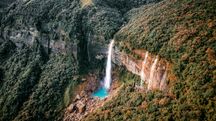
 Representative Image
- Jan 30, 2026,
- Updated Jan 30, 2026, 12:58 PM IST

Nearly half of Meghalaya’s springs have either dried up or are showing a sharp drop in discharge, raising fresh concerns over water security in the hill state, according to the Economic Survey 2025–26 tabled in Parliament.
The survey notes that declining spring flows have emerged as a major risk for both rural and urban communities, prompting the state to shift towards what it calls a community-centric, ecosystem-based adaptation strategy to deal with climate stress.
At the heart of this approach is the Protection of Vulnerable Catchment Areas in Meghalaya (MegARISE) project, which aims to improve water availability by safeguarding ecologically sensitive catchments through sustainable forest management. The initiative focuses on watershed treatment, forest restoration and participatory community involvement.
Under MegARISE, plantations are planned over 8,430 hectares, while two key catchments — Umiew and Ganol — have been identified for treatment and long-term protection. The survey underlines that these landscapes are critical to maintaining spring recharge and surface water flows.
The state has also undertaken extensive spring mapping using advanced Geographic Information System (GIS) tools. More than 55,000 springs have been mapped so far, a move the survey says allows “timely corrective actions” where discharge levels are falling.
Alongside this, over 500 community-based, climate-adaptive water harvesting projects are being set up across Meghalaya to improve local water management and reduce vulnerability to erratic rainfall patterns.
Collectively, the measures are designed not only to secure water resources but also to strengthen the ability of local communities to respond to climate change impacts, the survey notes.
Reacting to the findings, Meghalaya Chief Minister Conrad Sangma said the state’s efforts had received national recognition. “Meghalaya’s community-centric, ecosystem-based approach to water security and climate adaptation has been prominently highlighted,” he said, adding that initiatives such as MegARISE and spring mapping are helping protect critical catchments and restore forests. “When communities lead the way, great things are possible!”
The Economic Survey 2025–26 was presented in Parliament by Union Finance Minister Nirmala Sitharaman, with inputs on Meghalaya’s water and climate initiatives provided by the state government.