Meghalaya gets Northeast’s largest organic spice processing unit, set to benefit 5,500 farmers
Nirmala Sitharaman inaugurated an organic spice processing unit in Meghalaya's Ri-Bhoi district. The certified facility is expected to expand value addition, market access and farmer incomes.

- Jun 19, 2026,
- Updated Jun 19, 2026, 4:12 PM IST

- The unit can process over 10,000 metric tonnes of produce annually
- It holds NPOP and EU organic certification, a regional first
- Ginger, turmeric, black pepper and chilli will be processed onsite
A new organic spice processing facility capable of handling more than 10,000 metric tonnes of produce annually has been launched in Meghalaya’s Ri-Bhoi district, marking a major push towards value-added agriculture and export-oriented organic farming in the Northeast.
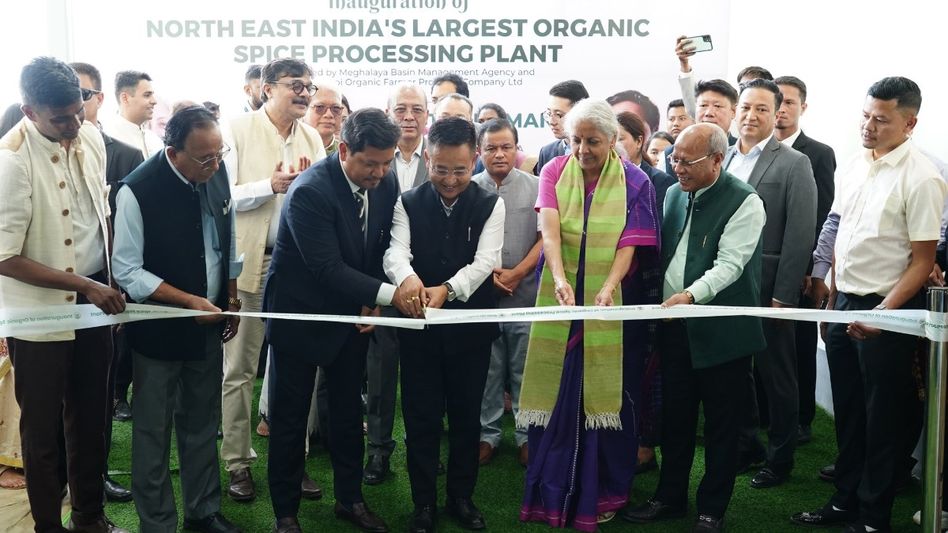
Union Finance Minister Nirmala Sitharaman inaugurated the facility on June 19 in the presence of Meghalaya Chief Minister Conrad K Sangma and Sikkim Chief Minister Prem Singh Tamang.
Built at a cost of about Rs 32 crore, the plant is the largest organic spice processing unit in the Northeast and the first in the region to receive organic certification under both the National Programme for Organic Production (NPOP) and European Union Organic Standards. The certification is expected to help local farmers access premium domestic and international markets.
The facility will process high-value crops including ginger, turmeric, black pepper and chilli. It is equipped with cold storage, dry storage, washing, drying and pulverising infrastructure aimed at reducing post-harvest losses and improving product quality.
Addressing farmers and stakeholders, Sitharaman said global demand is increasingly shifting towards agricultural products that are sustainable, traceable and of high quality.
“The future of agriculture belongs to those who produce not merely more, but better, cleaner, safer, more traceable and more sustainable products,” she said.
She noted that Meghalaya’s traditional farming practices and community-based stewardship place the state in a strong position to emerge as a leader in premium organic agriculture. The minister also highlighted the commercial potential of products such as Lakadong turmeric, which received Geographical Indication (GI) status in 2024, and the state's ginger varieties known for their low fibre content and quality.
Emphasising the need for greater value addition, Sitharaman said the focus should move beyond exporting raw produce to exporting finished products and recognised brands. She said processing, certification, packaging and market access would be critical in improving farmers’ incomes and retaining economic value within the region.
The project is expected to directly benefit around 5,500 organic farmers across Meghalaya and other Northeastern states through improved aggregation, quality control and market linkages.
Speaking at the event, Sangma described the facility as a significant intervention for the farming sector and said Meghalaya has steadily invested in infrastructure, training and market access to improve rural livelihoods.
According to the chief minister, 11 processing units are currently operational across the state, benefiting nearly 55,000 farmers and their families. He said the state's strategy has focused on building value chains around existing agricultural strengths rather than introducing entirely new farming systems.
Agriculture and Farmers’ Welfare Secretary Vijay Kumar D. said the facility could increase participating farmers’ incomes by nearly 50 per cent within a season by strengthening processing and value-addition capabilities.
The unit has been established by the Eastern Ri-Bhoi Organic Farmer Producer Company (FPC), a collective of around 500 organic farmers from nine villages organised through 26 Farmer Interest Groups. The FPC has developed a network of aggregation centres, storage facilities, vermicompost units and transport systems to support organic farming in the region.
The project received support under the Mission Organic Value Chain Development for North Eastern Region (MOVCDNER), Mission for Integrated Development of Horticulture (MIDH), the Meghalaya government and the International Fund for Agricultural Development (IFAD).
The launch comes as Northeastern states increasingly seek to position organic farming and value-added agricultural products as key drivers of rural income growth and exports.