Meghalaya High Court flags gaps in accessibility, calls for disability-friendly public buildings
The Meghalaya High Court has urged stronger enforcement of accessibility standards in public buildings under the RPwD Act. The court said gaps in awareness, planning and implementation continue to undermine the rights, dignity and independence of persons with disabilities.

- Sep 23, 2026,
- Updated Sep 23, 2026, 11:30 AM IST

- Justice Dere said poor awareness still blocks equal access for many
- She said disabled persons need independence, dignity and self-respect, not sympathy
- Engineers and architects were urged to adopt universal design from planning
The Meghalaya High Court has called for stronger implementation of accessibility standards in public buildings, warning that gaps in awareness and enforcement continue to create barriers for persons with disabilities.
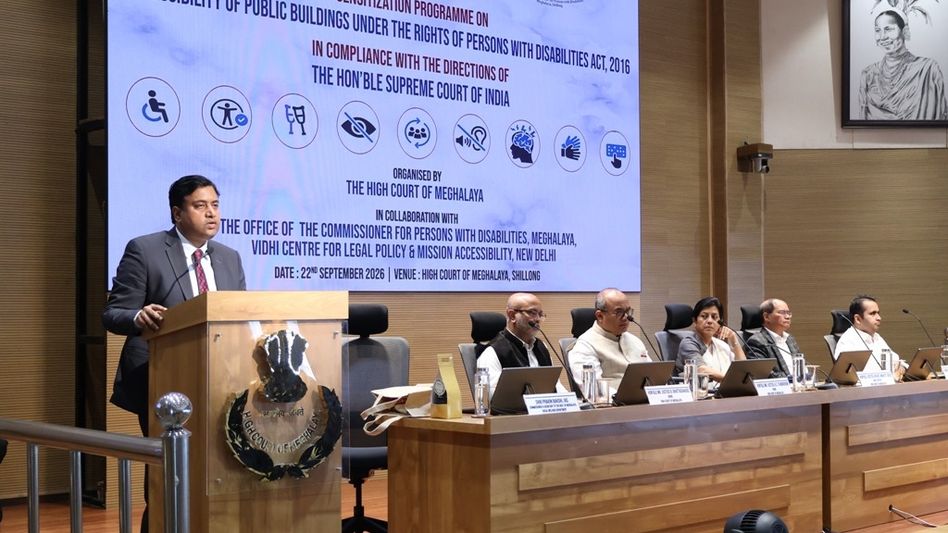
Chief Justice of the High Court of Meghalaya, Justice Revati Mohite Dere, made the remarks during a sensitisation programme on accessibility of public buildings under the Rights of Persons with Disabilities (RPwD) Act, 2016.
The programme was organised by the High Court in collaboration with the Office of the Commissioner for Persons with Disabilities, Meghalaya, Vidhi Centre for Legal Policy and Mission Accessibility, New Delhi, following directions of the Supreme Court.
Justice Dere said the RPwD Act was intended to protect the rights and dignity of persons with disabilities, prevent discrimination and ensure equal opportunities. However, she noted that several Supreme Court judgments and provisions of the Act had yet to translate into effective implementation on the ground.
She identified lack of awareness and sensitivity towards the needs of persons with disabilities as among the factors contributing to the continuing gaps.
“Instead of encouraging them to be independent and self-reliant, we tend to create barriers and obstacles by ignoring their rights and needs,” Justice Dere said, stressing that persons with disabilities seek independence, dignity and self-respect rather than sympathy.
She called for engineers, architects and other technical personnel involved in the planning and construction of public buildings to be trained in accessibility and universal design principles. Such considerations, she said, should be incorporated at the planning stage rather than added later.
Justice Dere also said accessibility should not be limited to buildings. Roads, workplaces, toilets and other facilities used in everyday life must also be accessible to persons with disabilities.
“A door is not accessible if it needs another person to open it,” she said, highlighting the need to keep independence and dignity at the centre of public infrastructure planning.
She said accessibility was not a matter of charity but a right guaranteed by the Constitution and the RPwD Act, and was essential for people with disabilities to exercise fundamental rights, including access to education, life and justice.
Commissioner and Secretary of the Meghalaya Social Welfare Department, Pravin Bakshi, said accessibility was a legal requirement and needed to be incorporated into building regulations, planning approvals, construction and maintenance.
Bakshi said access audits had already been carried out at 15 district courts and six district prisons and correctional homes to identify barriers and assess measures required to improve accessibility.
The programme was attended by Justices H.S. Thangkhiew, B. Bhattacharjee and W. Diengdoh of the Meghalaya High Court, besides officials from the Social Welfare Department, Police Department and other government departments.
Expert sessions were also held to familiarise officials and other stakeholders with accessibility requirements and the implementation of the RPwD Act and constitutional provisions concerning equality, dignity and accessibility.