Meghalaya HC flags gaps in August 19 violence probe, questions police over just seven arrests
The Meghalaya High Court questioned police over evidence gaps and seven arrests following the Shillong rally violence. The scrutiny highlighted delayed CCTV collection and failures to implement safeguards against mob violence.

- Nov 29, 2026,
- Updated Nov 29, 2026, 8:49 AM IST

- Police collected Jaiaw footage only after court intervention during proceedings
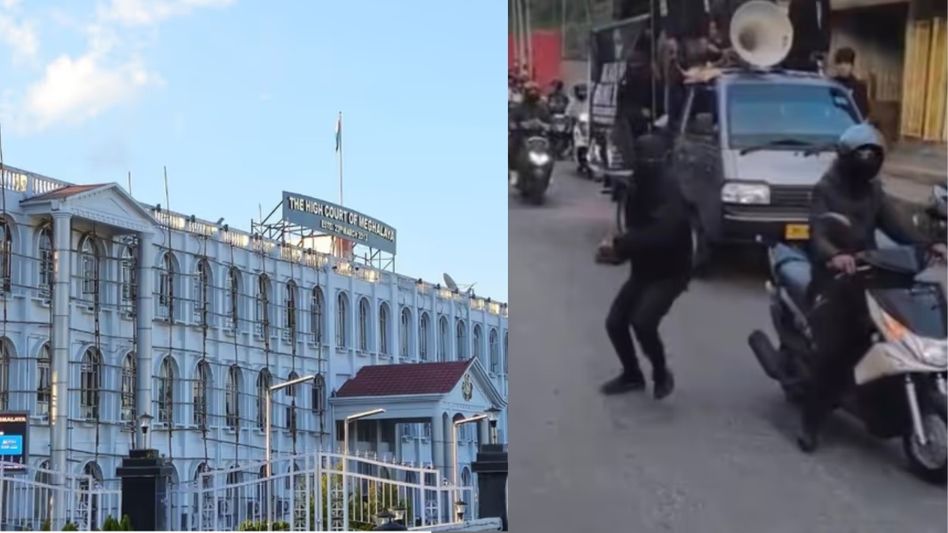
- Images showed masked participants carrying lathis and obscured vehicle plates
- SIT continues efforts to identify and arrest other alleged offenders
The Meghalaya High Court has questioned the police investigation into the violence during a rally in Shillong on August 19, pointing to gaps in evidence collection, the failure to identify all those involved and the non-implementation of measures to prevent mob violence.
A division bench comprising Chief Justice Revati Mohite Dere and Justice W Diengdoh, while hearing PIL No. 16 of 2026 along with PIL No. 18 of 2026 on November 26, expressed concern over the police's handling of the case and the delay in collecting crucial CCTV footage.
According to an affidavit submitted by East Khasi Hills Deputy Commissioner Abhilash Baranwal, around 20 to 25 volunteers of the Khasi Students' Union (KSU) had allegedly begun placing banners and posters on the iron grills and walls of the Meghalaya Secretariat at around 11 am on August 19, hours before the rally was scheduled to begin at 3 pm from Jaiaw.
An Executive Magistrate was subsequently directed to intervene and stop the placement of the banners and posters. The affidavit stated that the rally initially began peacefully from the KSU office in Jaiaw, with no incident reported at the assembly point.
However, the High Court noted that the police had failed to record the rally from its starting point, despite a Supreme Court directive in the Tehseen S Poonawalla judgment mandating video recording of processions.
The bench observed that if an incident had occurred outside the Meghalaya Secretariat at around 11 am on the same day, the police should have been "far more vigilant", particularly since the rally was scheduled for later that afternoon.
The court also flagged contradictions between the Deputy Commissioner's latest affidavit and an earlier police status report dated September 7. While the earlier report stated that rally participants were not permitted to wear masks or cover their faces, photographic and video evidence showed several participants with covered faces.
The court further pointed out that some participants were seen carrying lathis and covering vehicle number plates.
Questioning why the footage from Jaiaw had not been collected earlier, the bench observed that the police obtained the recordings only after the court directed them to do so during the pendency of the petition.
"We fail to see why the said video recording was not collected by the police first in point of time," the court noted, adding that the footage was necessary to establish whether the conditions imposed while granting permission for the rally had been violated.
The court also expressed concern over the progress of the investigation, noting that only seven accused had been arrested in connection with the August 19 incident, despite several other people allegedly being involved in vandalising property and assaulting members of the public.
It said the police had not seriously attempted to identify the remaining accused.
A fresh status report submitted by East Khasi Hills Superintendent of Police Vivek Syiem on behalf of the Special Investigation Team (SIT) stated that further investigation under Section 193(9) of the Bharatiya Nagarik Suraksha Sanhita (BNSS) was underway to establish the involvement of accused persons yet to be identified or arrested.
The State also submitted CCTV footage from around 32 locations, including Jaiaw, where the rally originated. The recordings were handed over to the court in a sealed envelope. The bench directed the amicus curiae, Paul, to examine the footage at the office of the Additional Advocate General.
The High Court also questioned the Meghalaya Police's failure to implement its own measures to prevent mob violence and lynching.
Taking note of an affidavit submitted by Director General of Police Anurag Agarwal, the court observed that the police department had issued a circular on September 13, 2018, directing district superintendents of police to implement the preventive, remedial and punitive measures laid down by the Supreme Court in the Tehseen S Poonawalla judgment.
Further, a Home (Police) Department notification dated October 25, 2023, had designated district superintendents of police as District Nodal Officers, assisted by their respective deputy superintendents of police, to coordinate preventive measures, monitor intelligence inputs and ensure prompt police response to incidents of mob violence and lynching.
However, when questioned about the implementation of these directives, the State's counsel informed the court that no special task force had been constituted by the concerned superintendents of police and no meetings had been held.
The bench said the government notification "cannot merely remain on paper" and should have been acted upon by the concerned district superintendents of police.
It directed that its order be placed before the Director General of Police, Meghalaya, to enable him to take appropriate steps against superintendents of police if non-compliance is established.
The DGP has also been asked to assess the implementation of the directives across all districts and obtain reports from the respective superintendents of police.
The court further directed the State government to file an affidavit detailing whether a victim compensation scheme had been prepared under Section 357-A of the Code of Criminal Procedure for cases involving mob violence and lynching.
It also sought details of compensation, if any, provided to victims who suffered bodily or psychological injuries, loss of earnings, employment or educational opportunities, and medical or legal expenses.
Additionally, the State has been asked to submit a point-by-point compliance report on the directions issued by the Supreme Court in paragraphs 40.1 to 40.23 of the Tehseen S Poonawalla judgment.
The matter has been listed for further hearing on December 11, 2026, by which time the Director General of Police and other concerned officials are expected to file their affidavits.