Meghalaya honours forgotten Khasi resistance leaders with 15-foot statues
The Hynniewtrep Youths' Council unveiled statues of Bormanik Syiem and Sngap Sing Syiem at Nongthliew. The memorial aims to restore recognition for Khasi resistance leaders in Meghalaya's anti-colonial history.

- Jul 18, 2026,
- Updated Jul 18, 2026, 8:13 PM IST

- Unveiling coincided with U Tirot Sing Syiem's 191st death anniversary
- Traditional heads and activists from across Meghalaya attended the ceremony
- Riti Academy artists created sculptures and compiled supporting historical documentation
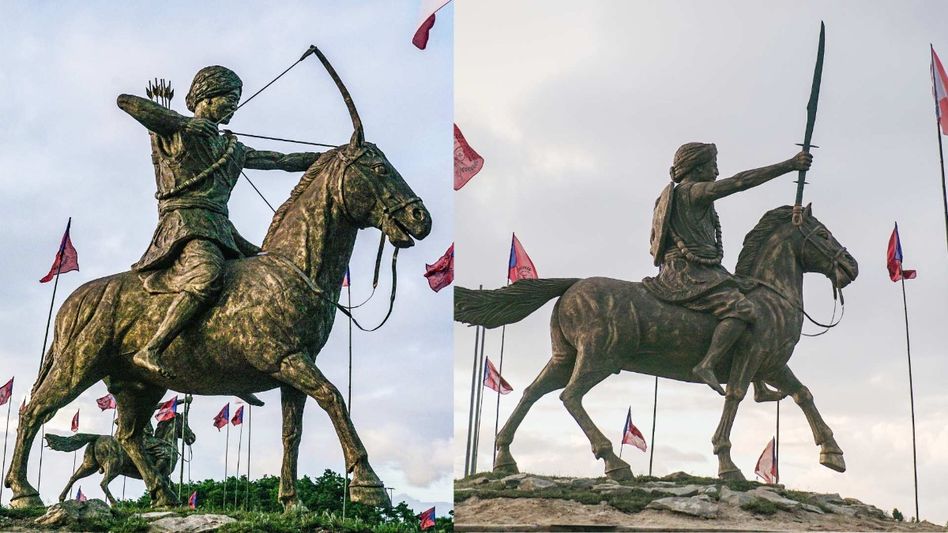
The Hynniewtrep Youths' Council (HYC) unveiled two 15-foot statues of Khasi resistance leaders Bormanik Syiem of the erstwhile Hima Shyllong and Sngap Sing Syiem of Hima Maram at Laitarted, Nongthliew, marking a renewed effort to recognise their role in the Khasi resistance against British colonial rule.
The unveiling coincided with the 191st death anniversary of freedom fighter U Tirot Sing Syiem and the foundation day of the HYC.
The statues were unveiled by Niandro Syiemiong of Hima Maram and Habapan Sing Syiem, Deputy Syiem of Hima Khyrim, in the presence of traditional heads, community leaders and social activists from across Meghalaya, including representatives from the Garo Hills and Jaintia Hills.
HYC leaders, including president Roy Kupar Synrem, general secretary Rhembor Saiborne and vice-president Donbok Kharlyngdoh, said the memorial seeks to restore public recognition of two historical figures whose contributions have received limited attention despite their role in the Khasi resistance.
The heritage enclave, developed by local artists from the Riti Academy, features full-length statues and historical documentation prepared by the academy's Documentation Cell. The sculptures were designed under the leadership of chief creative director Raphael Warjri, with sculptors Banteilang Hynniewta, Returnwell Sutong and Skhemlang Hynniewta, assisted by local artisans Iallissing Mawrie, Bapynskhem Mawrie and Batskhemlang Kharumnuid.
According to historical accounts highlighted at the event, Bormanik Syiem opposed the expansion of the British East India Company in 1828 by resisting its authority in the Dimurua region bordering Assam. He worked alongside U Tirot Sing Syiem to organise military resistance and encouraged neighbouring regions to unite against British rule.
The armed confrontation escalated in April 1829 when Khasi warriors attacked the British military station at Nongkhlaw, triggering the First Anglo-Khasi War (1829–1833). Following U Tirot Sing's capture and exile to Dacca, Sngap Sing Syiem continued the resistance during the Second Anglo-Khasi War (1835–1839), leading guerrilla campaigns from the stronghold of Nongnah before his capture in 1839. He was later granted amnesty and continued to serve as Syiem of Hima Maharam until his death in 1846.
Organisers said the memorial has been established to preserve the legacy of the three Khasi resistance leaders and ensure that future generations remain aware of their contribution to the region's history and the struggle against colonial rule.