Shillong forum spotlights Australia-India ties through Bay of Bengal lens
Shillong hosted the launch of Asian Confluence's Signature Series on Australia-India ties and the Bay of Bengal. Speakers said Northeast India and wider regional tensions are sharpening the case for closer coordination.

- May 07, 2026,
- Updated May 07, 2026, 4:46 PM IST

- Asian Confluence launched its Signature Series with a high-level Shillong discussion
- Speakers examined geopolitical shifts linking the Indian Ocean, Bay and Northeast
- Rajiv Kumar Bhatia stressed Northeast India's growing role in regional connectivity
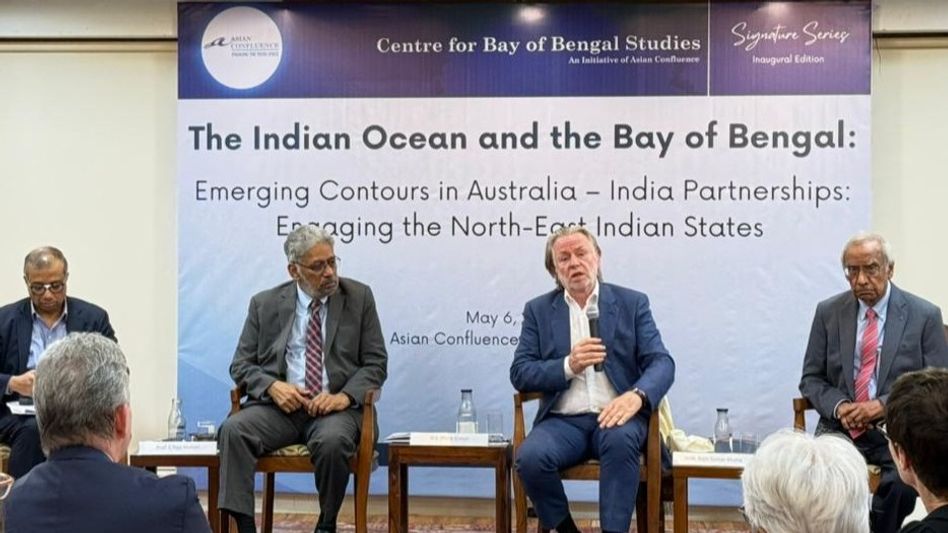
Shillong witnessed the launch of the Asian Confluence Centre for Bay of Bengal Studies' 'Signature Series' on May 6, kicking off with a high-level event themed "The Indian Ocean and the Bay of Bengal: Emerging Contours in Australia–India Partnerships: Engaging the North-East Indian States".
Policymakers, scholars, and civil society leaders gathered to unpack shifting geopolitical trends tying the Indian Ocean, Bay of Bengal, and India's Northeast to stronger Australia-India links.
Ambassador Rajiv Kumar Bhatia, a Governing Council member at Asian Confluence and Distinguished Fellow at Gateway House, opened proceedings by stressing the strategic growth in India-Australia relations. He pointed to Northeast India's rising role in regional connectivity via the Bay of Bengal.
Prof C Raja Mohan, Visiting Research Professor at the National University of Singapore's Institute of South Asian Studies and Advisor to Asian Confluence, delivered a special address. He traced the Indian Ocean's history, China's ascent, and evolving geopolitics, while flagging Northeast India's key place in connectivity, maritime ties, and Indo-Pacific strategies.
Australia's High Commissioner to India, HE Mr Philip Green OAM, gave the keynote. He highlighted converging interests in strategy, development, and connectivity around the Bay of Bengal and Northeast India. Stronger institutions, trade, mining, education, clean energy, and people-to-people bonds, he said, would secure a stable Indo-Pacific.
A lively Q&A wrapped up the session, diving into cooperation on sustainable development and trade. Talk turned to the West Asia conflict—especially the Strait of Hormuz blockade—and its push for tighter India-Australia coordination amid Indo-Pacific flux.
The Signature Series marks a core effort by the Centre for Bay of Bengal Studies. It will draw diplomats, academics, and others for ongoing talks on Bay of Bengal and Indo-Pacific issues, zeroing in on Northeast India to shape collaborative fixes for regional challenges.