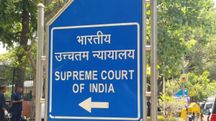
SC allows Mizo woman to challenge amended marriage, inheritance law before Gauhati High Court
The Supreme Court has allowed a petitioner challenging the constitutional validity of the 2026 amendments to Mizoram's marriage, divorce and inheritance law to approach the Gauhati High Court, instead of directly pursuing the matter before the apex court.
 Supreme Court
- Aug 29, 2026,
- Updated Aug 29, 2026, 4:33 PM IST

The Supreme Court has allowed a petitioner challenging the constitutional validity of the 2026 amendments to Mizoram's marriage, divorce and inheritance law to approach the Gauhati High Court, instead of directly pursuing the matter before the apex court.
A three-judge bench headed by Chief Justice of India Surya Kant, along with Justices Joymalya Bagchi and V Mohana, declined to entertain the petition at this stage, observing that the issues could effectively be examined by the jurisdictional High Court.
The court, however, took note of the petitioner's apprehension that the matter could be difficult to pursue before the Aizawl Bench of the Gauhati High Court because of the prevailing atmosphere. It therefore granted liberty to approach the principal bench of the Gauhati High Court, subject to the Chief Justice's approval. The Supreme Court indicated that the matter prima facie warrants preferential attention.
The petition challenges amendments to Sections 2, 3(m), 25 and 26(1) of the Mizo Marriage, Divorce and Inheritance of Property Act, 2014.
The petitioner has argued that the amended law discriminates against Mizo women who marry non-Mizo men. According to the challenge, the amended Section 2 effectively covers marriages where both spouses are Mizo or where the husband is Mizo, leaving Mizo women who marry outside the community outside the statutory framework.
The petition also challenges the revised definition of "Mizo" under Section 3(m), alleging that it introduces a patrilineal criterion by recognising individuals based on birth or whether their father belongs to a Mizo tribe.
The petitioner has contended that the changes could adversely affect the independent identity of Mizo women and result in unequal treatment of children born to Mizo women who marry non-Mizo men. The plea also raises concerns over inheritance, succession, property and community-linked land rights.
Another challenge concerns Section 25, which introduces a statutory limitation on a woman's share in matrimonial property. The petitioner has also objected to the removal of an explicit safeguard under Section 26(1) protecting a woman's personal property from interference.
The petitioner has argued that the amendments have wider implications for women's proprietary and inheritance rights as well as their access to protections linked to Scheduled Tribe status.
The Supreme Court's order does not decide the constitutional validity of the amended law. The substantive challenge will now be pursued before the Gauhati High Court.
The case is Meriam L Hrangchal vs State of Mizoram, Writ Petition (Civil) No. 1046/2026.