
Nagaland Assembly orders select committee review after ‘Vande Mataram’ controversy
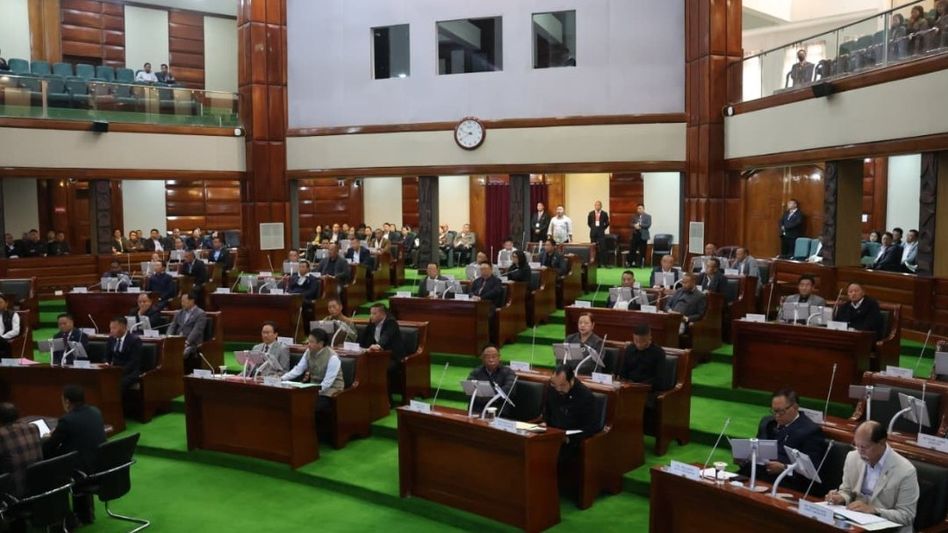
Nagaland Legislative Assembly on March 3 resolved to refer the Ministry of Home Affairs (MHA) directive on the singing of Vande Mataram to a select committee for examination of its applicability in the state.

- Mar 03, 2026,
- Updated Mar 03, 2026, 8:41 PM IST

Nagaland Legislative Assembly on March 3 resolved to refer the Ministry of Home Affairs (MHA) directive on the singing of Vande Mataram to a select committee for examination of its applicability in the state.
Speaker Sharingain Longkumer announced the decision after members across party lines, except the BJP, voiced objections during discussion on the Motion of Thanks to the Governor’s address.
The national song was played in the House on Monday at the commencement of the Budget session 2026–27, following an executive order issued by the MHA on January 28. This marked the first instance of Vande Mataram being played in the Assembly before the national anthem.
Chief Minister Neiphiu Rio acknowledged the concerns raised by legislators. While noting that the song carries historical importance in the freedom movement, he pointed out that the directive had been issued through an executive order.
Referring to Article 371A, which grants special constitutional safeguards to Nagaland, Rio said the state was formed under a political agreement and enjoys protections over its religious and social practices. Given the sensitivities involved, he proposed that the matter be examined by a select committee of the House.
Several members argued that any directive concerning national symbols or songs must be assessed in light of constitutional provisions and established conventions, particularly in a state protected under Article 371A.
During Zero Hour, MLA Achumbemo Kikon stated that the recitation of Vande Mataram preceding the national anthem required further discussion to ensure constitutional safeguards are respected.
Initiating the debate, NPF MLA Kuzholuzo Nienu objected strongly, linking the song to Hindu religious practice. “As Christians, we believe in one God. We cannot serve two masters,” he said. Calling the development “first-of-its-kind”, he added, “We were caught by surprise… Is it absolutely unnecessary to recite Vande Mataram when we are already singing the national anthem?”
Nienu further argued that references to Hindu deities in the song make its imposition inappropriate in a secular country and described it as an infringement of Article 371A.
NPF legislators P Longon and T N Manen, RPI (Athawale) MLA Lima Onen Chang, NPP MLA Tseilhoutuo Rhutso, JD(U) MLA Jwenga Seb and Independent MLA Neisatuo Mero also expressed reservations.
BJP leader and minister Temjen Imna Along defended the directive, stating, “We all have our opinions, but the national song has been adopted by the national constituent body and we have to understand the context.” He said that even if some may choose not to sing it, “we must respect the sentiments of the rest of the country,” drawing a parallel with Hindu students participating in the Lord’s Prayer in Christian schools in the state. He maintained that the matter should not be viewed as an infringement of Article 371A.
Concluding the discussion, Speaker Longkumer said the sense of the House was to refer the issue to the select committee tasked with examining the applicability of central Acts and laws in the context of Article 371A. He directed the Assembly Secretary to formally notify the matter to the Minister of Parliamentary Affairs.
MORE NEWS








Copyright©2026 Living Media India Limited. For reprint rights: Syndications Today
