
NSF observes ‘North East Black Day’ in Kohima, protests Citizenship Amendment Act
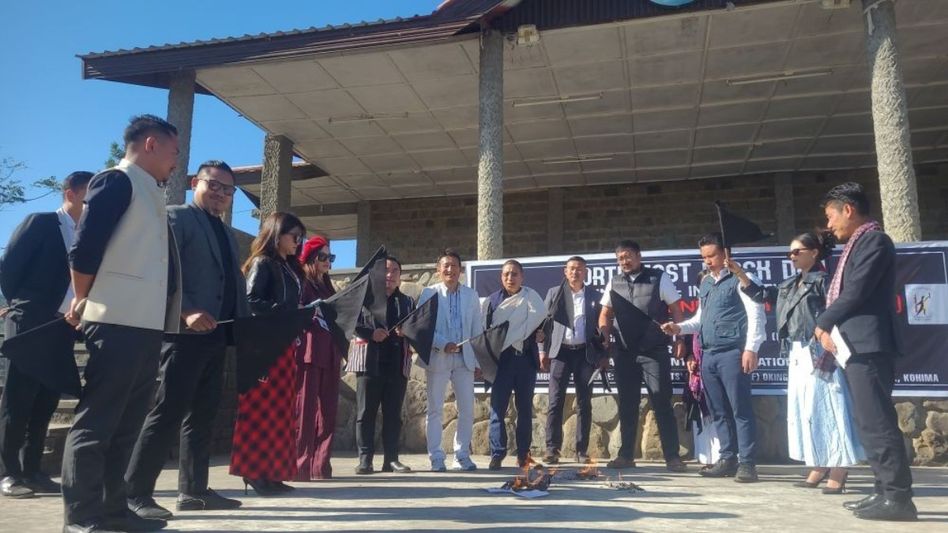
The Naga Students’ Federation (NSF) on December 11 observed ‘North East Black Day’ in Kohima, joining student bodies across the region in protesting the Citizenship Amendment Act (CAA) on the anniversary of its passage in Parliament in 2019.

- Dec 12, 2025,
- Updated Dec 12, 2025, 10:10 AM IST

The Naga Students’ Federation (NSF) on December 11 observed ‘North East Black Day’ in Kohima, joining student bodies across the region in protesting the Citizenship Amendment Act (CAA) on the anniversary of its passage in Parliament in 2019.
The demonstration was part of a coordinated call by the North East Students’ Organisation (NESO), whose member organisations held similar protests in all northeastern states.
NSF general secretary Kenilo Kent said the observance symbolised a united regional stand against what student groups described as a discriminatory and threatening legislation.
“Today, we stand together in collective defiance along with the rest of the people of the Northeast,” Kent said, alleging that the CAA poses a direct threat to the identity and rights of indigenous communities. “Our homeland is not just a physical space; it is the cradle of our identity, culture and history,” he added, warning that the Act represents an existential challenge to indigenous protections.
NESO secretary general Mutsikhoyo Yhobu said student organisations had opposed the CAA from the outset. “Today, the entire Northeast is observing this black day against the imposition of the Citizenship Amendment Act,” he said.
Yhobu reiterated NESO’s long-standing demand that the Act not be enforced in the region, arguing that even though states under the Inner Line Permit (ILP) system are exempted, the Northeast as a whole remains vulnerable.
He stated that NESO and its member bodies were compelled to mark the day in order to send a clear message to the Centre: “We don’t want this Citizenship Amendment Act.” During the protest, Yhobu led the symbolic burning of CAA documents as a gesture of public dissent.
In Arunachal Pradesh, All Arunachal Pradesh Students’ Union (AAPSU) vice president (protocol) Nabam Gandhi echoed similar concerns, calling the CAA “socially and economically damaging for the region.” He argued that no legislation should be implemented without a thorough assessment of its social and economic impact, particularly in tribal-majority states such as Arunachal Pradesh and Nagaland.
Gandhi dismissed the ILP exemption offered by the Centre as “a chocolate” intended to placate indigenous people. “This ILP can be lifted anytime,” he cautioned, adding that unrestricted migrant settlement could erode tribal culture, customary practices and natural resources.
Student organisations said they will continue to oppose the implementation of the Act and will intensify their campaign if their concerns remain unaddressed.
MORE NEWS










Copyright©2026 Living Media India Limited. For reprint rights: Syndications Today
