Who owns the marketplace? Illegal immigration and local survival in Nagaland
Since the recent years till today, concerns have grown among sections of Naga society regarding the illegal entry of immigrants from Bangladesh into Nagaland and its perceived impact on local livelihoods, particularly in the business sector.

- Jan 10, 2026,
- Updated Jan 10, 2026, 8:04 PM IST

Since the recent years till today, concerns have grown among sections of Naga society regarding the illegal entry of immigrants from Bangladesh into Nagaland and its perceived impact on local livelihoods, particularly in the business sector. While migration is a complex and sensitive issue, many local people feel that unregulated cross-border movement has begun to affect economic opportunities meant for indigenous communities.
Nagaland shares vulnerable borders with other states and lies close to international boundaries, making monitoring and regulation a constant challenge. According to the locals, some immigrants enter without valid documents and gradually establish themselves in small or medium scale businesses such as shops, construction trades, daily wage work, and informal economy. Over time, this led to the belief that local Naga entrepreneurs are facing unfair competition in their own land.
The Naga People's Front (NPF), a political party in Nagaland has also expressed it’s deep concern over what it describes as an "insidious threat" posed by the unchecked and growing presence of illegal immigrants in Nagaland.
For a number of countless Naga youths, unemployment remains a serious concern. When outsiders are seen dominating certain business spaces often by accepting lower wages, operating with fewer regulatory burdens, or relying on established migrant networks. The result often grows resentment alongside concerns about long-term economic security. Small local traders argue that this situation makes it harder for them to sustain their businesses or for young Nagas to enter the market with confidence.
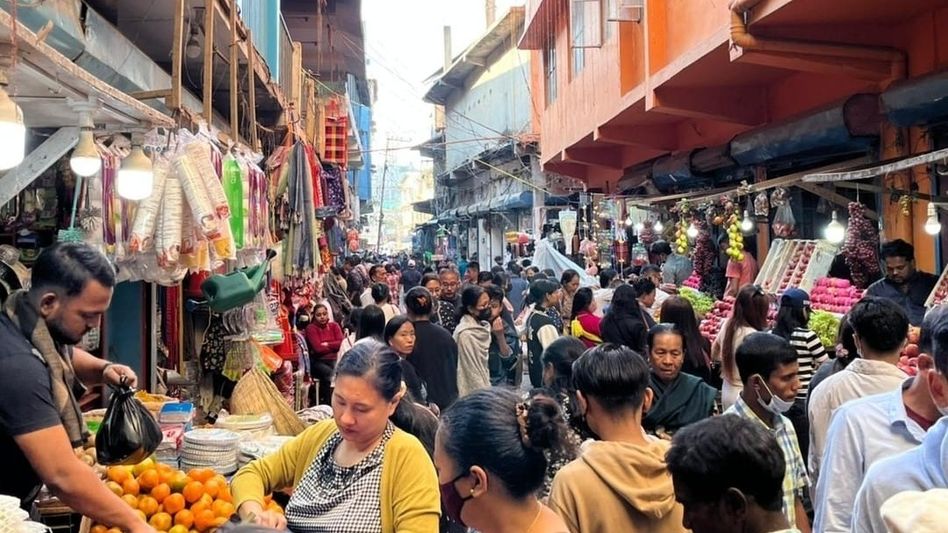
In Nagaland, the question of who truly owns the marketplace is far from straightforward it is a battleground of identity, power, and survival. Markets may seem open to anyone who can trade, but in reality, ownership is fiercely guarded by local Naga communities. This control, however, is increasingly contested. For instance, Illegal immigrants have begun entering these markets, drawn by opportunities in Nagaland’s growing towns such as Dimapur and Kohima.
The controversy escalates because while migrants often bring cheaper goods and wider variety, they are also perceived as undermining local authority and the social order. Who owns the marketplace, then, becomes a question of not just law or commerce, but of who has the right to exist and survive in Nagaland.
Beyond the economic structure, the issue also touches on cultural and social identity. The Nagas are indigenous peoples with distinct traditions, land systems, and customary laws. Many worry that unchecked migration could dilute local culture and strain limited resources. This issue is not necessarily directed at individuals, but meant to be perceived as a lack of effective enforcement of laws to protect indigenous rights. It is important to approach the issue with balance and responsibility and also understand that not all migrants are involved in illegal activities.
Broad generalizations, can deepen social divisions.
The real challenge lies in strengthening border management, ensuring proper documentation, enforcing labour and business regulations fairly, and creating more employment opportunities for the local youths of Nagaland.
Ultimately, the issue is not migration alone, but fairness in economic participation. The debate over illegal immigration in Nagaland reflects deeper concerns about economic security and local survival. Without effective regulation and fair enforcement, the marketplace risks becoming a flashpoint for resentment and Nagaland will remain a source of tension rather than shared growth