66 per cent want Dharmendra Pradhan to resign over NEET, CBSE controversies: CVoter survey
CVoter’s poll shows public anger over the NEET and CBSE crises has turned political: 66 per cent want Dharmendra Pradhan to resign, most blame leadership, trust in exams has collapsed, and voters demand urgent reform of India’s broken testing system.

- May 28, 2026,
- Updated May 28, 2026, 6:19 PM IST

- Forty-six per cent blamed the minister directly for the 2026 NEET leak
- NTA cancelled NEET nationwide after leaked questions closely matched the paper
- CBSE's digital marking drew complaints over unchecked answers and failed payments
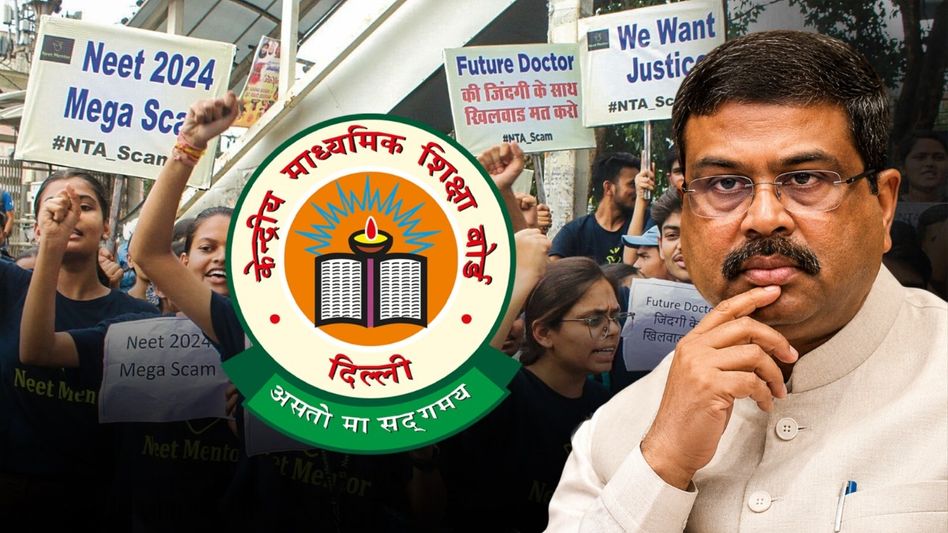
Two-thirds of Indians believe Union Education Minister Dharmendra Pradhan should step down over the twin examination crises that have shaken the country this summer. A snap opinion poll conducted by CVoter has found that 66 per cent of respondents want the minister to resign in the wake of the NEET and CBSE controversies. Only 21 per cent said he should stay on, while 13 per cent were undecided.
The poll also placed the blame squarely at the top. Asked who was responsible for the NEET-UG paper leak of 2026, 46 per cent of respondents named the Education Minister, the largest single share. The National Testing Agency (NTA), the body that actually conducts the exam, was blamed by just 12 per cent, while coaching centres and students chasing leaked papers drew 6 and 5 per cent respectively. Nearly a quarter, 24 per cent, said everyone was to blame.
A similar pattern emerged when respondents were asked who should be held accountable for the string of examination fiascos. The Education Minister again topped the list at 34 per cent, ahead of the boards and testing agencies at 27 per cent and ministry bureaucrats at 8 per cent. One in five, or 21 per cent, said all of them should answer for the mess. In both questions it was the political leadership, rather than the administrative machinery, that bore the brunt of public anger.
For those new to the controversy, this is what triggered the storm. NEET-UG, India’s single entrance test for undergraduate medical and dental courses, was held on May 3 for nearly 2.28 million aspirants across more than 5,400 centres, with about 1.3 lakh MBBS and 27,695 dental seats at stake. Days later, a handwritten “guess paper” of about 410 questions, circulated on WhatsApp and Telegram before the exam, was found to match the actual paper almost entirely, covering, by one estimate, 600 of 720 marks. NTA’s own review found the Chemistry paper identical and large parts of Biology compromised. On May 12, the agency cancelled the exam nationwide for the first time and ordered a re-test on June 21.
What made this leak more damning was its source. The paper was allegedly compromised not at a printing press or in transit, but at the question-setting and translation stage itself, with NTA-linked experts accused of selling Chemistry, Biology and Physics papers to students for lakhs of rupees. The Rajasthan police first investigated the case before it was handed to the CBI, which has arrested 11 people across seven cities, with many more under scrutiny. The human cost was devastating: at least four aspirants, three on their third attempt, died by suicide after the cancellation. Union Education Minister Dharmendra Pradhan later admitted there had been “a breach somewhere in the chain of command.”
The CBSE crisis ran alongside the NEET storm. This year, for the first time, the board used On-Screen Marking for Class 12 evaluation, a fully digital process in which scanned answer scripts are graded on screen. The scale was enormous: 17 lakh students, 98 lakh answer sheets and nearly 40 crore scanned pages. After the results, students flooded social media with complaints of unchecked answers, missing step marks, blurry scans, mismatched page and final totals, and a re-evaluation portal that repeatedly crashed or failed during payment. CBSE denied any tampering, saying the portal link circulating online was only a test site with sample data.
The row escalated after Rahul Gandhi alleged “massive tampering” and questioned the evaluation contract awarded to a private firm he linked to an earlier exam controversy. On May 28, after a meeting at CBSE headquarters, Union Education Minister Dharmendra Pradhan publicly took responsibility—“I take responsibility... a solution will be found”—and promised strict action if deliberate wrongdoing was found. The ministry brought in experts from IIT Kanpur and IIT Madras to fix the software, enlisted four public-sector banks to resolve payment failures, and cut the re-evaluation fee to Rs 100 per subject. But with re-evaluation only beginning and college admissions approaching, public confidence had already taken a hit.
None of this is new. NEET-UG has been dogged by allegations of leaks and irregularities for years, from a plea to cancel the 2021 exam over a leak, to the far bigger 2024 scandal involving a Bihar paper leak, suspicious grace marks and an unprecedented 67 toppers, which reached the Supreme Court. The CBSE has had its own share, from errors in Class 12 question papers to a faulty Odia answer key in 2022 that forced the board to revise the results of more than 28,000 students. Set against this history, the 2026 twin crises looked less like an accident and more like a pattern.
Little wonder, then, that faith in the system has eroded. Asked whether they trust the integrity of competitive and entrance examinations in India, only 21 per cent said “very much”, a clear majority were sceptical, with 29 per cent saying “not much” and 23 per cent “not at all”. The picture was bleaker still when respondents were asked whether they trust the education system and the government to be fair to millions of students. A majority, 52 per cent, said they had no trust at all, another 23 per cent said they were losing trust gradually, and just 16 per cent said they fully trusted the system.
This collapse of confidence could carry a political price. Seven in 10 respondents, 70 per cent, said the quality of governance on educational matters has deteriorated over the last five years, against just 18 per cent who disagreed. Crucially, 72 per cent believe that students hurt by the NEET and CBSE troubles, who will soon be voters themselves, could change their voting preference because of these experiences. For a government that has built much of its appeal among the young, that is a warning worth heeding.
The survey also captured how close the crisis has come to ordinary households. More than six in ten respondents personally knew a NEET aspirant affected by the cancelled exam, and 45 per cent said they were “extremely angry” about it. The CBSE numbers were much the same, with 47 per cent knowing an affected candidate and 40 per cent extremely angry over the questioned marking. The anger, in other words, is not abstract; it sits in family WhatsApp groups and neighbourhood conversations.
On solutions, opinion was more divided. A plurality of 42 per cent thought computer-based exams could stop paper leaks, but 32 per cent disagreed and 26 per cent were unsure, hardly a ringing endorsement of the very reform the minister has promised from 2027. There was far stronger feeling about the testing agency itself: 61 per cent wanted the NTA disbanded and exams returned to the states, the old model the agency was created to replace. On the CBSE side, an emphatic 65 per cent wanted the board to withdraw the results and physically re-check every answer sheet.
Coaching centres, often cast as the villains of India’s exam wars, drew a more measured response. Only 9 per cent wanted them banned outright, while 41 per cent favoured regulation and a third saw them as important. Views on whether CBSE’s exam management had improved or worsened were split, with 28 per cent reporting no major change and 20 per cent saying it had worsened significantly.
If there was one near-consensus, it was the appetite for change. A striking 71 per cent wanted the Class 12 board examination system to undergo urgent, major reform, with only 10 per cent content to leave it as it is. The message from the poll is blunt: Indians are no longer arguing about whether their examination system is broken, only about who should pay for it, and how soon it can be fixed.