After attack on judicial officers in Bengal, SC orders probe. ECI writes to NIA
The Election Commission has written to NIA seeking a probe into the Malda attack on judicial officers overseeing West Bengal’s SIR after the Supreme Court termed it a preplanned assault, flagged administrative failure, and warned of threats to electoral integrity.

- Apr 02, 2026,
- Updated Apr 02, 2026, 10:42 PM IST

The Election Commission of India (ECI) has sought an investigation by the National Investigation Agency (NIA) into the alleged gherao and attack on judicial officers engaged in the Special Intensive Revision (SIR) of electoral rolls in West Bengal, following sharp observations by the Supreme Court. In a letter dated April 2 to the NIA Director General, the ECI said it was acting on directions of the apex court, which is monitoring the SIR process in the state. The Commission requested that a preliminary inquiry report be submitted directly to the court.
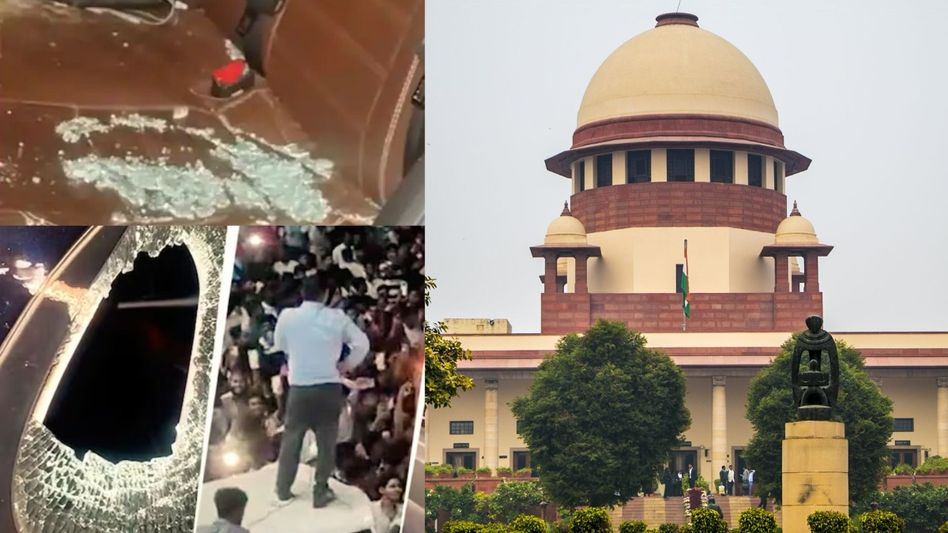
Seven judicial officers, including three women, were gheraoed for over nine hours by a mob at a Block Development Office in the Kaliachak area of Malda district on the evening of April 1. Taking suo motu cognisance, a bench led by the Chief Justice of India described the incident as a “calculated, well-planned and deliberate act” aimed at demoralising judicial officers and obstructing the electoral roll revision process.
The court said the attack amounted not just to intimidation of officials but also a “challenge to the authority of this Court,” adding that such actions could constitute criminal contempt. It also came down heavily on the West Bengal administration, noting “conspicuous inertia” and failure of the civil and police machinery to act promptly despite repeated alerts. Senior officials, including the Chief Secretary, Home Secretary, Director General of Police, and district authorities, have been asked to explain the delay in response.
The siege began around 3:30-4 pm on April 1 at the Kaliachak II BDO office, where the judicial officers were adjudicating objections to voter deletions under the Supreme Court-monitored SIR process. The Federal Protesters, angered by what they alleged was the large-scale removal of names from electoral rolls, first sought a meeting with the officers. When denied entry, they surrounded the premises.
What followed, according to the Supreme Court’s detailed order, passed after a D.O. letter from the Chief Justice of the Calcutta High Court reached the bench on the morning of April 2, was a cascading failure of the state administration. The Registrar General of the High Court immediately alerted state authorities and requested urgent intervention, but the court noted that nothing was done until approximately 8:30 pm. Neither the District Magistrate nor the Superintendent of Police reached the besieged office.
CJI Surya Kant, who personally monitored the situation until 2 am, told the West Bengal Advocate General that even food and water were denied to the officers, adding that a five-year-old child accompanying one of them was also deprived of sustenance.
The Calcutta High Court’s Chief Justice was eventually compelled to summon the Home Secretary and the DGP to his residence after midnight to jointly coordinate the rescue. The officers were finally freed after midnight when a large police contingent led by senior district officials dispersed the protesters. But even their evacuation turned violent, their vehicles were pelted with stones and attacked with bamboo sticks as they were being escorted to safety.
Protesters also blocked National Highway 12, the Kolkata-Siliguri arterial route. The blockade was lifted only after an Additional District Magistrate assured the crowd that names of eligible voters would be restored within four days.
A bench of Chief Justice Surya Kant, Justice Joymalya Bagchi and Justice Vipul M. Pancholi heard the matter on April 2, taking cognisance of the High Court Chief Justice’s letter and media reports. The court’s order was unsparing. It described West Bengal as “the most polarised state” and characterised the gherao as a “preplanned, calculated and motivated” attempt to derail the electoral process.
The court observed that the judicial officers handling the SIR adjudication were functioning as extensions of the Supreme Court itself, and that any attack on them amounted to criminal contempt under Section 2(c) of the Contempt of Courts Act, 1971. It described the incident as not a routine law-and-order disturbance, but a deliberate act intended to demoralise officers and obstruct the adjudication process.
Solicitor General Tushar Mehta told the court that the state could not be entrusted with the security of judicial officers, calling the attack “an affront to the majesty of rule of law”. The court’s directions were sweeping: the ECI must deploy central forces at all locations where judicial officers are working; security must extend to their residences and family members; not more than five persons may be present at any adjudication venue at a given time; and the Chief Secretary, DGP, and Chief Electoral Officer must submit compliance reports.
The court directed the ECI to entrust the investigation to either the CBI or NIA, leaving the choice to the Commission. The ECI subsequently chose the NIA. The Supreme Court will next hear the matter on April 5, with top state officials directed to appear virtually and explain their actions.
The Malda incident is the most violent escalation yet in the deeply contested Special Intensive Revision (SIR) exercise, the first comprehensive revision of West Bengal’s electoral rolls in over two decades, and one that has become the defining flashpoint of the state’s upcoming assembly elections scheduled for April 23 and 29.
The SIR commenced in West Bengal on November 1, 2025, following a similar exercise in Bihar that drew fierce opposition from the INDIA bloc parties. Door-to-door verification of voters ran through December 2025. The pre-draft roll contained about 7.66 crore electors; after the initial revision, the draft roll published on December 16, 2025, dropped to approximately 7.08 crore, with around 58.2 lakh entries removed on grounds of death, migration, duplication, or non-traceability.
The exercise became acutely contentious when the final roll, published on February 28, categorised voters into three groups: Approved, Deleted, and Under Adjudication. Over 60 lakh voters whose documents were flagged by micro-observers landed in the “under adjudication” category, most of them concentrated in Muslim-majority districts like Murshidabad (11 lakh), Malda (8.28 lakh), and South 24 Parganas (5.22 lakh).
On February 20, the Supreme Court intervened to bridge what it described as a “trust deficit” between the state government and the ECI, directing the Calcutta High Court to deploy judicial officers for the quasi-judicial task of verifying claims. Over 530 judicial officers from West Bengal, Odisha and Jharkhand were requisitioned for the exercise. By April 1, over 47 lakh of the 60 lakh-plus objections had been disposed of, with the court expressing satisfaction that the remaining cases would be cleared by April 7.
It was this very momentum that the Malda attack threatened to undo. As the Supreme Court noted in its order, the incident was likely to have a “chilling effect” on judicial officers who had been working without leave, including on weekends.
Meanwhile, Chief Minister Mamata Banerjee, addressing an election rally in Murshidabad's Sagardighi on April 2, blamed the Election Commission for failing to protect the judicial officers and demanded the resignation of Union Home Minister Amit Shah over the large-scale transfer of state officers. She maintained that law and order was effectively under the ECI’s control, given the election season, and alleged that the BJP’s strategy was to get elections cancelled and President’s Rule imposed.