
Centre pushes atmanirbhar container ecosystem with Bharat Container Shipping Line MoU
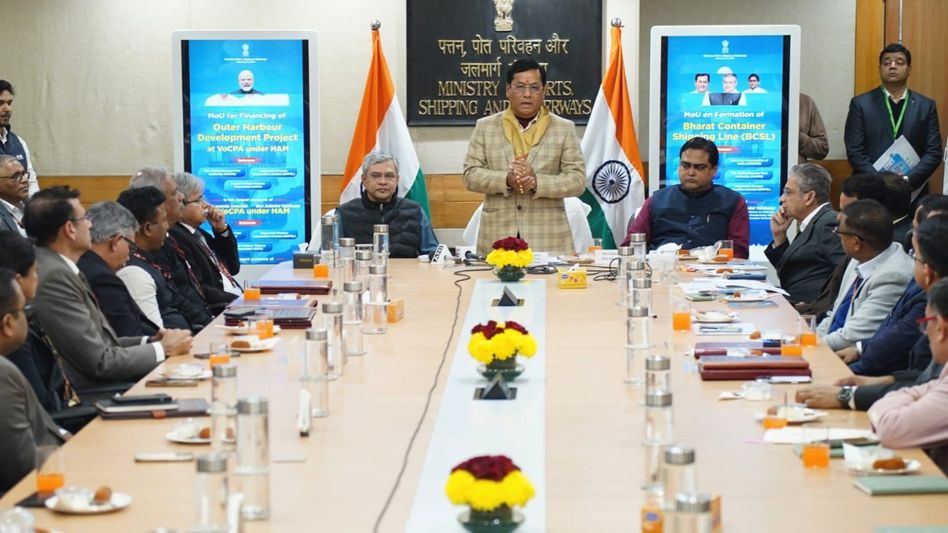
The Central government on Tuesday, February 3, took a decisive step towards reshaping India’s export-import logistics architecture by formalising plans for a national container carrier, as a key Memorandum of Understanding (MoU) was signed to establish the Bharat Container Shipping Line (BCSL).

- Feb 03, 2026,
- Updated Feb 03, 2026, 10:32 PM IST

The Central government on Tuesday, February 3, took a decisive step towards reshaping India’s export-import logistics architecture by formalising plans for a national container carrier, as a key Memorandum of Understanding (MoU) was signed to establish the Bharat Container Shipping Line (BCSL). The move is aimed at anchoring container shipping, manufacturing and port-led logistics firmly within India under the Atmanirbhar Bharat vision.
The MoU was signed in the presence of Union Minister of Ports, Shipping and Waterways Sarbananda Sonowal and Union Minister of Railways Ashwini Vaishnaw, signalling a coordinated, multimodal push across shipping, ports and rail-linked logistics. Union Minister of State for Ports, Shipping and Waterways Shantanu Thakur was also present at the ceremony.
The agreement brings together key public sector maritime and logistics entities—the Shipping Corporation of India (SCI), Container Corporation of India (CONCOR), Jawaharlal Nehru Port Authority, V.O. Chidambaranar Port Authority (VOCPA), Chennai Port Authority and Sagarmala Finance Corporation Limited (SMFCL)—under the aegis of the Ministry of Ports, Shipping and Waterways.
Officials said the BCSL initiative aligns closely with the Container Manufacturing Assistance Scheme (CMAS) announced in the Union Budget 2026–27, marking a shift towards a fully integrated, domestically owned container ecosystem encompassing ship operations, container manufacturing and port infrastructure.
In parallel, a separate tripartite MoU was signed between VOCPA, Indian Railway Finance Corporation Limited (IRFC) and SMFCL to finance the ambitious Outer Harbour Project at V.O. Chidambaranar Port, Tuticorin. The agreement provides for joint funding of up to ₹15,000 crore for eligible port capacity expansion projects under the Sagarmala Programme and the PM Gati Shakti National Master Plan.
The financing framework focuses on debt funding for breakwater construction and associated onshore and offshore infrastructure, largely through a Hybrid Annuity Model (HAM), aimed at de-risking large-scale maritime infrastructure development.
Union Minister Sarbananda Sonowal described the initiatives as critical building blocks of India’s long-term maritime strategy. He said the Bharat Container Shipping Line and the Outer Harbour financing represent concrete steps towards strengthening national shipping capabilities, enhancing port infrastructure and advancing the goals of Atmanirbhar Bharat and Maritime Amrit Kaal 2047.
“These MoUs mark the translation of our Prime Minister Narendra Modi ji’s vision into tangible maritime capability,” Sonowal said. “The Bharat Container Shipping Line, aligned with the CMAS announced in Budget 2026–27, will anchor India’s container trade in Indian hands, while the Outer Harbour financing strengthens our port backbone. Together, they will play a multiplier role in boosting India’s strategic and commercial presence in global maritime trade as we move towards a Viksit Bharat.”
Union Railway Minister Ashwini Vaishnaw said the signing marked the realisation of a long-pending national objective. “Under the guidance of Prime Minister Narendra Modi ji, we are ensuring speed, coordination and timely approvals. With the development of a national container line in partnership with CONCOR, India can build a robust, world-class container ecosystem. This is a natural progression after our initiatives in shipbuilding financial assistance, ship recycling and broader maritime development,” he said.
Union Minister of State Shantanu Thakur said the agreements reflect India’s growing maritime ambition. “These MoUs demonstrate the foresight of Prime Minister Narendra Modi ji, whose leadership is driving India’s maritime resurgence and positioning the country as a global force not just on land, but at sea,” he said.
India, now the world’s fourth-largest economy and projected to reach a GDP of $7.3 trillion by 2030, is expected to witness a sharp rise in export-import volumes and containerised cargo movement. Officials noted that the absence of a strong Indian container carrier in the past has often left exporters and importers vulnerable to volatile freight rates and global supply chain disruptions—a gap the BCSL seeks to address.
MORE NEWS









Copyright©2026 Living Media India Limited. For reprint rights: Syndications Today
