'Make farming smarter, empower farmers': PM Modi sets out vision for developed India
Prime Minister Narendra Modi outlined his agriculture vision at the Bharat Agriculture Conference. He said modern technology and stronger farmers were essential for achieving a developed India.

- Nov 13, 2026,
- Updated Nov 13, 2026, 8:24 AM IST

- Agricultural growth remained above four per cent throughout the past decade
- World Bank study says 50 crore Indians escaped poverty in 12-13 years
- Farm exports now exceed Rs 4 lakh crore annually, boosting incomes
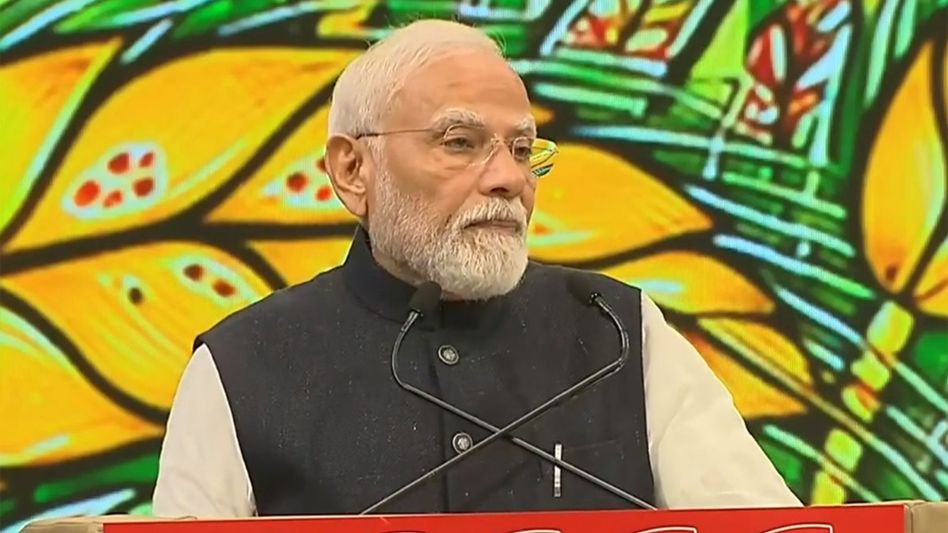
Prime Minister Narendra Modi on November 12 said India could not achieve its goal of becoming a developed nation without modernising agriculture, adopting smarter farming practices and strengthening farmers, stressing that the sector remained central to the country's economic and social progress.
Addressing the Bharat Agriculture Conference organised by the India Today Group, Modi said agriculture was not merely an economic activity but was closely linked to India's culture, traditions and way of life.
Connecting the conference with the ongoing festive season, particularly Chhath, the Prime Minister said the festival reflected the country's deep-rooted relationship with agriculture.
"This event is taking place at a time when the country is in a festive mood. We celebrated Diwali two or three days ago. Now the splendour of the grand Chhath festival has taken over," he said.
"Farming is our culture, our tradition, and the foundation of our social life," he added.
Referring to his Independence Day address from the Red Fort, Modi said agriculture was among the seven key areas identified as essential to building a developed India.
"I discussed the seven streams of strength for a developed India from the Red Fort, and agriculture is a key stream among them," he said, reiterating that the country's development ambitions could not be realised without transforming the agricultural sector.
Highlighting the sector's performance over the past decade, Modi said India's agricultural growth rate had remained above four per cent, making it the first decade since Independence to record such sustained growth.
"Now look at the coincidence: in the past decade, the agricultural growth rate has remained above 4 per cent," he said.
The Prime Minister also pointed to the reduction in poverty, particularly in rural areas, citing a recent World Bank study which, according to him, found that 50 crore people had moved out of poverty in India over the past 12-13 years.
He said the improvement had benefited rural communities, including small farmers and agricultural labourers, but claimed that the achievement had received inadequate attention.
"That means a large number of small farmers and agricultural labourers have defeated poverty," Modi said.
Turning to India's position in global agricultural trade, he said the country was exporting agricultural products worth more than Rs 4 lakh crore annually, adding that the growing exports were contributing to farmers' incomes.
The Prime Minister also highlighted India's position among the world's leading agricultural producers. He said India ranked first in milk, pulses, jute, rice and millet production, while it was the world's second-largest producer of wheat, cotton, fruits and vegetables. India also ranked second in fish production, he added.
"These are not just a few statistics; they show how great the potential of India's farmers is," he said.
Modi further highlighted the expansion of allied agricultural sectors, including dairy, poultry, fisheries, beekeeping and horticulture, over the past decade.
According to him, milk production had increased by nearly 70 per cent, egg production had grown by 90 per cent, while fish production had more than doubled during the period.
He also cited the growth in honey production under the government's Sweet Revolution initiative, saying output had increased from 80,000 tonnes to 1.5 lakh tonnes.
Horticulture production, meanwhile, had risen from 280 million tonnes to more than 350 million tonnes, he said.
Emphasising the role of technology and government schemes in changing agricultural practices, Modi cited the PM-KUSUM scheme, under which farmers are being encouraged to generate and supply renewable energy alongside producing food.
"Through the PM-KUSUM scheme, our Annadatas are becoming Urjadatas," he said.
He also referred to the Namo Drone Didi initiative, saying the use of drones in agriculture demonstrated how advanced technology could be brought into rural areas.
"Namo Drone Didis are demonstrating how advanced technology can be effectively used in villages," the Prime Minister said.