Three High Court Chief Justices take oath as Supreme Court judges, bench strength rises to 37
Three serving High Court Chief Justices were sworn in as Supreme Court judges on Tuesday. Their elevation takes the apex court's working strength to 37 and leaves one vacancy.

- Oct 06, 2026,
- Updated Oct 06, 2026, 5:28 PM IST

- CJI Surya Kant administered the oath at a 3.30 pm ceremony
- The proceedings were live-streamed on the Supreme Court's official YouTube channel
- The collegium recommended the elevations on September 28, cleared on October 5
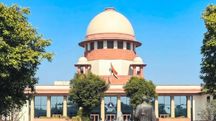
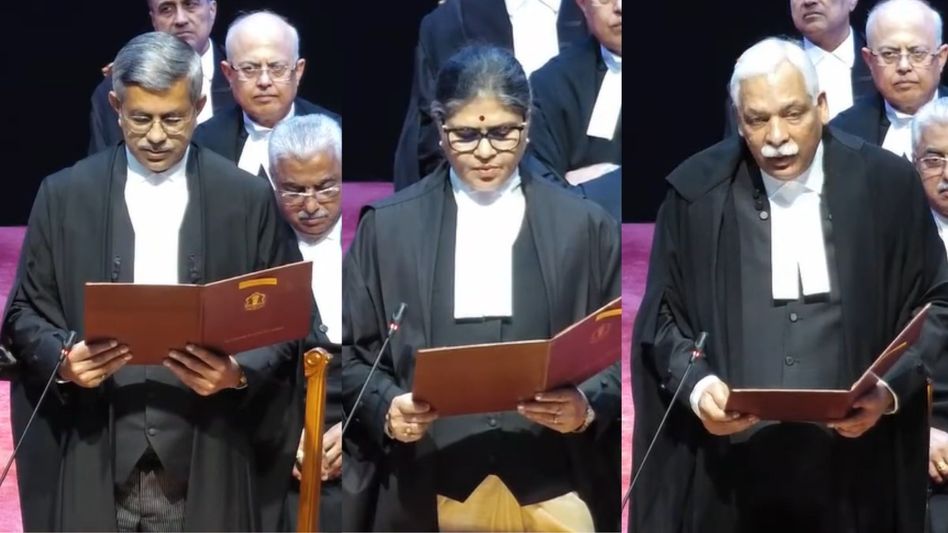
Three serving Chief Justices of High Courts — Justice Sunita Agarwal, Justice Devendra Kumar Upadhyaya and Justice Aparesh Kumar Singh — were sworn in as judges of the Supreme Court on Tuesday, taking the apex court’s working strength to 37.
Chief Justice of India (CJI) Surya Kant administered the oath to the three judges at a ceremony held at 3.30 pm. The proceedings were also live-streamed on the Supreme Court’s official YouTube channel.
Justice Agarwal was serving as Chief Justice of the Gujarat High Court, Justice Upadhyaya as Chief Justice of the Delhi High Court and Justice Singh as Chief Justice of the Telangana High Court before their elevation.
The Supreme Court Collegium, headed by CJI Surya Kant, recommended their elevation on September 28. The Union government cleared the recommendations through the Ministry of Law on October 5, following which President Droupadi Murmu approved their appointments.
With the latest appointments, the Supreme Court now has 37 judges, including the CJI, against its sanctioned strength of 38, leaving one vacancy.
The three judges were among the senior-most High Court judges in the country. Justice Agarwal ranked fourth, Justice Upadhyaya fifth and Justice Singh sixth in the all-India seniority of High Court judges.
Justice Agarwal's elevation has also taken the number of sitting women judges in the Supreme Court to three. She joins Justices BV Nagarathna and V Mohana. Justice Mohana was elevated to the apex court on June 2, while Justice Nagarathna has been a Supreme Court judge since August 2021.
Justice Sunita Agarwal, whose parent High Court is Allahabad, graduated in law from Awadh University and enrolled as an advocate in December 1990. She primarily practised on the civil side of the Allahabad High Court.
She was elevated as an Additional Judge of the Allahabad High Court in November 2011 and became a permanent judge in August 2013. She was appointed Chief Justice of the Gujarat High Court in July 2023.
Justice Devendra Kumar Upadhyaya, also from the Allahabad High Court, completed his law degree from Lucknow University in 1991 and enrolled as an advocate in May that year. He mainly practised on the civil and constitutional sides at the Lucknow Bench of the Allahabad High Court.
He served as Chief Standing Counsel for the Uttar Pradesh government before being elevated as an Allahabad High Court judge in November 2011. He became a permanent judge in August 2013.
Upadhyaya was appointed Chief Justice of the Bombay High Court in July 2023 and later became Chief Justice of the Delhi High Court in January 2025.
Justice Aparesh Kumar Singh, whose parent High Court is Jharkhand, completed his BA (Honours) and LLB from Delhi University and enrolled as an advocate in 1990. He initially practised at the Patna High Court before moving to the Jharkhand High Court.
He was elevated as an Additional Judge of the Jharkhand High Court in January 2012 and became a permanent judge in January 2014. He also served as Executive Chairman of the Jharkhand State Legal Services Authority.
Singh later served as Acting Chief Justice of the Jharkhand High Court before being appointed Chief Justice of the Tripura High Court in April 2023. He was subsequently transferred to the Telangana High Court and took oath as its Chief Justice in July 2025.
The three appointments come soon after the Supreme Court expanded its courtroom infrastructure with two new courtrooms and two Registrar courtrooms.
The newly appointed judges will now be assigned to the Supreme Court's regular roster, with the apex court operating with one vacancy against its sanctioned strength.