Women’s reservation: Kiren Rijiju defends delimitation link, Rahul Gandhi demands immediate implementation
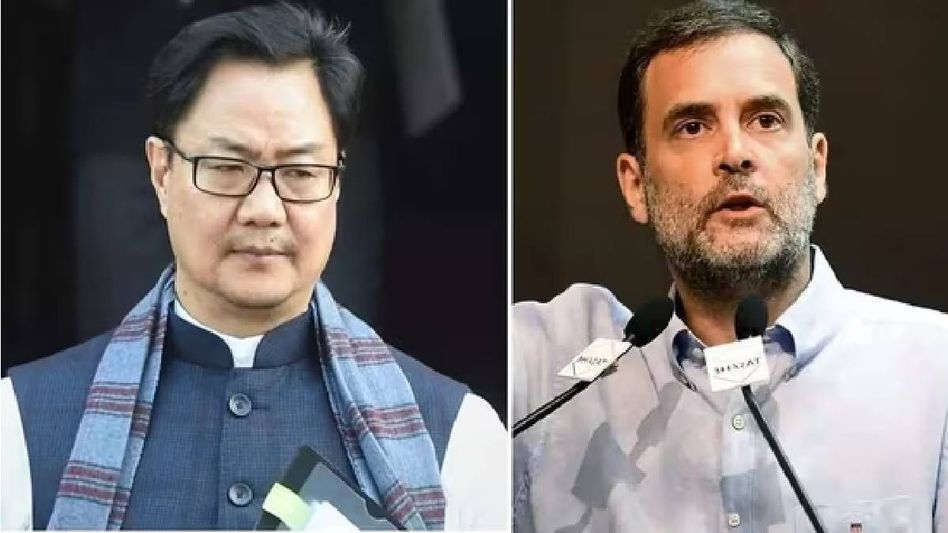
A fresh political confrontation has emerged between Union Minister Kiren Rijiju and Lok Sabha Leader of Opposition Rahul Gandhi over the implementation of the Nari Shakti Vandan Adhiniyam, 2023, with the two leaders taking divergent positions on whether the law should be linked to the proposed delimitation exercise.

- Aug 08, 2026,
- Updated Aug 08, 2026, 11:09 PM IST

A fresh political confrontation has emerged between Union Minister Kiren Rijiju and Lok Sabha Leader of Opposition Rahul Gandhi over the implementation of the Nari Shakti Vandan Adhiniyam, 2023, with the two leaders taking divergent positions on whether the law should be linked to the proposed delimitation exercise.
The exchange began after Gandhi questioned the Centre’s decision to make the implementation of the women’s reservation law contingent on delimitation, despite the legislation receiving unanimous approval in Parliament in 2023.
Responding to Gandhi’s criticism on X, Rijiju said the linkage between delimitation and women’s reservation was provided for in the constitutional amendment itself. He outlined six points to explain the government’s position and the legal framework governing implementation of the 33 per cent reservation for women in legislative bodies.
Rijiju said women’s reservation is already constitutionally mandated through the Constitution (106th Amendment) Act, 2023, popularly known as the Nari Shakti Vandan Adhiniyam.
He further pointed out that the law provides for implementation following a delimitation exercise based on the first Census conducted after the commencement of the constitutional amendment and publication of its relevant figures. The availability of updated Census data is therefore a key requirement for initiating the delimitation process under the existing framework.
Rijiju also cautioned that delays in completing and publishing the Census, particularly if caste enumeration is included, could affect the timeline for delimitation and consequently the implementation of women’s reservation. Such delays, he argued, could potentially push implementation beyond the 2029 Lok Sabha elections.
The Union minister maintained that if the government intends to implement the reservation from the 2029 general elections, the delimitation process would have to be completed at the earliest using the latest available Census data.
He also referred to the government’s proposed legislative route through the Delimitation Bill, 2026, which was introduced in the Lok Sabha along with constitutional amendments aimed at facilitating the proposed exercise.
Rijiju further cited the defeat of the Constitution (131st Amendment) Bill, 2026, in the Lok Sabha on April 17. The bill, which sought to facilitate the proposed mechanism, failed to secure the constitutionally required two-thirds majority, adding another hurdle to the implementation process.
Gandhi, meanwhile, maintained that the government was unnecessarily linking women’s reservation with delimitation. He reiterated that the legislation had received the support of the Congress and should be implemented without imposing additional conditions.
Questioning why the law had not been implemented three years after its passage, Gandhi called on the government to take immediate steps to enforce the reservation rather than linking it to other processes.
Gandhi had earlier stressed the need for greater participation of women in politics and argued that the country cannot achieve full representation without a larger role for women in political institutions.
Rijiju described Gandhi’s remarks on women’s political participation as positive but challenged the Congress to extend unconditional support to the government’s proposed framework for implementing the reservation.
The Congress and several other opposition parties support the principle of reserving 33 per cent of seats for women in the Lok Sabha and state legislative assemblies. However, they have raised objections to the proposed delimitation exercise and demanded that it be accompanied by an increase in the total number of Lok Sabha seats. The opposition has also argued that women’s reservation should not be made contingent on delimitation.
The Nari Shakti Vandan Adhiniyam was passed by both Houses of Parliament in 2023 and provides for 33 per cent reservation for women in the Lok Sabha, state legislative assemblies and the Delhi Assembly. Its implementation, however, is linked under the law to a delimitation exercise following the publication of relevant Census data.
The defeat of the Constitution (131st Amendment) Bill, 2026, has further complicated the government’s proposed legislative route for carrying out the delimitation process and implementing the women’s reservation framework.