
A Dangerous ‘Safety’ Guarantee Exposes the Crisis of Impunity in Manipur
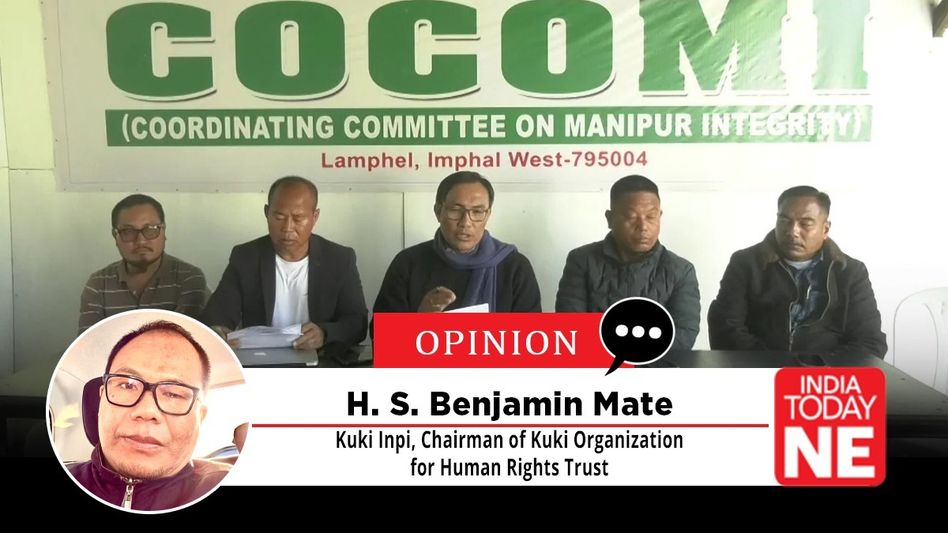
A recent statement by the Coordinating Committee on Manipur Integrity (COCOMI), a leading Meitei civil society organization, has laid bare the perilous and unaddressed power dynamics at the heart of the state’s ongoing ethnic conflict.

- Dec 30, 2025,
- Updated Dec 30, 2025, 7:07 PM IST

A recent statement by the Coordinating Committee on Manipur Integrity (COCOMI), a leading Meitei civil society organization, has laid bare the perilous and unaddressed power dynamics at the heart of the state’s ongoing ethnic conflict.
Its declaration that members of the Kuki-Zo community are now “safe” to travel in the Meitei-dominated Imphal Valley has been met not with relief, but with rightful outrage.
This is not a peace offering; it is a stark, self-incriminating admission. It reveals a faction positioning itself as a de facto authority capable of granting or withholding security—a chilling implication of control that underscores the profound breakdown of rule of law in Manipur.
Since violence erupted on May 3, 2023, Manipur has been torn apart. Official figures likely underestimates, cite over 250 deaths, thousands injured, and more than 60,000 people displaced from their homes. The conflict has carved the state into ethnic enclaves, separated by buffer zones manned by central security forces. Over 7,000 houses and more than 350 churches in Kuki-Zo areas have been reported burned. This is not mere communal strife; it is a violent partition fueled by armed militias sponsored by the state and deepened by a near-total absence of reconciliation or meaningful accountability.
COCOMI, an umbrella group presenting itself as a guardian of Manipur’s “territorial integrity,” has played a contentious role. In 2023, it framed the conflict as a “Manipuri national war” against “Chin-Kuki narco-terrorists,” rhetoric that observers argue helped inflame passions and legitimize mob actions. Its ecosystem is linked to groups like the Arambai Tenggol, a Meitei militia accused of orchestrating attacks, looting state armories, and targeting Kuki-Zo villages with apparent impunity.
It is against this backdrop that COCOMI’s “safety” assurance must be read. The statement inadvertently confesses to a grim reality: that the security of Kuki-Zo citizens in the valley was, and seemingly remains, subject to the dispensation of particular Meitei groups rather than the Indian state. This transforms the announcement from a confidence-building measure into a tacit acknowledgment of the very power structures that enabled mass violence and displacement. If safety can be granted now, who was responsible for its terrifying absence during the peak of killings and arson?
Also Read: An Administration in Exile: The Abandonment of Tengnoupal
The Government of India, now administering Manipur directly under President’s Rule, bears the ultimate responsibility for this crisis of impunity. Despite documented atrocities and calls from international and domestic human rights bodies, prosecutions have been selective and painfully slow. While sporadic arrests of militia members occur, the broader networks and alleged orchestrators remain operational. This failure to dismantle militant structures and pursue consistent justice risks cementing a perception of state-tolerated ethnic cleansing against the Kuki-Zo community.
New Delhi’s continued inaction sends a devastating message: that the political project of maintaining Manipur’s geographical unity outweighs the constitutional rights and safety of its minority citizens. A central government cannot credibly pose as a peace broker while being perceived as shielding actors accused of orchestrating violence. The arrest of COCOMI leaders and militia figures, alongside transparent, credible investigations into the destruction of homes and places of worship, are not acts of vendetta. They are the non-negotiable foundation for any future peace.
The tragedy of Manipur stems from decades-old contestations over land, identity, and political representation, explosively weaponized by vigilante forces and majoritarian rhetoric. A lasting solution requires impartial law enforcement, the dignified rehabilitation of all displaced persons, and inclusive dialogue. But none of this is possible while one side can brazenly claim the authority to guarantee the safety of the other.
COCOMI’s statement is more than a provocation; it is a mirror held up to India’s failing institutions in the state. It is a reminder of crimes that have gone unpunished and a warning that impunity is the surest catalyst for future bloodshed. The time for accountability is not simply overdue—it is the final barrier between Manipur and a permanently fractured future. Every day of delay further implicates the Indian state not as a neutral arbiter, but as a facilitator of Kuki-Zo minority ethnic cleansing.
MORE NEWS












Copyright©2026 Living Media India Limited. For reprint rights: Syndications Today
