A Hattrick With a Century: How BJP Turned Elections Into a Science
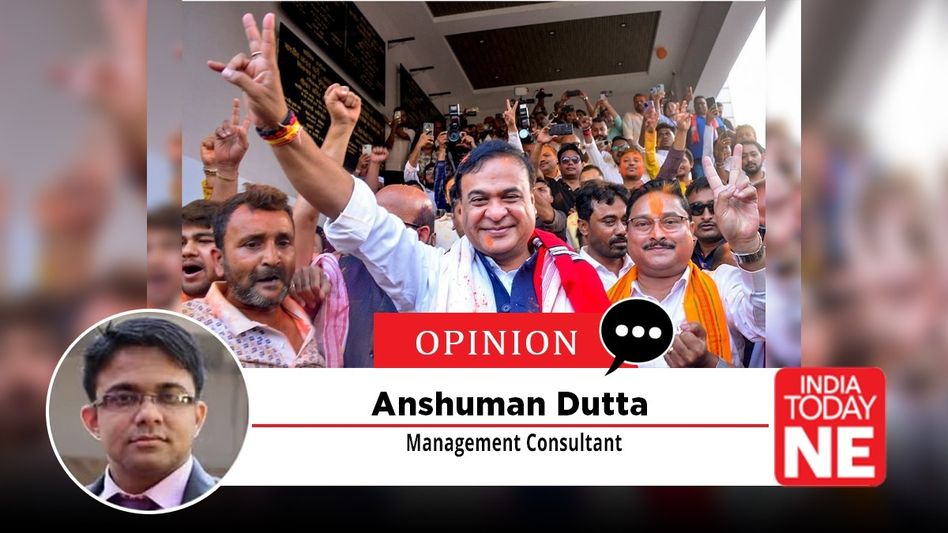
Himanta Biswa Sarma called it himself, and for once a politician's self-description was not hyperbole. "A hattrick with a century," he said from Jalukbari, where he had just won his sixth consecutive assembly election by a margin of over 80,000 votes. The phrase deserves to be taken literally, because the arithmetic it describes is genuinely without precedent in Assam's post-Independence history.

- May 05, 2026,
- Updated May 05, 2026, 5:02 PM IST

Himanta Biswa Sarma called it himself, and for once a politician's self-description was not hyperbole. "A hattrick with a century," he said from Jalukbari, where he had just won his sixth consecutive assembly election by a margin of over 80,000 votes. The phrase deserves to be taken literally, because the arithmetic it describes is genuinely without precedent in Assam's post-Independence history. One hundred and two seats in a 126-member assembly. A third consecutive term. A vote share that rose from 33.6 percent in 2016 to 38.59 percent in 2026. A mandate that grew in each successive elections 63 seats, then 75, now 102 not because the opposition collapsed, but because the BJP kept building.
Across the border, in West Bengal, a different chapter of the same story was being written. A state that the BJP had chased, campaigned in, poured resources into, and lost for fifteen consecutive years finally fell on May 4, 2026. Two hundred and six seats in a 294-member assembly. Mamata Banerjee's Trinamool Congress which had governed Bengal since 2011 and which had seen off ever iny BJP challenge with a combination of ground-level muscle, cultural capital, and sheer political tenacity was removed from power. West Bengal's voter turnout was 92.47 percent, among the highest in the state's recorded history. The people turned out. And they chose differently.
Taken together, these two results are a masterclass in what modern democratic politics, at its most disciplined and methodical, can achieve. They deserve to be studied not merely celebrated as an exercise in political craftsmanship that rivals anything produced in Indian electoral history.
It is a common mistake, in the hours after a decisive electoral victory, to reach for the nearest available explanation. Wave. Modi factor. Anti-incumbency. Identity politics. Each of these phrases is true in a partial sense and insufficient in a complete sense. What actually happened in Assam between 2016 and 2026 is something considerably more deliberate: the systematic construction of a governing coalition from the ground up, layer by layer, election cycle by election cycle, until it became structurally dominant rather than merely electorally competitive.
When the BJP won Assam for the first time in 2016 with 60 seats, analysts correctly noted that anti-incumbency against fifteen years of Congress rule was the primary fuel. That reading, while accurate for the moment, underestimated what the party did with the mandate once it had it. Under Sarbananda Sonowal, and then far more aggressively under Himanta Biswa Sarma from 2021 onward, the BJP did not merely govern. It built. It built organisational depth into constituencies it had never previously held. It built a welfare architecture that created direct, tangible, monthly relationships between the state government and previously unaffiliated voter blocs. It built an infrastructure record — roads, bridges, medical colleges, rural electrification, digital connectivity that gave the campaign a concrete answer to the question every honest government must face: what have you actually done?
Visible improvements in roads, bridges, and digital connectivity, and a focus on peace and anti-corruption measures, enhanced the party's image across constituencies where BJP had previously been a marginal force. The 2026 manifesto went further still: a pledge to invest five lakh crore rupees to develop Assam and make it India's eastern gateway, alongside a "One District, One Institution" model committing a medical college, engineering college, and university in every district. These are not small promises. They are a governing vision, offered by a party with a track record of delivery, to an electorate that has seen enough to judge the difference between promise and performance.
This is the foundation that made 102 seats possible. Not the headline. The foundation.
The most analytically interesting political innovation of the Sarma government and the one most likely to be studied and replicated across India is the conversion of welfare delivery into a durable voting relationship. The Orunodoi scheme, which provides a monthly cash transfer to women across Assam, is not unique as a welfare programme. What is unique is the precision with which it was designed as a political instrument.
Consider the result it produced. Female voter turnout in Assam on April 9, 2026 reached 85.96 percent exceeding male turnout by more than a full percentage point. In a state where the historical pattern had been lower female participation, this reversal is almost entirely attributable to direct benefit transfer creating a motivated, mobilised, and loyal constituency of women voters. Targeted social welfare, such as the Orunodoi cash transfer scheme, has helped build a loyal beneficiary base. The 2026 manifesto promised to raise the Orunodoi monthly amount from ₹1,250 to ₹1,350 and launch a new programme Nijut Sipini to support ten lakh weavers. The government did not ask women to trust a promise. It asked them to evaluate a record and then extended the offer forward.
In constituencies across Central and Upper Assam the agricultural heartland, the semi-urban belt, the tea garden peripheries women voters who had received a government transfer every month for five years voted with a coherence and an enthusiasm that no campaign rally could have manufactured. This is what political science means when it talks about state capacity as an electoral advantage. When the state is present in a voter's life in a material, monthly, undeniable way, the campaign practically runs itself.
If the women voter surge is the most replicable element of BJP's Assam formula, the Tea Tribe conversion is the most structurally significant. Tea garden communities represent over a quarter of the assembly's seats in Upper Assam and have been, historically, one of Congress's most reliable rural constituencies. Their political identity was shaped by the labour movement, by Congress-era union politics, by a sense of the party as the protector of their interests going back generations.
BJP broke that loyalty in 2016, deepened it in 2021, and in 2026 appears to have consolidated it beyond the point of casual reversal. The mechanism was not primarily ideological. It was a combination of welfare specificity schemes targeted directly at tea garden workers and the promise of Scheduled Tribe status, a long-pending demand that BJP actively worked as a campaign issue. The promise engaged. The community responded. Across upper Assam, in the districts of Dibrugarh, Tinsukia, Golaghat, Jorhat, and Sonari, Congress failed to win a single seat.
That sentence requires a moment to absorb. In the heartland of Tea Tribe country. In the districts that were, for decades, synonymous with Congress's rural base in the state. Not a single seat. This is not a swing. It is a structural transformation, built over ten years of sustained, granular, community-specific political work.
The Bengal Blueprint: When Organisation Becomes Destiny
The West Bengal result requires a different frame, because the story there is primarily about organisational precision rather than welfare delivery. BJP had been attempting to break into Bengal for fifteen years. It came within striking distance in 2021 competitive enough that the party won 77 seats, its best-ever Bengal performance but it lost to Mamata Banerjee's superior ground organisation and to the power of a Bengali identity narrative that the party had not yet learned to counter.
What changed between 2021 and 2026 was not BJP's politics. It was BJP's mechanics.
After BJP's 2021 near-miss, Amit Shah had already signalled that West Bengal was next. He reframed the party's approach in Bengal, moving it from expansion to precision. His reading of Bengal after 2021 was not that the party needed to reinvent its politics but that it needed to fix its mechanics. The margins from the previous election pointed to a consistent pattern: BJP was competitive across regions but its support was not translating into seats.
What Shah built in the five years between 2021 and 2026 was a booth-level accountability system of unusual granularity. Months before polling, Shah had begun reviewing booth preparedness with a clear directive that no polling station should remain unmanned. The emphasis was not on expanding reach but on ensuring that existing support was identified, tracked, and mobilised. Inputs from booth workers were regularly reviewed, and strategies were recalibrated in real time, allowing the campaign to adjust without losing structure.
This matters enormously. Bengal's previous elections had not been lost primarily because BJP lacked voters. They were lost because BJP's voters concentrated in certain areas, motivated in certain ways were not being efficiently converted into booth-level turnout. The gap between support and mobilisation is the difference between a competitive result and a winning one. Shah spent five years closing that gap, booth by booth, name by name.
The core of the BJP strategy is its network at the booth level. Instead of relying exclusively on large rallies or mass messaging, the party made significant investments in hyper-local mobilisation, with targeted outreach efforts, consistent presence at the booth level, and all of that based on data-driven insights as opposed to broad-based emotional appeals.
The result was 206 seats. Not a wave. A system.
Any analysis of BJP's Assam victories that does not give adequate weight to Himanta Biswa Sarma as an individual political actor is incomplete. Sarma is that rarest of political figures: a leader who is simultaneously an ideological force, an administrative operator, and a campaign strategist three qualities that rarely coexist in the same person at the same time.
He came to BJP from Congress in 2015, carrying with him a decade of insider knowledge of the state's political anatomy. He understood which communities moved on which issues, which regional identities required what kind of engagement, which welfare interventions would land and which would be perceived as cosmetic. Under Sarbananda Sonowal's first term, Sarma served as the effective political engine of the government. When he became Chief Minister in 2021, the engine became the driver.
His campaign posture in 2026 was characterised by confidence without complacency a distinction that matters enormously in an incumbent government's re-election effort. The first plank was development: ten years of visible infrastructure growth, road connectivity, urban transformation, and welfare delivery that gave the party a tangible record to campaign on rather than promises alone. Across the state, voters were asked to compare 2016 Assam with 2026 Assam. He bet his entire political reputation on that comparison. He won.
His personal majority of over 80,000 votes in Jalukbari is worth dwelling on. A Chief Minister seeking a third term in a competitive democracy, in a constituency he has held since before his party first came to power in the state, winning by that margin is not a routine electoral result. It is a referendum. The voters of Jalukbari were not merely voting for a candidate. They were endorsing a governing philosophy the idea that a strong, assertive, development-focused, identity-conscious government is what Assam needs at this juncture of its history. They voted for it emphatically.
There is a tendency, in post-election analysis, to focus entirely on what was at stake and who won. The more interesting question, sometimes, is how the win was constructed what it reveals about the quality of political thinking, organisational discipline, and strategic patience that produced it.
BJP's 2026 victories in Assam and West Bengal reveal a party operating at the peak of its institutional capacity. The welfare architecture in Assam was not assembled in the months before the election. It was built over five years, with consistent design and consistent delivery, until it became the background condition of daily life for millions of voters. The booth-level organisation in Bengal was not improvised during the campaign. It was constructed methodically over five years, reviewed quarterly by the party's most experienced organisational mind, and executed with a discipline that most political parties in India are not yet capable of.
The electorate has chosen Bharatiya Janata Party decisively in Assam, with welfare schemes, youth voters, and post-delimitation shifts having significantly reshaped the electoral landscape. The party's vote share rose five percentage points across a decade. That is not a wave statistic. That is a compound growth statistic the kind that results from building something durable rather than catching something temporary.
A good election is one where the result, when examined closely, reflects the quality of what was done before the campaign began. By that standard, BJP's May 4 victories in both states are very good elections indeed. They are the harvest of a decade of patient political construction of listening carefully to what voters wanted, designing programmes that delivered tangibly, building organisations that could be held accountable at the most granular level, and trusting that in a democracy, sustained excellence in governance eventually finds its reward in the ballot box.
Addressing supporters at BJP headquarters in New Delhi, Modi said the results pointed to the party's widening appeal. That widening appeal is real. But it was not gifted. It was built. That, more than the seat count or the victory speeches, is the lesson that will outlast this election cycle.