
After Khamenei: A New West Asian Faultline
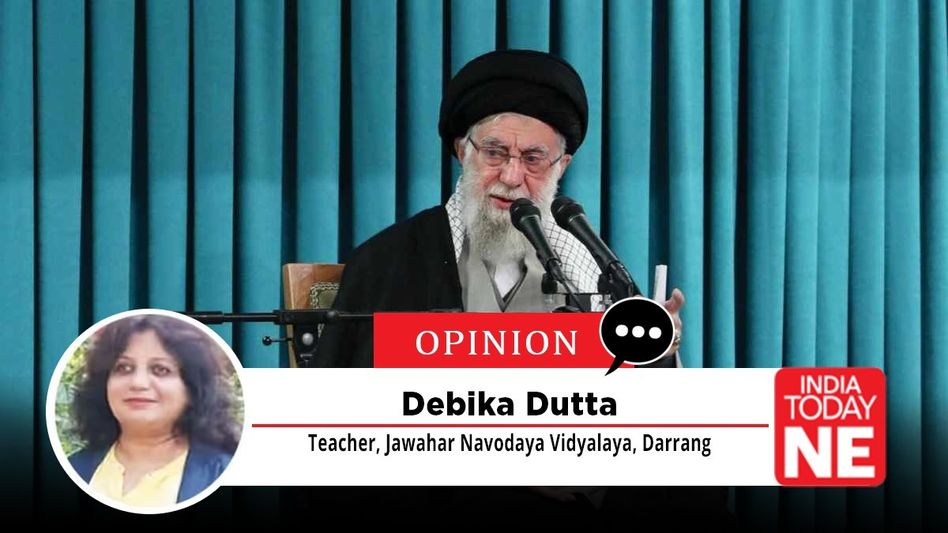
The reported death of Ali Khamenei is not merely a leadership transition inside Iran. It is a geopolitical rupture in a region already strained by open confrontation with Israel and deepening alignment with the United States. When a system built on ideological continuity loses its central arbiter, uncertainty does not drift — it accelerates.

- Mar 01, 2026,
- Updated Mar 01, 2026, 2:35 PM IST

The reported death of Ali Khamenei is not merely a leadership transition inside Iran. It is a geopolitical rupture in a region already strained by open confrontation with Israel and deepening alignment with the United States. When a system built on ideological continuity loses its central arbiter, uncertainty does not drift — it accelerates.
For more than three decades, Khamenei represented both authority and equilibrium within the Islamic Republic. He balanced clerical legitimacy with the formidable weight of the Islamic Revolutionary Guard Corps, calibrated confrontation without surrendering doctrine, and ensured that Iran’s rivalry with Israel remained intense but managed. That management now faces its severest test.
The Iran–Israel contest has long been defined by ambiguity. Precision strikes that carried no formal signature, cyber disruptions without attribution, proxy engagements across Lebanon, Syria and Iraq — this was a shadow war conducted with strategic restraint. Each side signalled capability without inviting total war. If recent developments indicate direct operational coordination between Washington and Tel Aviv in overt military action, the psychological threshold has shifted. What was once calibrated deniability risks becoming declared hostility.
The more complex variable, however, lies inside Iran itself. The Islamic Republic is not structured around personal charisma; it is institutional, layered, and ideologically anchored. Succession will follow constitutional procedure, but influence will be negotiated between clerical authorities and security establishments. A consolidation of hardline authority could sharpen confrontation and expand strategic risk-taking. A leadership attentive to economic strain and generational fatigue might pursue controlled recalibration without abandoning rhetoric. Neither scenario guarantees stability. Both introduce unpredictability into a tense regional equation.
Israel, meanwhile, confronts the limits of pre-emption. For decades, its security doctrine has rested on disrupting perceived existential threats before they mature. Yet visible escalation invites visible retaliation. Hezbollah’s missile capacities and dispersed militia networks across theatres mean that escalation can widen quickly. The architecture of deterrence is fragile when multiple actors possess asymmetric reach.
For the United States, the stakes are equally layered. Demonstrating resolve in West Asia reinforces credibility in a wider environment of great-power rivalry. Yet sustained military engagement competes with other strategic theatres and domestic political realities. Washington must balance strength with sustainability — a calculation that will shape the tempo of events.
For India, this is not distant geopolitics. It is immediate strategic exposure.
A substantial share of India’s crude oil imports originates in or transits through the Gulf. The Strait of Hormuz remains one of the world’s most sensitive maritime chokepoints, carrying roughly a fifth of global petroleum trade. Even temporary disruption would ripple through freight costs, insurance premiums and currency stability. Fuel inflation in India rarely remains confined to energy markets; it migrates into food prices, transport economics and public expenditure pressures.
The Northeast, often perceived as geographically removed from West Asian turbulence, is economically intertwined with its consequences. Higher fuel prices translate directly into increased logistics costs across Assam and the hill states, where terrain already elevates transport expenditure. Infrastructure expansion — roads, bridges, industrial corridors — depends heavily on petroleum-linked inputs. When energy costs spike, development slows. In a region where connectivity defines growth, external volatility becomes a local variable.
There is also the human dimension. Millions of Indians work across West Asia, including many from the Northeast whose remittances support households and small economies. Escalation tests evacuation readiness, labour continuity and financial flows. Past crises have shown how swiftly the government must pivot from diplomacy to logistics. Preparedness cannot be improvised.
New Delhi’s long-cultivated strategic equilibrium — deepening partnership with the United States, expanding defence and technological cooperation with Israel, and sustaining civilisational and economic engagement with Iran — reflects deliberate autonomy. That autonomy now faces sharper pressure. Alignment may tempt; overreaction may beckon. But strategic steadiness is the wiser course.
Diplomatic outreach across capitals must intensify quietly. Energy diversification must accelerate with urgency. Strategic reserves must be assessed not symbolically but pragmatically. The measure of policy will not lie in statements, but in readiness.
West Asia stands at an inflection point. If Iran’s transition consolidates ideological rigidity, volatility could deepen into prolonged instability. If recalibration prevails, narrow diplomatic corridors may reopen. But regardless of Tehran’s direction, India must prepare for systemic ripple effects.
The aftermath of Khamenei’s passing will define Iran’s internal balance of power. It will also reveal whether regional actors choose retaliation or restraint. For India, the imperative is clear: global instability is no longer a distant headline. It is a domestic economic and strategic variable.
In an interconnected world, geography offers no insulation. Foresight does.
MORE NEWS












Copyright©2026 Living Media India Limited. For reprint rights: Syndications Today
