Aranyak: Of Forests and Economics
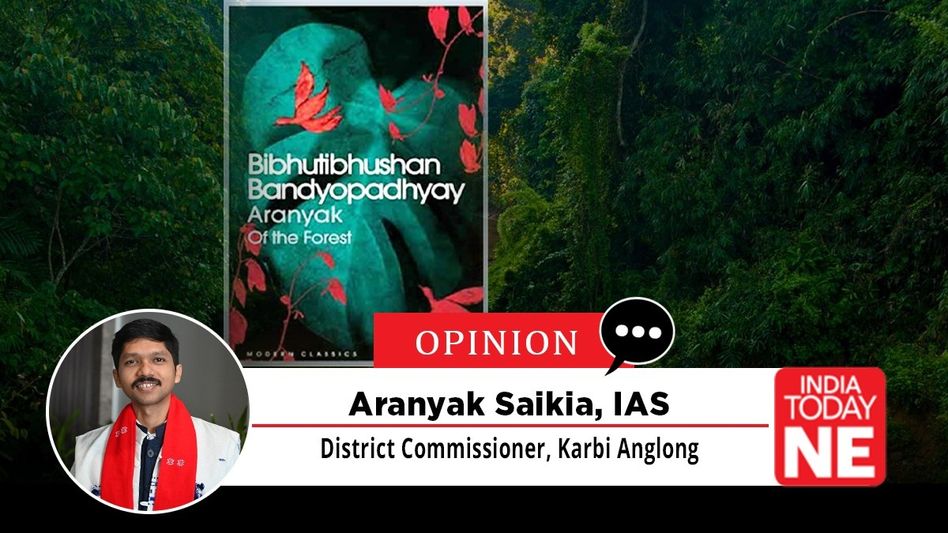
Though my name was not inspired by Bibhutibhushan Bandyopadhyay’s classic, the novel feels like an inherited warning. Nearly a century later, its forests, felled for settlement and revenue, mirror our ecological present, turning literature into prophecy, and nostalgia into urgent indictment.

- Jun 03, 2026,
- Updated Jun 03, 2026, 10:00 PM IST

I remember hearing about Bibhutibhushan Bandyopadhyay’s Aranyak when I was about 10 years old. Though my name had certainly not been inspired by the book’s title, my childhood was dotted with references to this book. In hindsight, I find it not quite surprising that I have an inclination for forests and wildlife. Wildlife documentaries on National Geographic and Discovery, with their ubiquitous narration by renowned naturalists, had generated in me a unique fascination for the natural world.
Children of my age back then could hardly distinguish the wildebeest of the African savannah from the Asiatic water buffalo of tropical Indian wetlands. I, for one, held on to my secret fantasy of becoming a herpetologist after devouring hours —in today’s lexicon, binge-watching—of Steve Irwin’s escapades with crocodiles and snakes.
Given these circumstances, it was perhaps natural to be frequently asked the question, “Oh, you must have surely read Aranyak, haven’t you?”, as if it was my religious duty, which I had failed to perform so far. Decades passed and I still continued with my supposed heresy.
A few months back, as I bade farewell to one of my departments after being transferred out, I was pleasantly surprised to receive a copy of the book from one of my colleagues as a parting gift. I loved the fact that there was still someone out there who did not presume I had read the classic that is my namesake. And this time, I decided to read the book.
There have been umpteen reviews of Bandyopadhyay’s classic. There is not much value that I can perhaps add to these wonderfully written pieces that themselves have enriched the literature around the book. However, nearly a hundred years after the book was first published, reading through the pages gives you that eerie consternation of seeing things being played out in exactly the same manner as the words play out in the book.
The first few chapters illustrate in vivid detail the wonders and beauty of the forests of northern Bihar, where Satyacharan, the novel’s protagonist, arrives to work on the landlord’s vast estate. Through Satyacharan’s evolving relationship with the forest, the novel explores the tension between anthropocentrism and a more eco-centric view of the world.
Initially, Satyacharan approaches the forest as a resource, something to be measured, divided, and exploited. However, as he becomes more deeply immersed in its rhythms and encounters the people who inhabit it, he begins to feel a sense of guilt and responsibility. It is this sense of guilt and anticipation of regret that, to me, stands out as the most striking aspect of the novel.
Aranyak’s approach to the tension between the preservation of the natural ecosphere and the pressures of human settlement-induced ecological destruction is an immersive experience. The reader is stealthily exposed to the intricacies of nature, not merely as a backdrop but as a living, breathing system to which the initially hesitant and suspicious Satyacharan gradually gets accustomed. His initial fear of being abandoned in the vastness of the jungle is replaced by an irresistible longing for the forests, the wildlife and the unsophisticated people who inhabit them.
As readers progress through the novel, they are lulled into a belief in the immensity of the forest, of the vastness of the tracts of trees that inhabit the forests of Labtulia and Nariha Baihar. Satyacharan has, in the meantime, completely assimilated with the cool summer breeze, the warm morning sun, the lush green forests and the sparkling water of the streams that flow through these jungles.
However, it is only a matter of time before the reader begins to get a taste of the sweeping emptiness that haunts Satyacharan as he realises that his presence only accelerates the inevitable—the conversion of these vast tracts of forests into barren lands of human habitation. As the manager of the estate, his principal occupation demanded that the forests be gradually let out to settlers for agriculture. The forests do not earn revenue for the owner of the estate; agricultural lands and human dwellings do.
This is the inherent contradiction between market economics and environmental externalities that is so poignantly illustrated in the novel. The contradiction is played out even today, a hundred years later, in an even starker form all around us. The inability of our market systems to internalise the value of forests is a source of discord not just at the international level but at the local level.
Forests around us disappear not because people find pleasure in destroying them, but because the environmental and economic value they carry cannot be internalised by the people or agents who live near them. While economics has tried really hard over the years to incorporate natural resource accounting into the overall national accounts through innovative tools such as hedonic pricing, the trade-off continues to play out.
There are intergenerational and spatio-temporal issues as well. Who gets the right to convert forestland into agricultural land? Is it the first generation of urban dwellers who now enjoy the “fruits” of the early conversion of forestland into settlements, or does the right continue to vest in subsequent generations living near the existing forests who are yet to derive “benefits” out of the forests around them?
While legal frameworks exist for the protection of forests, it is the economics of internalisation of costs and benefits that finally plays the decisive role in the long run. Aranyak, though a work of literature, systematically and subtly dwells upon this point. It does not provide an answer. Instead, it presents a perspective through the lens of human emotions and suffering.
“Labtulia was gone forever, and so was Narha Baihar. But the hills of Mahalikharup and Dhanjhari still remained. Perhaps, a day would come when the people of the country would crave to see a forest. But all they would be able to see would be factories, chimneys, cars, roads, houses and buildings. Perhaps then, people would realise the value of the forest… perhaps then, they would come running to the forest, much like they go on a pilgrimage to visit a holy place.”
Satyacharan’s lamentations turn out to be true today. Economically speaking, this is another subtle attempt at adding an economic value to the forest. People do throng to forests today; there is an economy around it today—from eco-camps, resorts and dhabas to treks, guides and safaris. To some, it is indeed a pilgrimage, a source of reckoning and rejuvenation. Bibhutibhushan’s novel was probably a hundred years ahead of its time.
The writer is an IAS officer currently serving as District Commissioner, Karbi Anglong, Assam. Views are personal.