Before We Reform the System
Every public scandal invites demands for reform. Far fewer ask what made the scandal conceivable in the first place.
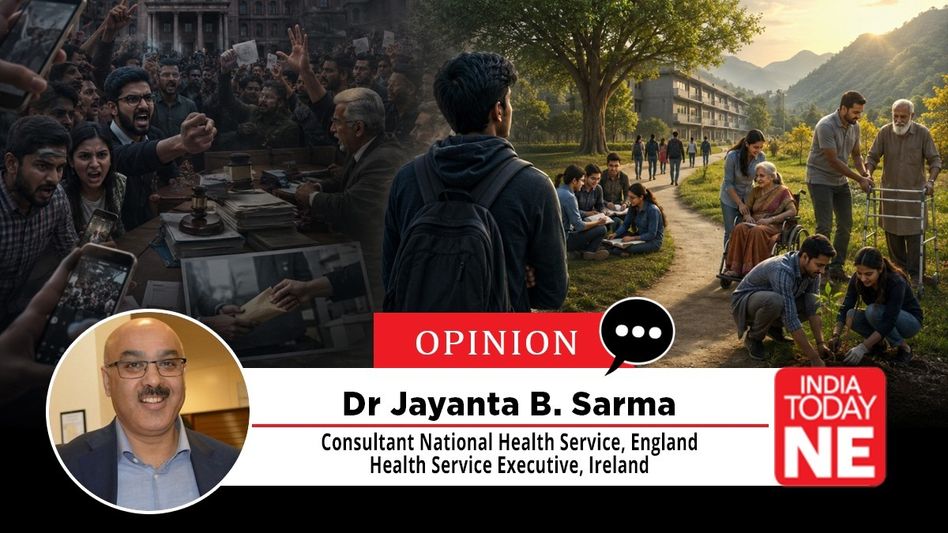

- Jul 23, 2026,
- Updated Jul 23, 2026, 4:33 PM IST

- Author says outrage over exam scandal often stops before tougher questions
- The piece urges scrutiny of social assumptions behind corruption and success
- Punishing culprits alone cannot prevent repeated failures across public institutions
Yesterday I found myself writing three unusually caustic Facebook posts. That is not my usual style. They were prompted by the familiar spectacle that accompanies almost every public scandal, moral lectures, symbolic solidarity, demands for resignations and calls for systemic reform. After a night's sleep, however, it became clear that my irritation was directed less at the individuals who had provoked those posts than at the way public debate itself was unfolding.
The examination controversy had exposed something larger than a failure of an institution. It had revealed how readily we stop our thinking precisely where the more difficult questions begin.
THE REVOLUTION OF THE VISIBLE
Every public controversy now seems to follow a recognisable script. A scandal erupts, outrage gathers momentum and social media quickly divides the world into heroes and villains. Television studios become courtrooms. Politicians demand resignations. Activists organise protests. Commentators compete to occupy the moral high ground.
There is nothing inherently unhealthy about this. Democracies depend upon citizens who refuse to accept wrongdoing, and public pressure has often been the catalyst for necessary reform.
Yet there is something curious about the pattern. We devote enormous energy to examining the event itself. We spend rather less time examining the system that produced it. And we rarely ask whether the system rests upon assumptions that society has quietly accepted for years.
The visible scandal becomes the destination of public debate when it should perhaps be the beginning of a deeper inquiry.
THE DISCIPLINE OF LOOKING DEEPER
Medicine teaches an important habit of mind: distrust the obvious explanation.
When a patient deteriorates unexpectedly or a hospital experiences an outbreak, the investigation does not end with identifying the immediate mistake. It asks what conditions allowed the mistake to occur, which safeguards failed, what incentives were operating and why warning signs went unnoticed. The visible event matters, but it is rarely self-explanatory.
Public life deserves the same discipline.
A leaked examination paper, a manipulated recruitment process or the arrest of a public official all demand investigation and, where appropriate, punishment. Yet events do not explain themselves. The more difficult question is why similar failures appear endlessly capable of reproducing themselves, regardless of who occupies positions of authority.
THREE REVOLUTIONS
Perhaps every public crisis contains three different revolutions.
The first is the most familiar. It seeks justice through punishment. Identify those responsible, remove them from office, arrest the culprits and restore public confidence. Such demands are often justified because accountability is indispensable to public life. Yet punishment alone rarely prevents repetition.
The second revolution turns its attention to institutions. It asks how the system itself should change through better oversight, greater transparency, stronger safeguards and fewer opportunities for abuse. This is considerably harder than demanding punishment because institutional reform requires sustained effort long after public outrage has subsided.
There is, however, a third revolution that receives remarkably little attention.
It asks a different question altogether.
Why would a bright young student even contemplate buying a leaked question paper?
That question is no longer about the examination board.
It is about the society that produced the student.
THE OPERATING SYSTEM BENEATH THE SCANDAL
The leaked paper is the visible event. The examination system is the visible structure. Beneath both lies something less visible but ultimately more influential: the social assumptions that shape how success, fairness and opportunity are understood.
Why does the thought of purchasing unfair advantage appear morally available? Why does it not immediately provoke revulsion? At what point does such an idea become one of the recognised options available to an ambitious young person?
These questions extend well beyond a single examination.
Across India, millions of parents make extraordinary sacrifices for their children's education. Most do so honestly and with remarkable dignity, saving for years, postponing personal ambitions and working tirelessly to create opportunities they themselves never had.
Alongside these stories, however, exists another reality. Influence is cultivated. Connections are sought. Undisclosed wealth occasionally opens doors that merit alone cannot. The forms differ, but the lesson absorbed by the next generation may not. Success is celebrated; the route to success sometimes appears negotiable.
Children rarely invent a society's moral habits. They inherit them.
Long before they enter an examination hall, they have spent years observing what adults admire, excuse and quietly tolerate. If the thought of buying a leaked paper has become conceivable, the more important question is not what happened on the morning of the examination. It is what happened during the preceding eighteen years.
THE IRONY OF THE EASIER REVOLUTION
One of my Facebook posts proposed a deliberately provocative response. If a student knowingly secured admission through a leaked paper or bribery, why should the beneficiary retain that advantage? Why should punishment stop with those who sold corruption while leaving untouched those who willingly purchased it?
The proposal was never intended as a policy prescription. It was a thought experiment. Its purpose was simply to test where we instinctively locate responsibility. Public debate readily examines those who supply corruption. It is often less willing to examine those who knowingly receive its benefits. Yet corruption survives only because supply and demand reinforce one another. Ignoring either side makes the problem easier to discuss but harder to solve.
THE REVOLUTION WE SELDOM DEMAND
The current movement quite rightly demands institutional reform. Examination systems must become more secure. Accountability must improve. Public confidence must be restored.
Yet another possibility deserves equal attention.
Imagine if student organisations across the country publicly pledged that they would never knowingly purchase a leaked paper, never seek unfair advantage and never ask their families to secure success through dishonest means.
Such a pledge would not replace institutional reform, nor would it eliminate corruption. It would simply recognise that institutions and societies reform one another.
Changing regulations is difficult. Changing habits may be harder still.
TWENTY-ONE LIVES
One aspect of the present controversy deserves quieter reflection.
The movement frequently invokes the reported twenty-one students who died by suicide during the prolonged uncertainty surrounding the examination crisis. The number has become a powerful symbol of the human cost of institutional failure.
Yet numbers have a curious habit of replacing people.
Suicide is among the most complex tragedies encountered in medicine. No responsible observer should attribute it to a single cause. Personal vulnerability, mental illness, family circumstances and immediate events often combine in ways that no outsider can fully reconstruct.
Acknowledging that complexity, however, should not make the individuals disappear.
Behind every statistic was a young life, a family, teachers, friendships and an imagined future that will never now unfold. Long after inquiries have concluded and public attention has shifted elsewhere, those families will continue living with a grief that no administrative reform can repair.
If these young lives have become the moral force behind a national movement, perhaps we owe them more than repeated reference in speeches and memoranda. We owe them remembrance. We owe their families compassion that endures after the headlines have faded.
THE QUIETER INDIA
While public attention remains fixed upon scandal, another India is quietly taking shape.
Across Assam and elsewhere, organisations providing home care for older people and those living with chronic illness are emerging with little fanfare. Some are charitable initiatives, others commercial enterprises and many combine elements of both. Together they are responding to genuine social need while creating employment and strengthening communities.
Nobody organised a protest demanding that these organisations should exist. Nobody waited for the perfect government policy. They emerged because ordinary people recognised unmet needs and quietly began addressing them.
Complex societies renew themselves in precisely this way—not only through moments of confrontation but through countless modest acts of responsibility that gradually become institutions in their own right.
These stories rarely become headlines. Perhaps they deserve to.
BEFORE WE REFORM THE SYSTEM
The examination scandal will almost certainly produce tighter regulations, stronger safeguards and renewed oversight. It should.
Whether it also prompts a wider conversation about the society that quietly shapes the institutions it later condemns is less certain.
Institutions matter because they influence how people behave. But they are also created by people whose habits, expectations and compromises have been formed long before they assume public office. Reforming institutions is therefore only part of the task. The more enduring challenge is to cultivate a society in which certain advantages become not merely illegal, but unthinkable.
Public scandals inevitably ask what went wrong.
They should also invite us to ask what allowed it to seem right.
That may be the more difficult conversation.
It is certainly the more important one.
(Author’s Note: Dr Jayanta Biswa Sarma writes on politics, institutions, and society through the lenses of history, philosophy, and systems thinking, drawing on both Indian and Western intellectual traditions. Artificial intelligence tools may be used in preparing this article as research and editorial aids. All arguments, interpretations, and final editorial judgement remain the author’s responsibility)