Between Borders and Bonfires: The Precarious Belonging of Bengali Hindus
Bengali Hindus grapple with identity and belonging across India and Bangladesh. They preserve their culture despite migration and political challenges

- Jan 12, 2026,
- Updated Jan 12, 2026, 4:36 PM IST

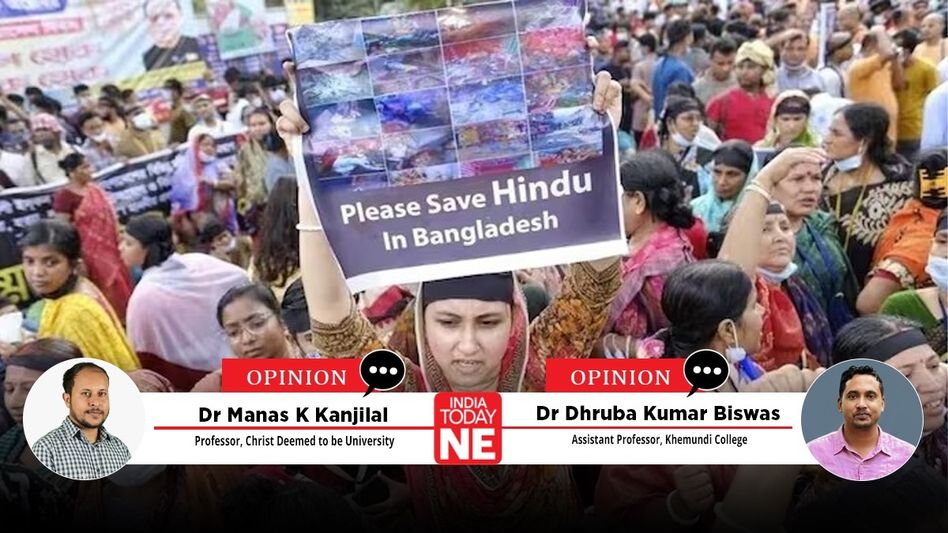
The lynching of 25-year-old Hindu garment worker Dipu Chandra Das in Bhaluka, Mymensingh, on 18 December 2025, has rightly shaken public conscience across South Asia. Accused of blasphemy at a factory event, a mob beat him, his body tied to a tree and set on fire, before images of his killing circulated widely online. The Bangladeshi authorities have since arrested several suspects and publicly condemned the violence, yet the attack has become another grim reminder of how precarious minority lives remain in our region.
Two violences, two moral responses
In India, protests and digital outrage followed swiftly, especially from Hindu groups and civil society voices who condemned the barbarity and demanded justice for Bangladesh’s Hindu minority. Several Hindu groups have protested in West Bengal, Mumbai, Hyderabad, and Odisha, demanding urgent attention to their concerns and submitting memoranda to the authorities. A notable demonstration by the Vishva Hindu Parishad (VHP) at the Delhi High Commission saw activists confront police barricades, chanting slogans to assert their right to be heard. But barely days earlier, on 5 December, another scene of collective violence unfolded much closer home, in Odisha’s Malkangiri district, targeting Bengali-origin Hindu families in MV-26 village (MV-Malkangiri Village).
Following the discovery of the decapitated body of a tribal woman, Lake Podiami, near the Dudametta river, a mob of 4000-5000 people from a nearby tribal village, as well as from neighbouring states, entered MV-26 and torched over 160 houses belonging to Bengali communities, looting property and forcing families to flee. The community was forcibly made homeless, losing their hard-earned assets and enduring profound social trauma. Police personnel were deployed immediately by the district collector, but survivors narrate that the organised violence unfolded faster than the state’s capacity to protect them.
What is striking is not only the scale of destruction, but also the asymmetry of empathy. The lynching of a Hindu man across the border mobilised transnational outrage; the burning of an entire Bengali Hindu settlement within India struggled to enter the national conversation beyond a few news reports and social media threads. This selectivity reflects a more profound discomfort with acknowledging Bengali Hindu refugees and their descendants as fully belonging within certain parts of the Indian nation-space.
The long shadow of Dandakaranya
The Bengali families of MV-26 are not recent ‘illegal infiltrators’, as larger segments on social media, as well as natives from different parts of the state, quickly labelled them ‘Bangladeshi infiltrators’ and ‘illegal Bangladeshi’. However, there is a much longer history of displacement and resettlement in this terrain. Amid the upheavals of the Bangladesh Liberation War during the 1960s, countless Hindu families (a huge portion is Dalit Hindus called Namasudra) left behind their ancestral homes, driven by waves of persecution and fear. Their displacement remains a haunting testament to the human cost of intolerance—reminding us how the scars of history continue to shape identities and belonging across borders. According to various reports, around 10 million Hindu refugees from East Pakistan (now Bangladesh) were displaced to India. They were later settled in several parts of Odisha, Chhattisgarh, Madhya Pradesh, Karnataka, Maharashtra, Andhra Pradesh, Uttarakhand, and other regions of India, including the Andaman and Nicobar Islands. All the migrated refugees were relocated under the Dandyakarnya Rehabilitation Scheme, which was conceived in the late 1950s under the aegis of Indira Gandhi.
Along with Pakhanjur/Paralkote in Chhattisgarh and Nabarangpur district in Odisha, Malkangiri emerged as one of the largest resettlement areas in this project, where thousands of Bengali Hindu families were given land, basic housing, and some livestock, along with the promise of a dignified livelihood. According to Sudhir Ranjan Halder, a writer and editor of Dalit and Matua literature, the terrain was ecologically harsh, characterised by dense forests, wild animals, dry and difficult soils, and almost no infrastructural support in the early decades. Yet over time, these communities helped open up land for cultivation, introduced new agricultural practices, invested in schooling, and conserved/rejoiced in Hindu culture and identities.
This history does not romanticise Bengali refugees as without fault. Land relations have been fraught, with some settlers purchasing land from local communities and entering into sharecropping or lease cultivation arrangements. Such patterns of agrarian inequality are hardly unique to Bengalis; they reflect broader structural tensions between relatively new arrivals with some resources and historically marginalised Adivasi communities. But to collapse this complex history into the language of “Bangladeshi intruders” or “Bangladeshi Refugees” is to erase both legal citizenship and decades of lived contribution to these regions.
From neighbour to “outsider”
The MV-26 violence cannot be understood only as a spontaneous reaction to a horrific murder; it is embedded in a longer process of othering. Bengali Hindus here are often simultaneously neighbours and “bahari” (outsiders), marked by language, caste location, refugee background and an enduring association with cross-border migration.
However, in the world of everyday experience, one also finds stories of interdependence: sharecropping contracts, labour migrations, inter-community marriages, cultural transfers, and networks revolving around agriculture and trade. However, very quickly, stories of political mobilisation, rumours, and competitive victimhood can re-code these relationships into a world of zero-sum opposition: TRIBAL LAND vs. encroachment by refugees, ORIGINAL vs. SETTLER populations. Opinion leaders, pressure groups, other communities and now social media abet these dualisms by breathing new life into terms like Bangladeshi, refugee, encroacher, or Rohingya to signify the absence of legitimacy.
From the standpoint of a Bengali Hindu academic who shares this broader history of displacement, the hurt is twofold. There is the immediate trauma of arson, loss of home, livelihoods and documents, which will scar families for generations. And there is the symbolic violence of being refused empathy in one’s own country, of seeing solidarity extended to co-religionists abroad. In contrast, one’s own community inside India is framed as suspect or expendable.