Beyond Allegations: A Chakma Perspective on Mizoram's Electoral Debate
The debate surrounding the Special Intensive Revision (SIR) 2026 of electoral rolls has once again brought the Chakma community into the public spotlight. Allegations regarding a sharp increase in voters in Chakma-dominated areas have brought headlines and social media discussions, raising questions that deserve careful examination. In a democracy, scrutiny of the electoral process is both legitimate and necessary. Yet scrutiny must always be accompanied by responsibility, evidence, and respect for the rule of law.

- Jul 07, 2026,
- Updated Jul 07, 2026, 2:39 PM IST

The debate surrounding the Special Intensive Revision (SIR) 2026 of electoral rolls has once again brought the Chakma community into the public spotlight. Allegations regarding a sharp increase in voters in Chakma-dominated areas have brought headlines and social media discussions, raising questions that deserve careful examination. In a democracy, scrutiny of the electoral process is both legitimate and necessary. Yet scrutiny must always be accompanied by responsibility, evidence, and respect for the rule of law.
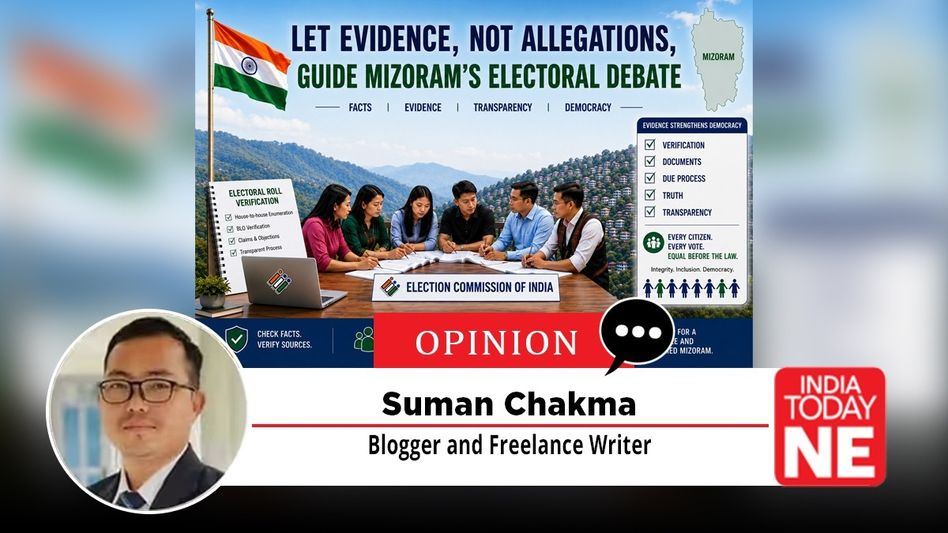
The recent statement by Mizoram Chief Electoral Officer Garima Gupta deserves careful attention. Following the completion of the Special Intensive Revision, the Chief Electoral Officer on July 4, 2026 stated that no foreign nationals had been included in the state’s electoral rolls and that there had been no abnormal growth in the number of voters. These findings emerged from a statewide verification exercise conducted under the supervision of the Election Commission of India through house-to-house enumeration and verification by Booth Level Officers.
For many members of the Chakma community, this official clarification is significant. For years, allegations of illegal migration have often been accompanied by broad suspicions directed towards Chakma-dominated areas, particularly the southern part of the state. Such narratives can easily create an impression that an entire community is under suspicion, even though citizenship and electoral eligibility are matters that must be determined individually and according to law.
At the same time, the concerns raised by the Mizo Zirlai Pawl (MZP) should not be dismissed simply because the Chief Electoral Officer has presented a different assessment. Every citizen and every civil society organisation have the democratic right to question public processes and seek greater transparency. What matters is how those concerns are pursued.
It is therefore encouraging that the joint meeting of the Mizo Zirlai Pawl (MZP), Young Chakma Association (YCA), and Mizoram Chakma Students' Union (MCSU) resolved to address perceived discrepancies through documentary verification. By agreeing to compile and submit such cases to the competent authorities, the organisations chose constitutional procedure over public confrontation. That approach deserves appreciation because it allows facts—not assumptions—to determine the outcome.
It is also important to remember that electoral rolls are not static documents. Over the years, new voters become eligible after attaining the age of eighteen, families relocate, deaths are recorded, duplicate entries are removed, and administrative corrections are made. Consequently, differences between electoral rolls prepared many years apart cannot, by themselves, establish illegal enrolment. Every allegation requires independent verification supported by evidence.
For the Chakma community, this debate is about more than electoral statistics. It is about the dignity of citizens who should not be judged collectively for allegations that have not been established through due process. The Constitution of India guarantees equality before the law to every citizen, regardless of ethnicity or language. That principle must remain central to public discourse.
Equally, this is not an argument against accountability. If any ineligible person has been enrolled, irrespective of community, the law should take its course. Likewise, if any eligible citizen has been wrongly excluded, that too must be corrected. Electoral integrity demands both inclusion and exclusion in accordance with the law—not according to perception or prejudice.
Mizoram has long been admired for its strong civic institutions and vibrant civil society. The present debate offers an opportunity to reinforce those strengths rather than weaken them. The Claims and Objections process exists precisely to resolve disagreements through documentary evidence and impartial scrutiny.
The way forward is therefore neither denial nor accusation. It is verification. If evidence supports an allegation, appropriate action should follow. If evidence does not support it, public discourse should move beyond suspicion and avoid allowing unverified claims to define perceptions about any community.
The future of Mizoram's democracy depends not only on accurate electoral rolls but also on preserving trust among its diverse communities. Trust cannot be built on rumours or sustained by repeated allegations. It grows when constitutional institutions are allowed to function independently, when evidence is respected, and when every citizen is judged not by identity but by law.
That is the democratic principle that should guide Mizoram today—and it is a principle that serves every community equally.