Beyond the margins: Why India must recognise the youth of Northeast
Unlike the rigid social hierarchies found elsewhere, the hills breathe a spirit of equality where caste distinctions are openly dismissed. Today’s youth go beyond just saying “no” to practices like dowry or child marriage. Instead, we make it a point to openly mock these traditions, emphasising that such behaviours have no place in our communities.

- Mar 16, 2026,
- Updated Mar 16, 2026, 12:00 PM IST

“Where are you really from?”, a seemingly straightforward question. Yet, for the people of the Northeast, it’s a shared experience which turns into a moment of explanation. This question alone evokes a feeling of nostalgia and longing for home and, of course, a flicker of frustration. Behind the familiar feeling of being perceived as outsiders, lies an unvoiced struggle to be understood.
Once restricted by location and scant exposure, this generation now rises to rewrite the region’s story. Beauty appears in art, stories, and colours, yet in the Northeast, it also emerges as a forceful mix of hope and determination, aggressively in its intensity. But even with this charm, the youth cannot ignore the transgressions against human dignity. They demand that their voices, whether in celebration or protest, be heard.
Unlike the rigid social hierarchies found elsewhere, the hills breathe a spirit of equality where caste distinctions are openly dismissed. Today’s youth go beyond just saying “no” to practices like dowry or child marriage. Instead, we make it a point to openly mock these traditions, emphasising that such behaviours have no place in our communities. Meanwhile, a gentle shift blooms as young people work to heal longstanding patterns of sexism and domestic harm once quietly endured. This progressive energy is fueled by exceptional literacy rates, with Mizoram at 98.2%, Nagaland at 95.7%, and Meghalaya at 94.2%, proving that education is the engine of this transformation. Ultimately, it is the bravery of women that continues to redefine what it means to lead and thrive even in the hills.
The festivals in our region, like Nagaland’s Hornbill, Arunachal’s Ziro Festival of Music, Manipur’s Chavang Kut, Assam’s Bihu, and Meghalaya’s stunning Shillong Cherry Blossom festival, to name a few, aren’t just celebrations, they’re expressions of our cultural identity that draw thousands of visitors annually. For instance, the Hornbill Festival alone attracts over 100,000 tourists each year, generating an estimated economic impact of approximately ₹200 to ₹300 crore for Nagaland’s local economy. The youth of Shillong create vibrant music scenes that draw, to name a few, Grammy-nominated artists like Ed Sheeran and Diplo, along with legends like Boney M, to the city. Today, The Shillong Cherry Blossom Festival is now eagerly awaited by both locals and visitors from mainland India, drawn to the city’s spirit.
Northeast is considered the rock capital of India, and I can tell you that our young musicians are now changing the face of Indian music in their own ways. Ours is the only place where you’d find tribal rhythm meeting modern sounds. Meghalaya for example, has artists like Reble, who delivered a rap verse in one of Bollywood’s biggest films of 2025, Dhurandhar, and artists like Meba Ofilia, who was awarded Best Indian Act at the MTV Europe Music Awards 2018, have brought us pride. Nagaland’s Moko Koza, whose song was featured on Amazon Prime’sThe Family Man andsinger-songwriter, Abdon Mech, who even opened for John Mayer on his recent India tour. Arunachal Pradesh’s Taba Chake who recently went on a world tour, performing across Europe, North America, and Asia, showcasing his incredible talent, and Rito Riba, a talented artist who has collaborated with the renowned singer Shreya Ghoshal. Mizoram too buzzes with energy thanks to rapper FENGa, Sangtei Khuptong, and the indie band Rnzx amongst others. I have never been prouder to flaunt my homeland’sgrace.
In terms of storytelling, we aren’t too far behind either. Lakshmipriya Devi directed the heartfelt film Boong, which achieved success at the 2026 British Academy Film Awards by winning the Best Children’s & Family Film award for its moving storytelling. From Meghalaya, Pradip Kurbah has gained recognition for his profound and insightful depictions of Shillong’s society and culture, earning three National Film Awards in the process. In Assam, the youth draw strength from Jahnu Barua's pioneering spirit whois admired for his sensitive narrative style with his acclaimed film Halodhia Choraye Baodhan Khai receiving the National Film Award for Best Feature Film in 1987. Santwana Bordoloi brought to life the poignant film Adajya, highlighting the quiet yet powerful struggles faced by widows in traditional communities. Meanwhile, Rima Das captured the essence of rural youth with Village Rockstars, a touching coming-of-age story that won the National Film Award for Best Feature Film and resonated deeply with audiences across the world. Despite their remarkable talent and contributions, these filmmakers often remain underrated, and their significant impact on Indian cinema warrants much broader recognition. Nonetheless, they are excellent templates for the coming generations.
Had it not been for the books and poems, our history, often brushed out by textbooks, and our politics, deemed too insignificant to be covered by the media, our imprints thus far would be lost. From Nagaland, Temsüla Ao shared Naga folktales of loss and resilience in These Hills Called Home, while Easterine Kire brought myths of hornbill hunters and WWII spirits to life in When the River Sleeps, sharing Naga identity and worldview with more people. Key figures like Birendra Kumar Bhattacharya from Assam, whose novel Yaruingam captured Naga insurgency anguish and won the Jnanpith Award, and Indira Goswami, whose raw depictions of widowhood in The Moth Eaten Howdah earned her the Sahitya Akademi, made a big name across the country with their prize winning books. This carries on with Mamang Dai from Arunachal Pradesh, who brings in Adi oral stories of spirits and rice fields I've heard elders share around the fire. Younger writers like Janice Pariat, Anjum Hasan, and Daribha Lyndem from Meghalaya look at memories, mental health, and how old traditions mix with modern life, themes that hit close to home growing up here. It’s rounded out by Kynpham Sing Nongkynrih’s records of culture, and fresh voices of Avinuo Kire, and Rita Krocha. These works keep our culture alive, and these authors turn Northeast from just a tiny dot on the map into a cosmos that dig into what it means to belong.
In the vibrant mosaic, a new wave of fashion is emerging, weaving together tradition and innovation to redefine its cultural identity. Hannah Khiangte reimagines Mizoram’s puan fabric into chic, modern outfits, skillfully highlighting the artistry of local weavers and bringing regional craftsmanship into contemporary fashion spaces. Ngoté, launched by alumni of NIFT Mumbai, Zosangliani and Elizabeth Darsiempui, takes inspiration from Mizo textile traditions and transforms them into versatile accessories like vests and bags, seamlessly blending heritage with streetwear appeal through strategic social media outreach that captures the attention of a global audience. Kintem by Moala Longchar partners closely with Nagaland’s weaving communities to develop designs that honor Naga cultural roots with modern accents, creating a harmonious balance between tradition and trend. Ura Maku, led by designer Manjushree Saikia, of Assam, offers timeless, well fitted garments that showcase indigenous textiles and craftsmanship. Lastly, Kuka Mizo, created by Van Chhangte, produces gender-neutral, socially responsible clothing made from Zo puan (textile), supporting women artisans working from their homes and promoting sustainable fashion practices. Together, these designers are not only elevating Northeast Indian textiles on the global stage but also fostering a deeper appreciation for the region’s rich cultural heritage through innovative fashion.
From IITs in Mumbai and Delhi to IISc Bangalore and medical colleges in Chennai and Kerala, driven by a burning ambition to succeed the pioneering scholars of their region, our youths are nationwide. In Shillong's spirit, they draw inspiration from Jennifer Lyngdoh, Scientist-E at the North Eastern Regional Centre of the Zoological Survey of India, fueling dives into ecological research at top labs. Naga students channel Lipokmar Dzüvichü, a historian and Assistant Professor at Jawaharlal Nehru University who specialises in the history of Northeast India, particularly frontier, transport, and labour history. From Mizoram, they emulate Dustin Lalkulhpuia, the innovative biotech entrepreneur and British Council Fellow at the University of Edinburgh's IASH, specializing in Indigenous studies, while Assam's aspiring scientists mirror Dipankar Borah's Himalayan plant discoveries in biodiversity labs. Facing stereotypes and homesickness, they innovate in renewables, conservation, and biotech to tackle regional challenges like climate shifts, reshaping India's scientific future with unbreakable regional pride.
We want to transform "Where are you really from?" into "What will you build next?", and no longer be confined to the margins, rather claim the centre stage of India's future.I yearn for an India where my form will fade into the background and get surpassed by my contributions. I crave a nation of expansive minds, free from superficial divides. I await our generation's India.
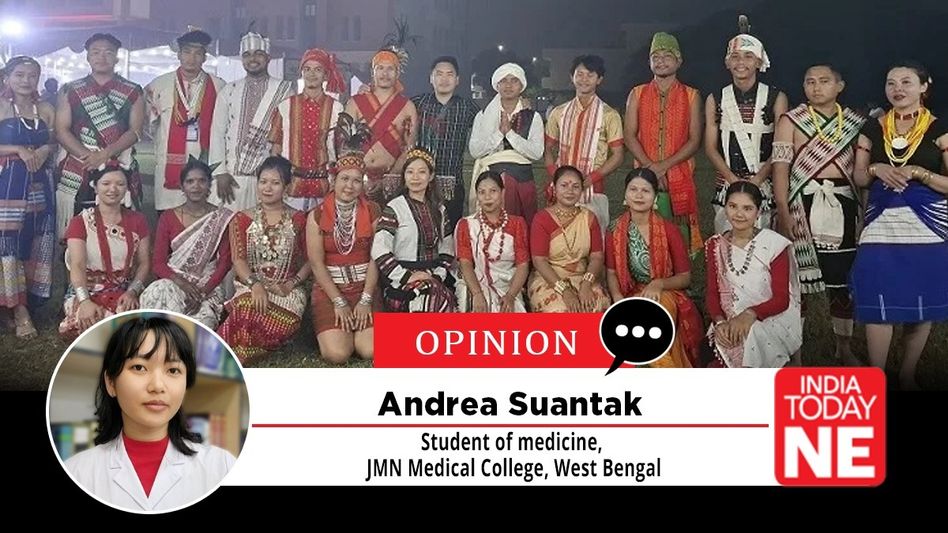
By Andrea Suantak, a native of Manipur, and a student of medicine at JMN Medical College, West Bengal.