Bhagawad Gita and a life with happiness, success and full of purpose
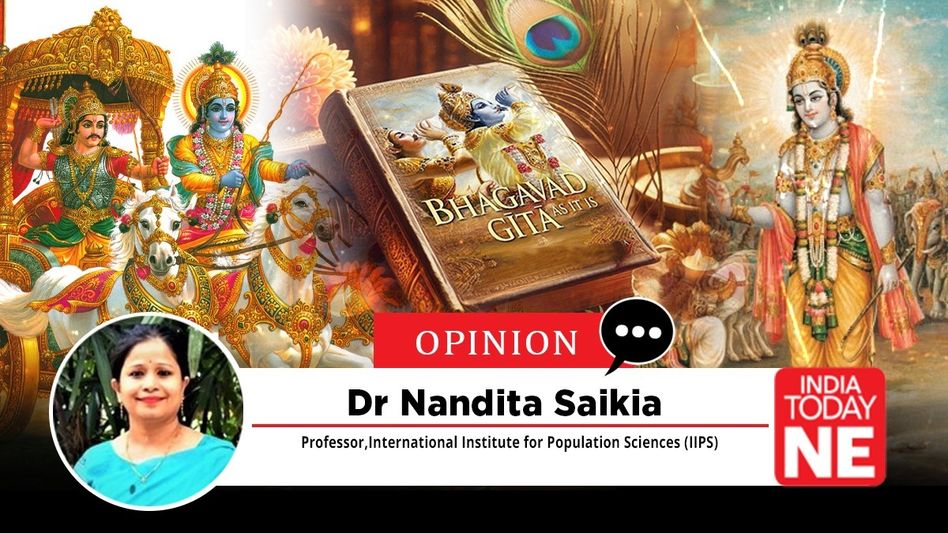
In the last shloka of Bhagawad Gita, Sanjay said: “यत्र योगेश्वर: कृष्णो यत्र पार्थो धनुर्धर: | तत्रश्रीर्विजयो भूतिध्रुवा नीतिर्मतिर्मम ||”

- Dec 01, 2025,
- Updated Dec 01, 2025, 9:19 AM IST

In the last shloka of Bhagawad Gita, Sanjay said:
“यत्र योगेश्वर: कृष्णो यत्र पार्थो धनुर्धर: |
तत्रश्रीर्विजयो भूतिध्रुवा नीतिर्मतिर्मम ||”
“Wherever there is Shree Krishna, the Lord of all Yog, and wherever there is Arjun, the supreme archer, there will also certainly be unending opulence, victory, prosperity, and righteousness. Of this, I am certain.”
But a natural question arises — “How is this possible?This is because of all the principles laid by Sri Krishna in Bhagawad gita. The Bhagawad Gita is the master piece of human psychology. Following are some of the key points which we can learn from Bhawagad Gita on the #GitaJayanti Today!
1. The Law of Karma
We cannot escape from our “Karma.” In this life or the next, we inevitably receive what we give to the universe. Our right lies only in performing action (karma), not in controlling its results. Therefore, do your righteous duty and stay at peace, knowing that the outcome will unfold as it must.
2. Energy and Eternity
When we break ourselves down to our essence, we are pure energy — and energy cannot be destroyed, only transformed. Thus, when we die, we merely transition into another form. Death is not an end but a new beginning for the “Atma” (soul). There is no need to fear death; we are eternal beings, we born again and again; we remain in manifested and unmanifested form.
Also Read: Sacred Bites: The Rituals and Science of Food Offerings to the Divine
3. The True Self: Atma, Not the Body
We are not this body, name, gender, religion, caste, or nationality — all these are temporary attributes of a single lifetime. The “Atma” (soul) transcends these boundaries. In another life, the same Atma may inhabit any form — human or animal, male or female. As Shri Bhagwan teaches, the true yogi perceives the same divine essence in all beings and empathizes with their joys and sorrows as their own.
4. The Balance of Prarabdha and Purushartha
Though we are born with our past karma (Prarabdha) in this and previous birth, we must still practice Purushartha — righteous effort in a given context. Regardless of good or bad fortune, we must act according to Dharma without attachment to results. A fortunate person without effort may fall, while one with misfortune but with righteous effort will rise to a positive destiny. Life offers everyone a fair chance through their actions.
5. Dharma and Consciousness (Chetna)
Dharma should never be confused with religion. Dharma is the righteous duty that naturally arises when our consciousness (Chetna) is elevated. We can enhance our Chetna through constant devotion, meditation, and adherence to the yogic principles taught by Shri Bhagwan in the Bhagavad Gita.
Following Dharma is challenging because it requires renouncing material indulgences — lust (Kam), anger (Krodh), and attachment (Moh). These can, however, be transformed and directed toward universal welfare rather than personal gratification.
6. Renouncing Sense Gratification (Indriya Tripti)
Completely renouncing sense gratification is extremely difficult. Yet, the great saints of India achieved this through years of deep meditation, across different births. They elevated themselves to such spiritual heights that they could consciously choose when to leave their physical bodies. These enlightened beings — true yogis — exist perpetually in a state of bliss (Ananda).
7. The Path for Common People
Even ordinary individuals can approach this state by dedicating every action to the Supreme — Vasudeva Krishna — and by working for the welfare of the universe. Krishna teaches that through Abhyasa (constant practice) and Vairagya (detachment), one can reach spiritual steadiness. Detachment does not mean owning nothing, but rather, not being possessed by what one owns — the freedom to renounce at will.
8. Vasudeva Krishna: The Supreme Source
Shri Bhagwan Krishna declares, “I am That.” Unlike other faiths where divine figures are messengers or sons of God, Krishna reveals Himself as the ultimate source of both the material and spiritual worlds. All existence — living and non-living — emanates from Him. He pervades everything, both as spirit and as matter.
9. The Manifest and the Unmanifest
Shri Bhagwan exists both as the Avyakta (Unmanifested) and Vyakta (Manifested) forms. It is up to each of us to choose our path of connection. For most, the manifested form — the tangible expression of the divine — provides a more accessible means of devotion and realization.
10. The True Measure of a Brahmin
According to Shri Bhagwan, one’s status as Brahmin or Shudra depends not on birth but on qualities and actions — “Guna-Karma-Vibhagashah.” A true Brahmin is marked by calmness, self-control, purity, patience, honesty, wisdom, and steadfast pursuit of knowledge.
In Bhagavad Gita (16.1–16.3), divine qualities are described: fearlessness, purity of mind, firmness in spiritual knowledge, charity, self-restraint, truthfulness, non-violence, compassion, humility, forgiveness, and freedom from envy or arrogance. These virtues define the divine nature of one who walks the path of Dharma.
11. The Timeless Wisdom of the Bhagavad Gita
All spiritual paths practiced across space and time find their fullest expression in the Bhagavad Gita. It encompasses the essence of every faith and philosophy — yet goes beyond them all, offering a deeper and more comprehensive understanding of existence itself.
The teachings of the Gita are universal and timeless, applicable to every human being, whether in India or anywhere in the world. Within its verses lie the answers to life’s most profound questions:
Who am I? Why am I here? What is the true purpose of my life?
Every sholka in #bhagavadgita can be spoken for hours. More you go deeper, more you realise. It is the most #sacredknowledge; very shloka of the Bhagavad Gita holds infinite meaning — one could speak for hours on a single verse. The deeper you explore, the more profound your realization becomes. It is not merely a scripture; it is the most sacred knowledge — the science of self-realization.
In today’s fast-paced world, where people struggle with stress and the endless race for success, the Bhagavad Gita offers a path to true happiness, peace, and lasting fulfillment — guiding one toward balance between worldly achievement and inner serenity.