Booming Economy, Bruised Happiness
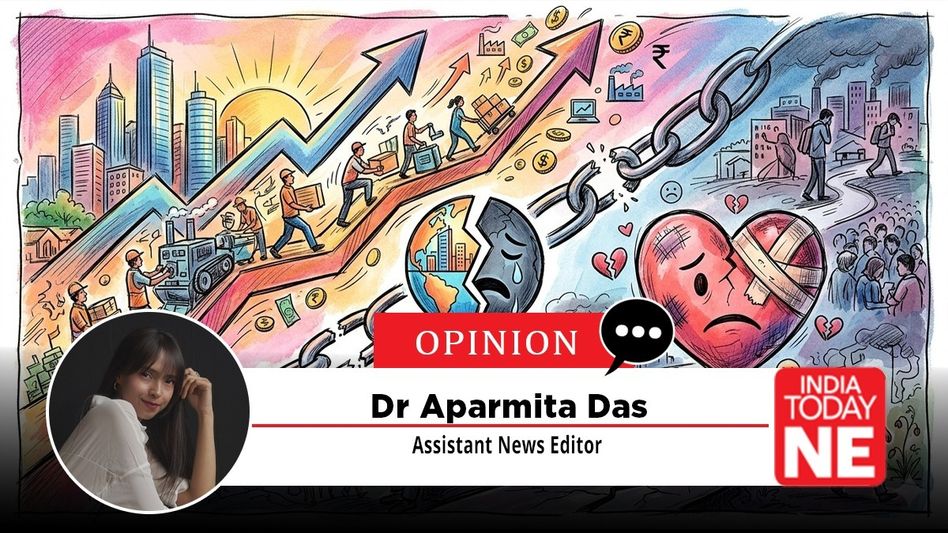
Progress is easy to measure in numbers, but much harder to feel in everyday life. Somewhere between growth and lived experience, something important gets lost.

- Mar 23, 2026,
- Updated Mar 23, 2026, 12:39 PM IST

- India ranked 116th out of 147 countries in 2026 happiness report
- Nepal ranked 99th and Pakistan 104th, ahead of India
- India scored lowest in social support at 123rd place
Every year, researchers from Oxford University ask people in 147 countries one question. Imagine a ladder. Zero at the bottom, ten at the top. Where are you standing right now in your life — not where you hope to be, not where you're supposed to be, but actually, honestly, today?
India said 4.54 this year. Out of ten.
That is the finding of the World Happiness Report 2026, released on March 20 by Oxford's Wellbeing Research Centre alongside Gallup and the UN Sustainable Development Solutions Network. India ranked 116th out of 147 countries, improving from 118th in 2025 and 126th in 2024. Finland ranked first, for the ninth year in a row. At this point Finland topping this list is less a news event and more a law of nature.
Now here is the part that stings. Nepal is at 99th. Pakistan is at 104th. India, the fifth largest economy on the planet, sits at 116th, behind both its neighbours. This is not a rounding error. This is a pattern, and it has been going on for years.
So why are we unhappy? And more importantly, what would it actually take to change?
The report does not just rank countries. It measures six specific things: income, social support, healthy life expectancy, freedom to make choices, generosity, and perception of corruption. India ranked 64th on perception of corruption, 78th on generosity, 61st on freedom, 89th on GDP per capita, 95th on healthy life expectancy, and 123rd on social support.
That last number. Social support. Whether you have someone to call when your life is falling apart — not a helpline, not a chatbot, a real person. India ranks 123rd in the world on this. The report's researchers have found consistently, across decades of data, that this single factor predicts national happiness more powerfully than income does. More than healthcare. More than freedom. The quality of your human connections is, by the data, the most important variable. And we rank 123rd on it.
This is the number that deserves to be on the front page of every newspaper in India and gets the least attention. We are a country of 1.4 billion people. We are never alone. Joint families, chaotic neighbourhoods, festivals that take over entire cities. So how is it possible that we rank 123rd on social support?
The answer is that the India of that image is changing fast, and the change has a cost nobody fully accounts for. Millions of people have moved from small towns to cities over the last two decades, which makes economic sense and quietly hollows out the social fabric. The cousin network, the colony uncle who kept an eye on things, the grandmother who held everything together — that entire informal support system gets left behind when you move to a flat in Bengaluru where you have never spoken to the person who lives next door. Cities are lonely. India has been building a lot of cities. The loneliness has been accumulating, and the happiness data has finally caught up with it.
The inequality problem makes this worse. The richest one per cent of Indians own over 40 per cent of the country's wealth. The bottom half share three per cent. When you average the happiness of a startup founder in Pune and a daily wage worker in Jharkhand, you get a number that honestly describes neither. India's 4.54 is partly what happens when you average a country that is doing brilliantly for a small number of people and grinding hard for everyone else.
ALSO READ: The Great Instagram Decay: How we chose chaos over creativity
This is also why states tell a more honest story. The happiest state in India, per the Indian Happiness Index 2025 by HappyPlus Consulting, is Himachal Pradesh. Not Mumbai, not Bengaluru, not the cities that dominate every economic headline. A hill state with clean air, smaller communities, and a pace of life that has not been entirely consumed by anxiety. Mizoram follows closely — tiny, deeply literate, with community bonds that most of urban India has traded away in exchange for faster Wi-Fi. Tamil Nadu, Kerala, and Goa round out the top tier, places that combine liveable environments with public services that actually function. Uttar Pradesh is last. The gap between Himachal Pradesh and UP in this domestic ranking is larger than many country-to-country gaps in the global report. India's happiness problem is not evenly distributed — it sits precisely where poverty, poor governance, and inequality are heaviest.
The neighbour comparison keeps coming up, and it is worth sitting with rather than rushing past.
Nepal leads South Asia at 99th, despite various economic challenges, with Pakistan following at 104th, Bangladesh at 127th, and Sri Lanka at 134th. Neither Nepal nor Pakistan is more economically powerful than India. Neither is more stable. And yet when their citizens stood on that ladder and looked around, they placed higher. The explanation researchers return to is social capital — the density of trust and mutual obligation in communities. Nepal's mountain communities have preserved it. Pakistan, for all its turbulence, has dense family structures that absorb shocks in ways that India's fragmenting urban middle class is rapidly losing access to.
Meanwhile, for a bit of global context: China sits at 65th, Russia at 79th, and the USA at 23rd. The US number is instructive on its own — the world's largest economy cannot break into the top 20. The richest countries and the happiest countries are simply not the same list.
One more thing that is quietly making young people less happy everywhere, and India is not exempt.
Researchers found that moderate social media use, under one hour per day, is actually better for well-being than zero use, but the global average has now climbed to 2.5 hours per day, crossing into what the report calls the harmful zone. The report also draws a distinction that feels important: passive and visual platforms like Instagram and TikTok trigger social comparison and are linked to lower well-being, while communication platforms like WhatsApp and Facebook are linked to higher life satisfaction in regions like Latin America and the Middle East.
In other words, scrolling is the problem. Talking is not. The difference is whether you are using your phone to compare your life to a curated highlight reel of everyone else's, or whether you are using it to actually stay connected to people you care about. Even BTS — whose fanbase is among the most engaged communities on the internet — have spoken candidly about the mental health cost of living inside that kind of relentless digital visibility. If it wears down people at the top of the algorithm, think about what it does to a seventeen-year-old in Lucknow who is just trying to figure out who she is. India has 500 million daily social media users. The mental health consequences of that, at scale, are already baked into future happiness surveys. The warning is in the report. Whether anyone acts on it is another question.
So what does a genuinely happy country look like, and can India get there?
Finland is the answer the report keeps returning to. Nordic countries continue to lead world happiness rankings, with Finland first, Iceland and Denmark following, and Costa Rica's rise to fourth marking the highest-ever ranking for a Latin American country. Finland's dominance is not genetics or cold weather or some Scandinavian mystery. It is universal healthcare, free education through university, a social safety net that actually works, low corruption, and institutions people actually trust. The Finns have a word, talkoot, for communal effort toward shared benefit. There is no direct Indian policy equivalent. That gap is instructive.
ALSO READ: When life was actually vibes: 2016 vs 2026
Costa Rica is the more surprising and more useful example for India. It is not a wealthy country by European standards. But it abolished its military in 1948 and put the savings into schools and hospitals. Today it ranks 4th globally. Its citizens report extraordinary community and family bonds. The lesson is not complicated: governments that invest consistently in people's daily lives produce happier citizens than governments that invest in prestige and GDP optics.
India's 4.54 is not a verdict on its culture or the warmth of its people. Anyone who has been at a festival, or inside a home where three generations are arguing loudly over dinner, or watched strangers organise themselves after a crisis knows this is not a joyless country. The capacity for happiness here is real and evident.
But the Gallup poll is not asking about capacity. It is asking about today. And today, for the median Indian, involves overloaded hospitals, dangerous air quality in most major cities, institutions that require heroic personal effort to navigate, and a social fabric that is under more pressure than it publicly admits.
The good news is the number is moving in the right direction. 126th in 2024. 118th in 2025. 116th now. The climb is real. The research is also completely clear on what accelerates it: invest in healthcare that reaches people before they are desperate. Build communities, not just buildings. Reduce inequality enough that growth actually shows up in ordinary lives. Create institutions trustworthy enough that people stop having to work around them.
India has the ambition. It increasingly has the resources. What it needs now is the decision that ordinary people's daily happiness is a metric worth actually governing for, not as a side effect of growth, but as the point of it.
Sources: World Happiness Report 2026, Wellbeing Research Centre, University of Oxford; Gallup World Poll 2023–25; Indian Happiness Index 2025, HappyPlus Consulting.