Boong: India’s First BAFTA in Children’s Cinema and Why It Matters
When Aribam Shyam Sharma made Imagi Ningthem and later Ishanou, he proved that cinema from Manipur could travel far beyond the state’s borders. His films were deeply local in flavour, yet universal in feeling. They introduced global audiences to a culture many had barely encountered, and placed Manipuri cinema firmly on the arthouse map. In 1981, Imagi Ningthem won the Grand Prix at the Festival des 3 Continents in Nantes - the first Indian film to do so.

- Mar 09, 2026,
- Updated Mar 09, 2026, 4:46 PM IST

When Aribam Shyam Sharma made Imagi Ningthem and later Ishanou, he proved that cinema from Manipur could travel far beyond the state’s borders. His films were deeply local in flavour, yet universal in feeling. They introduced global audiences to a culture many had barely encountered, and placed Manipuri cinema firmly on the arthouse map. In 1981, Imagi Ningthem won the Grand Prix at the Festival des 3 Continents in Nantes - the first Indian film
to do so.
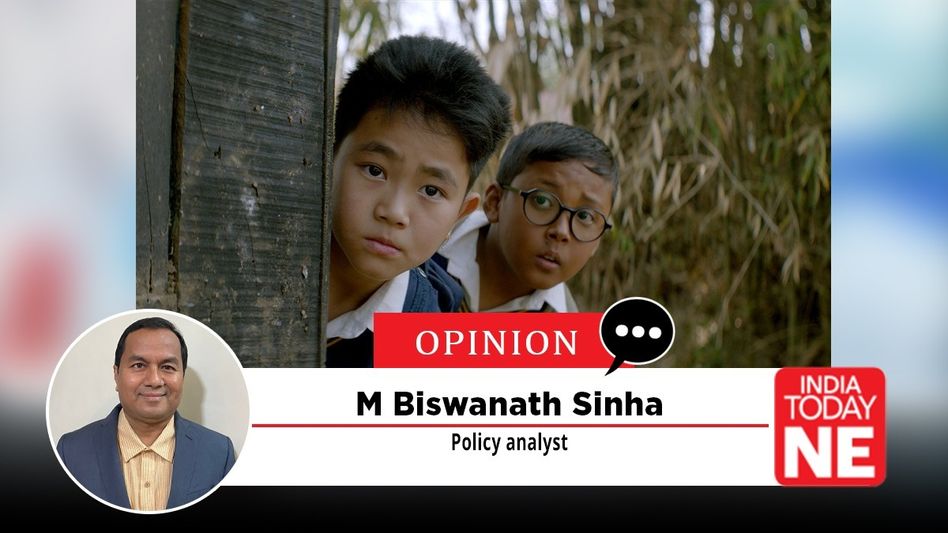
Four decades later, that journey has taken a dramatic leap forward. Boong, directed by Laiphangbam Lakshmipriya Devi, has won the Best Children’s and Family Film Award at the British Academy of Film and Television Arts (BAFTA). It is the first Indian film to win in this category. For a state that often appears in national headlines because of unrest rather than
art, this is more than a trophy - it is a powerful cultural statement.
Set in a Manipur marked by violence and uncertainty, Boong tells a story about childhood, choice and compassion. It does not dramatise conflict for effect, nor does it tie itself to any single political event. Instead, it focuses on ordinary lives - on small acts of care, moral dilemmas, and the quiet strength of people trying to live with dignity in difficult times. The young Gugun Kipgen anchors the film with remarkable sensitivity. He is supported by a strong ensemble that includes Vikram Kochhar, Bala Hijam, Sadananda Hamom, Angom Sanamatum, Jenny Khurai and Nemetia Ngangbam. Together, they create a textured portrait
of a society in transition.
What does this achievement mean for Manipuri cinema, and for Indian cinema at large? Five key lessons emerge from this achievement.
1. The Power of the Local
Manipuri, or Meiteilon, is spoken by roughly 1.8 million people. By commercial standards, this is a very small market. Yet Boong’s success shows once again that cinema is not ruled by arithmetic. The film does not dilute its identity to appeal to a larger audience. It embraces its language, landscapes and cultural rhythms. And that is precisely what makes it travel. Viewers in London, Los Angeles or Lucknow may not understand the words, but they understand love, fear, guilt, and hope.
Indian cinema often assumes that global recognition requires big budgets, metropolitan settings or dominant languages. Boong quietly dismantles that myth. Authentic stories, told honestly, can cross borders without losing their roots.
2. Collaboration in Divided Times
Given recent tensions between the Meitei and Kuki communities, some viewers might look for a direct political statement in Boong. The film is not structured as a commentary on specific events. Yet its making carries its own significance. Gugun Kipgen, who plays Boong, is a Kuki child actor. Other major roles are performed by Meitei artists and by actors from outside Manipur, including Vikram Kochhar. The producers Farhan Akhtar, Ritesh Sidhwani, et al are from outside Manipur. Overall, the creative team reflects a mix of identities and geographies. In a region often described through rigid binaries, such collaboration matters. The film does not preach humanity; it practices it. In that sense, cinema offers something politics often struggles to provide - a working model of coexistence.
3. Beyond the Headlines
For decades, Manipur’s image in national media has been tied to insurgency and unrest. Boong acknowledges that background but refuses to reduce the state to it. Instead of gunfire and slogans, we see families, friendships, and moral choices. We see a child trying to make sense of a complicated world. The film reminds us that even in conflict zones, life does not
pause. People continue to cook, study, argue, forgive and dream. This shift in focus is crucial. It humanises a region too often flattened into statistics and breaking news. For audiences outside the Northeast, Boong offers a fuller, more intimate understanding of Manipuri society - not as a permanent crisis, but as a living, breathing community.
4. A Quiet Look at Gender
Though marketed as a children’s and family film, Boong carries a subtle but sharp observation about gender. The women in the film shoulder enormous emotional and practical burdens. They hold families together, absorb trauma, and keep daily life moving. Yet their authority remains limited, and their chastity under the scanner. Manipuri women have long been visible in public life, including in protest movements. But visibility does not always equal power. The film hints at this tension without turning it into a lecture. Its critique is woven into everyday scenes. That such a layered perspective emerges in a children’s film speaks to the maturity of contemporary Manipuri cinema. It shows that storytelling for young audiences need not be simplistic.
5. Forgiveness as Strength
Perhaps the film’s most striking theme is forgiveness. Director Laiphangbam Lakshmipriya Devi, while accepting the award, has said, “No conflict is ever formidable enough to destroy the superpower that all of us have as human beings - that is forgiveness.”
In a state seeking stability and healing, this idea resonates deeply. Forgiveness in Boong is not about ignoring injustice. It is about breaking cycles of hatred. By placing this moral choice in the hands of a child, the film suggests renewal - the possibility that the next generation need not inherit every grievance of the past.
It is this emotional clarity that likely explains the film’s global appeal. Polarisation is not unique to Manipur. Across the world, societies grapple with division. A story about empathy and moral courage speaks to all of them.
A Turning Point for Indian Cinema
The BAFTA honour is not just a personal triumph for the director and her team; it is a moment of reckoning for Indian cinema. Industries in the Northeast have long worked with limited funds, fragile distribution networks, and minimal national attention. Their films rarely receive sustained mainstream exposure. A win at the British Academy compels a second look. It challenges the idea that innovation flows only from Mumbai, Chennai or Hyderabad. If Imagi Ningthem announced Manipuri
cinema to the world in the 1980s, Boong confirms that the tradition has not only survived, but also evolved. More importantly, it repositions Manipur in the national imagination. Instead of being seen solely through the lens of conflict, the state is recognised for artistic excellence. That shift in perception may be as valuable as the award itself.
From the era of Imagi Ningthem and Ishanou to the global recognition of Boong, Manipuri cinema has retained its ethical core while finding new voices and new audiences. The BAFTA is a historic first for India in its category. But beyond the accolade lies a deeper achievement: a small-language film from a small state has reminded us that cinema’s greatest strength lies in its moral imagination - its ability to help us see one another, not as adversaries or abstractions, but as fellow human beings.
(M Biswanath Sinha is a senior policy analyst. This is his personal view.)