China Is Moving East. Is India Looking Far Enough East?
China’s expanding influence across Asia and the Indian Ocean challenges India’s traditional focus on the Himalayas. India must broaden its strategic vision and strengthen regional connectivity to safeguard its future interests.

- Aug 18, 2026,
- Updated Aug 18, 2026, 2:41 PM IST

The most consequential changes in geopolitics do not always arrive with the sound of gunfire. Sometimes they take shape quietly, through ports, roads, supply chains, technology, military deployments and diplomatic relationships, while the world's attention remains fixed elsewhere. Today, much of that attention is absorbed by the war in Ukraine, continuing turbulence in West Asia and the strategic contest involving Washington, Beijing and other major powers. Yet beyond these immediate crises, China is steadily redrawing the strategic geography of Asia. Its pressure around Taiwan, expanding presence across the South China Sea, growing engagement in the Indian Ocean and relentless investment in technology, manufacturing and connectivity are parts of a larger project. For India, the significance is profound. The China challenge is no longer confined to the Himalayas. Increasingly, it is moving towards the waters, islands, neighbourhoods and economic corridors of India's East.
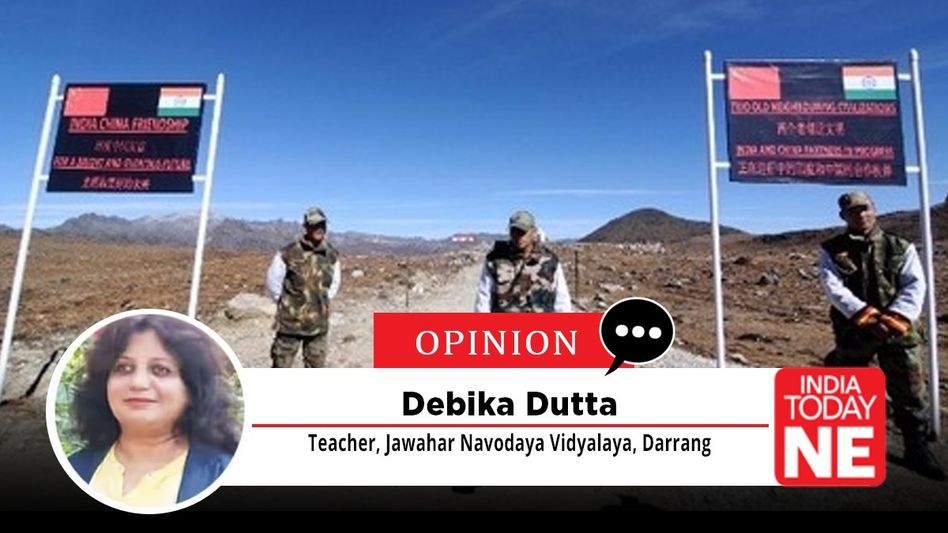
India has understandably viewed China through the mountains. The unresolved boundary question, the Line of Actual Control and the events of 2020 have made the Himalayan frontier central to national security. But the danger lies in allowing the border to become the entire map. Beijing does not see India only from the Tibetan plateau. Chinese power operates simultaneously across continental, maritime, technological, economic and diplomatic theatres. Its strategic imagination stretches from Tibet to the Pacific, from the South China Sea to the Indian Ocean and from ports and shipping lanes to semiconductor supply chains and digital infrastructure. India's strategic imagination must therefore become equally expansive. The question is no longer simply how India protects its northern frontier. It is how India prepares for a China whose understanding of power extends far beyond that frontier.
Taiwan provides perhaps the clearest indication of the changing Asian order. The island is no longer merely the centre of a political and territorial dispute between Beijing and Taipei. It sits at the intersection of global technology, semiconductor manufacturing and maritime commerce. A prolonged crisis in the Taiwan Strait would reverberate far beyond East Asia, affecting supply chains, shipping, manufacturing and financial markets. It could also draw significant American military and diplomatic resources towards the Western Pacific at a time when Washington is already managing strategic pressures in Europe and West Asia. India must therefore look beyond the immediate question of what China might do around Taiwan and examine what a Taiwan contingency could mean for the strategic balance across the Indo-Pacific and, ultimately, for India's own neighbourhood.
The South China Sea offers another lesson. China's influence has not been built solely through overt military confrontation. Coast guard operations, naval exercises, maritime militia, administrative assertions, infrastructure and sustained diplomatic and economic pressure can cumulatively alter the strategic environment without crossing the threshold of open war. That is the essence of grey-zone competition: facts are changed gradually, perceptions are reshaped incrementally and the moment requiring a decisive response is deliberately avoided. India must understand this method because the Indian Ocean is increasingly becoming part of the same strategic contest. What happens in the waters around India may be just as consequential to the country's future as what happens along its northern frontier.
For India, the Indian Ocean is not an outer theatre of national security. It is the maritime foundation of national prosperity. Energy supplies arrive through it, international commerce moves through it and India's growing relationships with West Asia, Africa and Southeast Asia depend upon its stability. As India seeks to become a major manufacturing and trading power, secure sea lanes will become more important, not less. The Indian Navy must therefore be understood not merely as a fighting force but as the guardian of India's economic arteries. Maritime domain awareness, satellite surveillance, undersea capabilities, unmanned systems, secure communications, logistics and protection of commercial shipping are no longer specialist concerns of naval planners. They are essential elements of national power.
This is where India's East acquires extraordinary strategic importance. The Bay of Bengal is India's natural maritime gateway to Southeast Asia, while the Andaman and Nicobar Islands sit close to the approaches to the Malacca Strait, one of the world's most important maritime passages. Their significance therefore extends far beyond their geographical distance from New Delhi. They represent a strategic asset at the intersection of India's maritime security, Act East policy and Indo-Pacific ambitions. The islands must be developed not merely as remote territories but as an integral component of India's wider maritime architecture, supported by infrastructure, surveillance, logistics and connectivity. Geography has given India an advantage. Strategic imagination must convert that advantage into power.
The same principle applies to the Northeast. For decades, India's Northeast was too often perceived primarily through the vocabulary of borders, insurgency and internal security. That paradigm is increasingly inadequate. The region is India's land bridge to Southeast Asia and one of the most important geographical foundations of the Act East policy. Connectivity through roads, railways, waterways, border infrastructure and digital networks can transform the Northeast from a perceived frontier into a strategic gateway. India's eastern states should not merely look towards Delhi for economic integration; they should increasingly become the country's bridge towards Bangladesh, Myanmar and Southeast Asia. In the emerging geopolitical environment, every highway, logistics corridor, border trade route and digital connection can carry strategic significance because connectivity determines access, and access creates influence.
Myanmar becomes especially important in this context. Its geography connects South Asia with Southeast Asia and places it at the intersection of the Bay of Bengal and China's southwestern strategic interests. Instability in Myanmar has direct implications for India's Northeast, border management and connectivity ambitions. India's engagement with Myanmar therefore cannot be reduced to the immediate management of security concerns. It must also be part of a longer-term strategy to ensure that India's eastern frontier remains connected to the wider Indo-Pacific. The successful implementation of Act East will depend not merely upon diplomatic declarations but upon whether the Northeast can function as a living economic and strategic bridge to Southeast Asia.
India must also rethink the way it views its wider neighbourhood. Bangladesh, Sri Lanka, the Maldives and the island states of the Indian Ocean are not pieces on a geopolitical chessboard waiting to be claimed by either India or China. They are sovereign societies with their own interests, vulnerabilities and aspirations. India's advantage is not that it can match China project for project. It lies in proximity, trust, capacity building, disaster relief, education, healthcare, technology and maritime cooperation. Influence cannot be built only when a rival arrives. It must be cultivated continuously, through relationships that create confidence
before a strategic crisis makes them necessary. India's neighbourhood policy must therefore become an investment in enduring partnerships rather than a succession of tactical reactions.
China's relationship with Pakistan demonstrates why connectivity has become a strategic instrument. The China-Pakistan Economic Corridor is important to India not only because of the territory through which it passes, but because it illustrates how infrastructure, economic relationships and strategic geography can reinforce one another over decades. India must respond not by attempting to imitate every Chinese initiative, but by creating its own network of connectivity and influence: stronger links with Southeast Asia, deeper engagement with the Gulf and Africa, sustained maritime partnerships across the Indian Ocean, better integration of the Northeast and greater investment in strategic infrastructure. In the twenty-first century, connectivity is no longer merely an economic concept. It is power because it determines who can reach whom, how quickly and with what degree of strategic dependence.
This also explains the importance of India's partnerships with the United States, Japan, Australia and other Indo-Pacific countries. The Quad and India's wider strategic partnerships can contribute to a balance that discourages unilateral attempts to alter the status quo. Yet India's Indo-Pacific strategy should never become simply an anti-China enterprise. Secure sea lanes, freedom of navigation, resilient supply chains, technological cooperation and a stable maritime neighbourhood are Indian interests irrespective of Chinese behaviour. Strategic autonomy does not mean standing alone. It means possessing sufficient national strength and diplomatic flexibility to cooperate widely without surrendering the freedom to choose.
India's relationship with China will test this maturity more than almost any other relationship. Dialogue must continue because two major Asian powers cannot communicate indefinitely through suspicion alone. Every reduction in border tensions matters. But stabilisation should not be confused with the disappearance of strategic competition. The territorial question remains unresolved, China's claims over Arunachal Pradesh remain a serious concern and competition for influence across Asia is likely to continue even during periods of improved bilateral relations. There is nothing contradictory about speaking to a rival while preparing for the possibility that rivalry may intensify. Indeed, that is the essence of mature statecraft: diplomacy reduces the possibility of conflict, while preparedness reduces the temptation to exploit vulnerability.
The nature of security itself is also changing. A future conflict may not begin with soldiers crossing a frontier. It could begin with a blockade, a cyberattack, disruption of communications, targeting of a port, interruption of a supply chain or disabling of critical infrastructure. Satellites, undersea cables, power networks, financial systems and digital platforms can become strategic vulnerabilities. India therefore needs a broader conception of national security—one that combines military preparedness with technological capability, resilient supply chains, advanced manufacturing, energy security and secure digital infrastructure. A strategically secure India is not merely one whose borders are defended. It is one whose critical choices cannot easily be taken away.
China has demonstrated the strategic value of thinking in decades rather than headlines. India must develop the same patience without abandoning its democratic character or strategic autonomy. It possesses formidable advantages: geography, a large and expanding economy, military capability, technological talent, democratic legitimacy and relationships across competing geopolitical blocs. But potential becomes power only when it is converted into sustained capability. The China challenge cannot be managed through periodic bursts of
attention after border incidents or diplomatic disputes. It requires continuity, institutional memory, infrastructure, investment and the political will to think beyond the crisis of the day.
The most important question before India, therefore, is not what China will do next. It is what India intends to become. The answer must begin with seeing the whole map. The Himalayas will remain central to national security, but they cannot be the outer boundary of India's strategic imagination. The Bay of Bengal, the Northeast, the Andaman and Nicobar Islands, the Malacca Strait and the wider Indian Ocean are increasingly central to India's economic and strategic future. India's East can become the bridge between the Indian subcontinent and the Indo-Pacific if connectivity, economic integration, maritime capability and diplomacy move together.
India does not need to out-China China. It needs to build an India so resilient, connected, capable and strategically confident that no external power can determine the terms on which it engages with the world. The world may remain absorbed by crises in the West, while China continues to calculate across the changing geography of Asia. India has no luxury of looking in only one direction. Its strategic horizon must extend from the Himalayas to the Bay of Bengal, from the Northeast to Southeast Asia and from the Andaman and Nicobar Islands to the wider Indian Ocean. China is moving east. India must ensure that its own East is not merely a frontier, but the gateway to its future.