
Coaching Factories and the Cost of Ambition
India's exam coaching industry is under renewed scrutiny as student suicides rise and Guwahati's centres expand. The focus has shifted from isolated tragedies to accountability in a high-pressure system built on scarce seats and costly promises.
Advertisement

Rituparna Bhattacharyya
- Sep 30, 2026,
- Updated Sep 30, 2026, 4:10 PM IST
Story highlights
- Lakhs of teenagers leave home chasing ranks with family savings at stake
- For 24 lakh candidates, around 82,000 MBBS seats leave most behind
- Assam's private centres are expanding fast, drawing students from neighbouring states
India's coaching industry sells certainty in an exam system that offers very little. As NEET and JEE aspirants keep dying by suicide, and as a new youth movement reaches Guwahati, the question is no longer whether the coaching model is harming children. The question is who will be made to answer for it.
Every year, lakhs of teenagers leave home for rented rooms in Kota, Delhi, Patna and, more and more, Guwahati. Each carries a family's savings and a single number to chase: a NEET or JEE rank. For roughly 24 lakh NEET candidates, there are only about 82,000 MBBS seats, government and private combined. The arithmetic guarantees that most will fail, and the coaching industry is built on promising each child that they will be the exception.
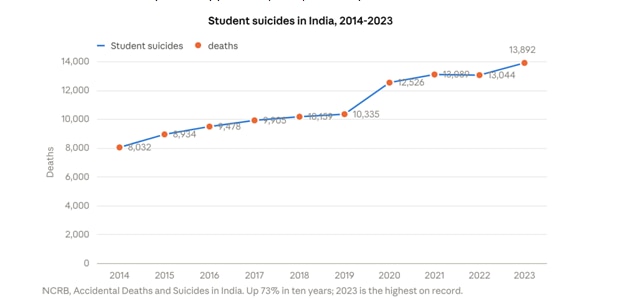
In 2023, 13,892 students died by suicide in India, according to the National Crime Records Bureau (NCRB). That is the highest figure in a decade, and about 38 young lives a day. Not all of them were coaching students. But the coaching hub has become the most visible symbol of a system that turns adolescence into a two-year examination.
For North East India, this is no distant Rajasthani problem. Assam's own coaching sector has grown quickly. National brands have opened centres in Guwahati. Families from Tripura, Manipur and Meghalaya now send children to Kota as well as to Dispur's coaching lanes.
A ₹58,000-crore promise
India's coaching sector is officially valued at about ₹58,000 crore, and industry watchers put the real figure closer to ₹1 lakh crore. Its leaders are now household names. ALLEN, born in Kota, has over 45 branches across the country. PhysicsWallah (PW) began as a YouTube channel and is now a listed company. PW reported ₹1,051.2 crore in revenue in a single quarter, July to September 2025, and plans more than 75 new offline centres.
In a recent Routledge chapter on the transformation of higher education in India, Suman Singh and I argued that the privatisation of coaching has "taken a cancerous route". The coaching centre becomes the primary institution, and the school becomes a "dummy" where the child is enrolled but rarely taught. ALLEN's two-year Nurture classroom course for IIT-JEE (target 2026) costs ₹1,66,000 a year. One Guwahati school allied with ALLEN charged ₹2,51,200 a year for Class XI–XII science in 2024–25, up from ₹2,30,750 the year before. The result is a parallel school system that only some can afford, and that measures a child's worth in percentiles.
None of this makes any single institute responsible for any single death. But a business model that sorts children into "rankers" and "the rest", publishes toppers' faces on every hoarding, and treats a second or third attempt as normal is not a neutral bystander either.
What the numbers say, and what they don't
Student suicides in India rose from 8,032 in 2014 to 13,892 in 2023, a 73 per cent rise in a decade. Students now make up 8.1 per cent of all suicides in the country. In Kota alone, police and district records show a steady toll every year except the pandemic years.
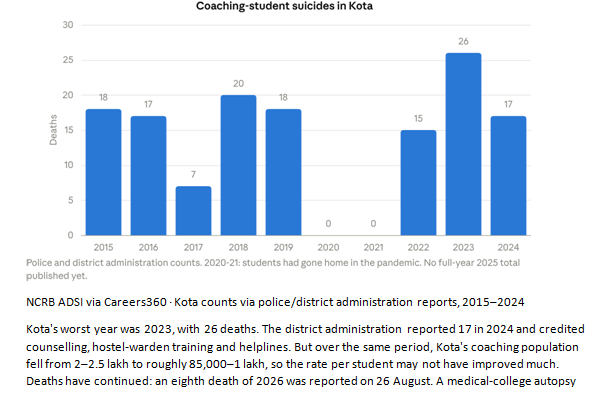
NCRB ADSI via Careers360 • Kota counts via police/district administration reports, 2015–2024
Kota's worst year was 2023, with 26 deaths. The district administration reported 17 in 2024 and credited counselling, hostel-warden training and helplines. But over the same period, Kota's coaching population fell from 2–2.5 lakh to roughly 85,000–1 lakh, so the rate per student may not have improved much. Deaths have continued: an eighth death of 2026 was reported on 26 August. A medical-college autopsy study of 27 Kota cases found that 93 per cent were NEET aspirants, most were aged 17 or 18, and academic stress was the main factor in three out of four.
One honest caveat is essential. No public dataset records suicides institute by institute. The NCRB does not note whether a student was enrolled with ALLEN, PhysicsWallah or anyone else, and Kota's police figures cover all coaching students in the city. Anyone who claims a year-wise death toll "at ALLEN" or "at PW" is guessing. That gap is itself a failure of accountability: an industry this large should be required to report deaths and serious self-harm among its enrolled students, as schools and universities increasingly are.
The rules exist. Enforcement does not.
The Supreme Court has already said what the coaching model does wrong. In Sukdeb Saha v. State of Andhra Pradesh (25 July 2025), a bench of Justices Vikram Nath and Sandeep Mehta issued 15 binding guidelines. Coaching centres must stop sorting batches by performance, stop public shaming and stop setting targets beyond a student's capacity. Any institute with 100 or more students must employ a qualified counsellor. Helpline numbers must be displayed in every classroom and hostel. The Court named Kota, Jaipur, Sikar and Hyderabad for extra care.
Assam moved early. The Assam Coaching Institutes (Control and Regulation) Act, 2025, passed on 25 March 2025, requires every centre to register, disclose fees, faculty and infrastructure, and admit only students aged 16 or above. Education Minister Ranoj Pegu said guardians "had no one to approach if they are duped or misled".
Yet laws on paper have not changed what happens inside the classroom. Toppers' photographs still cover hoardings from Kota to Guwahati. "Dummy" schooling continues. Weekly rank lists are still read out. And a 2025 national survey by the Supreme Court's task force drew responses from only 3.5 per cent of institutions. The pressure does not come only from coaching centres. Parents, schools, a shortage of seats and a leaky exam system all share the blame. But coaching centres profit most directly from that pressure, and they can do the most to reduce it.
Will the Cockroach Janta Party (CJP) take on the coaching industry?
So far, the Cockroach Janta Party (CJP) has not called for coaching centres to be shut. Its anger has been aimed at the state. The satirical youth movement was founded on 16 May 2026 by Abhijeet Dipke . It led 50 days of protests at Jantar Mantar after the NEET-UG 2026 paper leak, and those protests ended with Education Minister Dharmendra Pradhan's resignation on 25 July. In June, Dipke wrote to the Prime Minister asking for ₹1 crore in compensation for each family of an aspirant who died by suicide after the leak. Its demands were exam reform and ministerial accountability, not the closure of private coaching.
The CJP has now come to Assam. It launched a membership drive at the Guwahati Press Club on 4 August, saying students and youth would be its priority. On 28 September, members were detained in Guwahati ahead of a volunteers' meeting. Spokesperson Ashutosh Ranka called it "bullying" and criticised the state of Assam's rural schools. The movement's next national protest, planned for 2 October, is about the voter-roll revision, not education.
A campaign to close ALLEN, PW and their rivals is unlikely, for three reasons. First, the CJP's base is largely the aspirant generation itself, and for them coaching is a lifeline as well as a burden. Second, closure is not legally realistic: coaching is a lawful business, and both Assam and the Supreme Court have chosen regulation over bans. Third, the movement wins by pointing at government failures, such as paper leaks and scarce seats, which coaching merely exploits. A more plausible CJP agenda, if it turns to coaching at all, would include enforcement of Assam's 2025 Act, audits of fees and refunds, an end to dummy schools, and compulsory public reporting of student deaths.
Regulate hard, not shut down
Closing coaching centres would not save lives on its own. The demand would simply move online, where PW already earns much of its revenue and where no warden or counsellor can see a child in trouble. What would help is making the industry answer for the pressure it creates:
• Count the dead. Require every registered centre in Assam to report student deaths and serious self-harm to the state authority and publish the figures each year.
• Enforce the Supreme Court's 15 guidelines. Check for counsellors, ban rank-based batches and public shaming, and suspend the registration of centres that ignore the rules.
• End dummy schooling. Schools that enrol students who never attend should lose recognition.
• Police the advertising. Topper-photo hoardings and "guaranteed selection" claims should face the same scrutiny as any misleading advertisement.
• Fix the scarcity. Nothing will ease the pressure while about 24 lakh aspirants chase roughly 82,000 medical seats. More public seats in the North East, and a leak-proof exam, matter more than any ban.
The CJP has shown that angry young people can bring down a minister. If it turns that energy towards making coaching accountable, it could do more for the next batch of aspirants than any hoarding ever promised.
If you or someone you know is struggling, call Tele-MANAS on 14416 or 1-800-891-4416 (free, 24x7, in several languages including Assamese).
Dr Rituparna Bhattacharyya is a human geographer and Founding Editor-in-Chief of Space and Culture, India.
POST A COMMENT