Dasyu Bhaskar the Floodborn
Dasyu Bhaskar stands as a symbol of justice and resilience amid Assam’s devastating floods. His stories reflect the courage of ordinary people battling nature’s fury and social neglect.

- Jul 29, 2026,
- Updated Jul 29, 2026, 7:19 PM IST

For almost every member of Gen X in Assam who studied at least up to matriculation, one fictional character occupies a place as familiar as an old friend. Dasyu Bhaskar, created by Rabin Dey under the pen name Rangmon, was much more than the hero of an adventure series. His stories became an inseparable part of our childhood and fired our imagination at a time when books were our constant companions, much like smartphones have become for today's Gen Z.
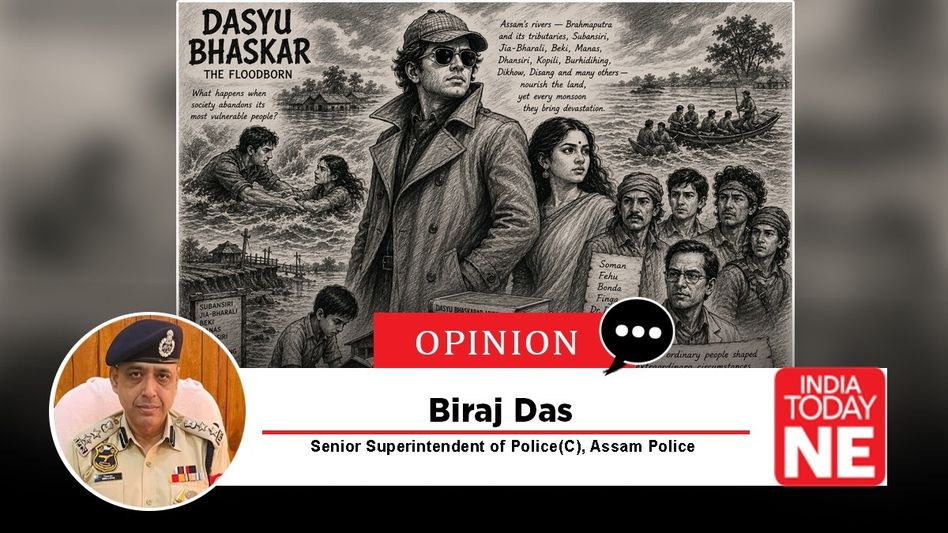
We admired Bhaskar not because he lived outside the law but because he stood for justice when the law failed ordinary people. Like the legendary Robin Hood, he challenged the powerful, protected the poor and refused to accept injustice. Around him stood unforgettable companions such as Soman, Fehu, Bonda, Finga and the brilliant Dr. Dhiren. Each played an important role in Bhaskar's mission and each became memorable in his own way.
Then there was another remarkable figure whose courage often unfolded quietly rather than dramatically. Dasyu Rani Champa rarely sought the spotlight, yet she remained Bhaskar's strongest ally. Intelligent, fearless and deeply compassionate, she gathered information, protected him from hidden dangers and ensured that justice prevailed even when society looked the other way.
What made these characters unforgettable was that they were ordinary people shaped by extraordinary circumstances.
The story begins with Kamal Bora, an ordinary young man whose life changed forever because of the annual fury of Assam's rivers. Every monsoon, not only the mighty Brahmaputra but also tributaries such as the Subansiri, Jia-Bharali, Beki, Manas, Dhansiri, Kopili, Burhidihing, Dikhow and Disang swell beyond their banks, inundating villages, eroding fertile land and leaving thousands of families homeless.
One devastating monsoon, the floodwaters rose beyond imagination. Villages disappeared beneath swirling currents. Houses collapsed. Standing crops vanished overnight. Cattle were swept away and entire families found themselves stranded on bamboo platforms or on the roofs of their homes, waiting desperately for rescue.
Amid this catastrophe Kamal noticed a young woman struggling against the current. Her name was Minati Baruah. Without thinking about his own safety, Kamal jumped into the raging floodwaters and managed to rescue her. That single act of courage changed both their destinies forever. When the waters finally receded, they realised that everything they had known had disappeared. Their homes were gone. Their land had been buried under sand. Their livelihoods had vanished. The world expected them to rebuild their lives, yet no one offered them the means to do so.
Relief arrived slowly. Society soon forgot them. Those with wealth remained safe in their comfortable homes while thousands of ordinary families struggled simply to survive. It was not greed that pushed Kamal and Minati outside the law. It was desperation. Kamal became Dasyu Bhaskar. Minati became Champa. Together they chose to fight injustice in their own way, helping the poor while challenging those who exploited them. Rangmon never glorified crime. Instead, he asked a question that still feels relevant today: What happens when society abandons its most vulnerable people?
When Rangmon began writing the series around 1970, Assam was already living with the destructive cycle of annual floods. Readers immediately recognised the places and situations. They had seen rivers swallow roads. They had watched schools become relief camps. They had witnessed families carrying whatever little remained of their lives on bamboo rafts. The floods described in the novels were not imaginary. They reflected everyday life in Assam.
Assam's rivers were much more than geographical features in those stories. The Brahmaputra stood at the centre, but the countless tributaries that criss-cross the state carried the same dual identity. During winter they appeared calm and life-giving. With the arrival of the monsoon they turned fierce and unforgiving, breaching embankments, eroding riverbanks, burying fertile fields under sand and uprooting entire communities. Together these rivers have nourished Assam's civilisation for centuries, yet they have also written countless stories of loss and displacement.
I belong to that fortunate Gen X which grew up before mobile phones, computers and social media transformed childhood. Books were our greatest entertainment. Libraries were our favourite places. Friendships grew through conversations about stories rather than through digital screens.
In 1982, I was a student at Dergaon Higher Secondary School. My elder brother, Late Dhiraj Das, affectionately known to everyone as Kaju, joined a cricket coaching camp organised at Dergaon Kamal Dowerah College under the guidance of Pranab Baruah Sir from Dibrugarh University. It was there that I first met Bedanta Bikash Thakur, whom we all knew simply as Rinku. He was a student of Indranee Devi Higher Secondary School.
After our cricket practice sessions, we would often sit together and talk, and more often than not, our conversations revolved around books. Someone would enthusiastically narrate the latest adventures from the Pafu series. Another would recommend detective novels such as Jomkal (যমকাল), Diamond Robbery and others. Then, with remarkable calmness, Rinku casually mentioned that he had already finished reading all sixty-two books in the Dasyu Bhaskar series.
We were barely twelve years old. To me it sounded almost unbelievable. That single conversation lit a fire within me. I decided that I too would complete the entire series.
My brother introduced me to the small lending libraries scattered around Dergaon, such as Ajala Puthibhoral (আজলা পুথিভঁৰাল), the library at Jelehuwagaon, and several others whose shelves were lined with well-worn paperbacks that had passed through hundreds of eager readers. I began with "Dasyu Bhaskarar Abirbhab", and continued one book after another until Bhaskar aru Sarpasannyasi purchased from Mantu Book Stall at Narikalguri, while many others I borrowed from friends such as Rajmohon Sarma, Vedabhaskar Phukan, Nikhil Borthakur and countless others who were equally captivated by Bhaskar's adventures. For nearly two months, my evenings belonged entirely to Bhaskar.
Looking back today, I realise that I was not merely reading adventure stories. I was, in many ways, reading about the catastrophes of Assam itself. Nearly half a century has passed since Rangmon first introduced Bhaskar to Assamese readers. Technology has transformed our lives. Roads have improved. Cities have expanded. Yet, with every monsoon, the headlines remain painfully familiar.
The Brahmaputra and its tributaries overflow. The Subansiri, Jia-Bharali, Beki, Manas, Dhansiri, Kopili, Burhidihing, Dikhow, Disang and many other rivers breach their banks. Embankments collapse. Entire villages disappear beneath muddy water. Children miss months of schooling. Farmers lose the crops that sustain their families. Cattle are swept away by relentless currents.
When the waters finally recede, thick layers of sand cover once fertile fields and cultivation becomes almost impossible. Relief arrives. Compensation is announced. Committees are formed. Reports are written. For countless families, however, recovery remains painfully slow. Many never recover at all.
One cannot help wondering how many modern-day Kamal Boras still exist across Assam, young men and women whose dreams are washed away not by personal failure but by forces completely beyond their control. Most rebuild their lives with remarkable resilience. History also reminds us that prolonged despair can push vulnerable people towards desperate choices. That timeless truth gives Rangmon's novels their enduring relevance.
The lasting appeal of Dasyu Bhaskar lies not in thrilling chases or daring adventures. It lies in the humanity of its characters. Bhaskar was not born an outlaw. Champa was not born a rebel. They were ordinary people who lost everything and refused to surrender their dignity. Their story symbolises countless anonymous Assamese families who continue to confront the same catastrophes year after year.
For those of us who belong to Gen X, the memories remain vivid. Cycling to neighbourhood libraries, waiting eagerly for the next available volume, exchanging books with friends and discussing Bhaskar's latest adventures long after the pages had been closed. Those books entertained us. They also taught us empathy. They reminded us that poverty, injustice and natural disasters can change the course of ordinary lives.
Sometimes I imagine another young Kamal Bora standing beside one of Assam's many flood-swollen rivers as dark monsoon clouds gather overhead. Would he once again leap into the torrent to save a stranger? Would another Minati Baruah emerge from those waters? Would society embrace them before despair overwhelmed them? Or would history quietly repeat itself? The rivers never answer. They simply continue their timeless journey across Assam, nourishing the land while reminding us every monsoon of their immense power.
Perhaps that is why Dasyu Bhaskar has never really disappeared from the hearts of Gen X. He is not remembered merely as an outlaw or the hero of a popular adventure series. He represents every ordinary Assamese who refused to surrender after losing everything. Dasyu Rani Champa stands beside him as a reminder that courage often works quietly, without applause, yet leaves the deepest mark.
The rivers of Assam have shaped its civilisation, enriched its culture and sustained its people. Yet the same rivers have also written countless stories of loss, displacement and resilience. Rangmon understood this truth more than half a century ago. His fiction was never only about bandits. It was about the human spirit tested by nature's fury and by society's indifference.
Until the day Assam finds a lasting answer to its annual floods, the story of Bhaskar and Champa will continue to transcend fiction. Every monsoon, somewhere along the banks of the Brahmaputra or the floodplains of the Subansiri, Jia-Bharali, Manas, Kopili, Dhansiri, Burhidihing or any of the state's countless rivers, another Kamal Bora and another Minati Baruah may stand at the edge of despair, hoping that compassion arrives before desperation does.
For rivers do not create outlaws. They create victims. It is society's failure to stand beside them that turns survival into rebellion.