Dead Bodies at the CM’s Gate: The Sleeper-Dancer CM Wakes Up—but Not Really
A government that wakes up only when dead bodies arrive at the Chief Minister’s gate has failed in its most fundamental duty: protecting human life.

- Oct 25, 2026,
- Updated Oct 25, 2026, 3:02 PM IST

A government that wakes up only when dead bodies arrive at the Chief Minister’s gate has failed in its most fundamental duty: protecting human life.
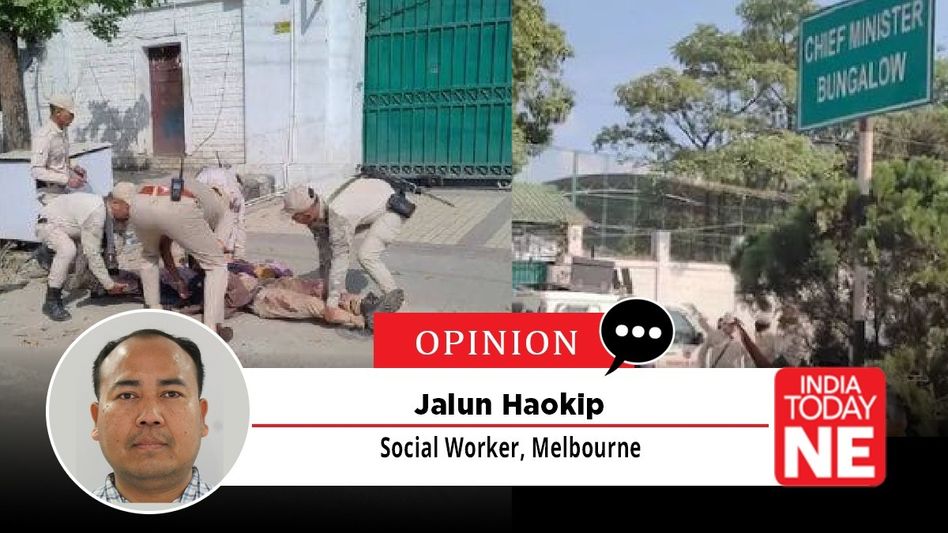
On 19 October 2026, three Meitei civilians were killed in a massacre in Sunurok Hills, Kangpokpi district, by Kuki armed militants amid Manipur’s continuing cycle of violence. In an extraordinary expression of public anger, the bodies of two victims were placed at the gate of Chief Minister Yumnam Khemchand Singh’s official residence.
In the aftermath, three cadres of the Kuki National Front–Nehlun (KNF-N) were arrested, two of whom reportedly confessed to their involvement in the killings, according to Manipur Police. KNF-N is described as a proxy of the Kuki National Front (KNF-P), a Kuki militant group covered by the Suspension of Operations (SoO) arrangement. On 20 October, security forces also raided Sinai Camp in Kangpokpi district, a designated camp for Kuki militant groups covered by the SoO arrangement.
The dumping of the dead bodies at the Chief Minister’s residence was more than a shocking demonstration of grief. It was an indictment of a government whose routine condemnations, ex gratia announcements and official meetings have failed to convince the public that it can prevent further killings. Since the 19 October massacre, there have been multiple incidents of violence, including the killing of Paolen Khongsai on 20 October, and attacks and counterattacks on villages.
The message was unmistakable: people have grown tired of words that follow death but fail to prevent it.
The Sleeper-Dancer CM, Khemchand Singh, appeared to wake up when the dead bodies reached his doorstep. This was followed by an unprecedented “noise protest” on 23 October 2026, when the banging of utensils and electric poles echoed across Imphal and adjoining areas in protest against the ongoing crisis in Manipur. But has the government truly awakened to its constitutional responsibilities, or will this moment be followed by yet another cycle of condemnations and compensation until the next killing?
The Kuki Militants’ Sinai Camp Raid and the Failure of the SoO Arrangement
Reports indicated that only 18 armed Kuki militants were present at the camp, despite 159 SoO cadres—93 from the Kuki National Army (KNA) and 66 from the Kuki Liberation Army (KLA), both groups under the Kuki National Organisation (KNO)—were supposed to be stationed there. Of the 18 people found at the camp, only one had been identified as a registered cadre covered by the SoO arrangement at the time of the Manipur Home Minister’s statement on 23 October. Such conduct by Kuki SoO militant groups would constitute not merely a breach of the ground rules warranting termination of the arrangement, but potentially serious criminal offences under Indian law.
Taking action against cadres alone, without holding their leaders accountable—who appear to enjoy immunity—will not resolve the problem. The cycle will persist because there is no shortage of cadres or potential recruits to replace those apprehended.
Enforcing law and order, including compliance with the SoO ground rules, falls within the state government’s responsibilities. Chief Minister Khemchand cannot dismiss these responsibilities by claiming that the SoO arrangement is not a state subject when the state government is itself a party to the agreement. Regardless of the SoO arrangement’s status, the state government remains obligated to maintain law and order and take action against criminal activities.
A government or Chief Minister propped up by Kuki militant groups, the MLAs who represent Kuki SoO militant groups, and their proxies, and dependent on their support to remain in power, has a strong incentive to appease these groups rather than act in the people’s best interests.
The raid on Sinai Camp might never have happened without the mass public uprising and the dumping of the innocent Meitei woodcutters’ bodies at the Chief Minister’s gate. If this is what it takes to compel the government to act against armed actors who kill civilians, what message is it sending? Apparently, that in Manipur, justice comes only when dead bodies are dumped at the Chief Minister’s gate.
There have been historical and ongoing reports of similar situations at other designated Kuki SoO camps, but these issues have repeatedly been allowed to die down for political reasons, primarily because Kuki SoO groups serve as a powerful, convenient and effective vote bank for those in power.
The SoO ground rules prohibited recruiting new cadres. If cadres who were 18 when the agreement was first signed in 2008 are now 36, and those who were 28 are now 46, how do we explain the apparent presence of numerous young cadres under 35 in SoO groups? Are these existing cadres, or does their presence point to possible violations of the no-recruitment provision? These questions warrant transparent investigation.
The SoO arrangement has failed miserably and deserves abrogation without further review or extension. Numerous organisations and members of the public from both the valley and the hills, as well as political parties, have called for its abrogation. On 31 August 2025, Thadou Inpi Manipur (TIM) formally demanded its termination by submitting a comprehensive 35-page memorandum to the Central and state governments, documenting numerous breaches of the SoO ground rules and setting out the rationale for abrogating the agreement.
Manipur Home Minister Govindas Konthoujam clarified on 23 October 2026 that the SoO agreement had not been extended after it expired on 4 September 2026. If this is the case, why has the government not begun rounding up and disarming all the more than 2,000 Kuki SoO-armed militants, dismantling their designated camps, and taking action against all cadres and leaders found in possession of illegal arms or involved in illegal activities, not just those at the KNO’s Sinai Camp?
Thadou bodies have repeatedly raised concerns about Kuki militant groups and their proxies, including the Kuki Inpi, Kuki Students’ Organisation (KSO), Committee on Tribal Unity (CoTU), Indigenous Tribal Leaders’ Forum (ITLF) and Kuki Zo Council (KZC). They accuse these organisations of acting as parallel authorities in civilian communities, pursuing a violent, extremist Kuki-supremacist agenda, stoking communal tensions and violence, accumulating personal wealth, and engaging in widespread electoral manipulation, including mass election rigging.
Ethnic Violence, Political Agendas and the Consolidation of Power
For more than three years, Manipur has been trapped in a cycle of ethnic polarisation, displacement, killings and institutional breakdown. Ethnic grievances and intercommunal hostility are real, but describing the crisis solely as a conflict between communities cannot explain its persistence or the failure to restore normalcy.
For several years before 3 May 2023, Manipur experienced a relative decline in insurgent activity and a degree of normality not seen for decades. During roughly six years of BJP rule under Chief Minister N. Biren Singh, who took office on 15 March 2017, he gained recognition for his reformist agenda, political will and actions, particularly his efforts to protect Manipur’s territorial integrity and indigenous identity, remove the redundant 'Any Kuki Tribes' from Manipur ST list, introduce the Inner Line Permit System (ILP) in Manipur, implement the National Register of Citizens (NRC) in Manipur, wage a war on drugs, protect land and forest, protect the border, stop illegal immigration, strengthen law and order, and rein in Kuki armed militant groups under the SoO agreement. One example was his decision in March 2023 to withdraw the Manipur government from the Suspension of Operations (SoO) agreement with the Kuki National Army (KNA). During this period, strikes and bandhs became less frequent, extortion and violence declined, and armed militancy came under greater pressure. People enjoyed greater freedom of movement and a semblance of stability.
However, these positive changes were disrupted when violence broke out in Manipur on 3 May 2023, in what appears to have been a deliberate, preplanned act by those opposed to the then Chief Minister N. Biren Singh and the reformist actions he pursued, which people of Manipur supported. The more difficult questions concern power: Who benefits from continued polarisation and violence? Whose political position is strengthened by the crisis, and who continues to suffer? When public debate is dominated by competing ethnic narratives, questions of governance, accountability, political patronage and armed-group activity risk disappearing from view.
The result is a dangerous inversion of democratic responsibility: people judge political leaders and law enforcement agencies and security forces by whether they appear to defend an ethnic constituency rather than by their ability to protect citizens. Retaliation after a killing is futile if nothing is done to prevent the next one. The dead cannot be brought back through revenge, but further deaths can be prevented through accountability, justice and effective governance.
The people of Manipur deserve to know whether the political system is working to end the crisis or whether certain interests have adapted to it so successfully that a return to normalcy threatens their influence.
Manipur’s crisis is not merely a question of ethnic hostility. It is a test of political leadership, institutional integrity, India’s sovereignty and democracy, and the government’s willingness to confront the forces undermining constitutional rule and threatening the country’s sovereignty.
Political Power, Family Ties and Armed Groups: The Constitution or the Gun—Who Really Governs Manipur?
One of the most troubling aspects of Manipur’s crisis is the overlap between political networks and armed organisations. Deputy Chief Minister Nemcha Kipgen is the wife of Thangboi Kipgen, president of the Kuki National Front (KNF-P), a SoO group under the United People’s Front (UPF). Kimneo Haokip Hangshing, the Saikul MLA, is the wife of the chairman of the Kuki Revolutionary Army (KRA), a SoO armed group under the Kuki National Organisation (KNO). Other MLAs, including Saikot MLA Paolienlal Haokip, Henglep MLA Letzamang Haokip, Saitu MLA Haokholet Kipgen and Tengnoupal MLA Letpao Haokip, also have close family ties to leaders of Kuki SoO militant groups operating in their respective areas.
Kuki militant groups sponsored these MLAs, while the MLAs supported the groups, creating a mutually reinforcing relationship between armed organisations and elected representatives. Before the 2022 Assembly election, the Kuki National Organisation (KNO) and the United People’s Front (UPF), umbrella organisations representing SoO groups, publicly endorsed BJP candidates in areas where they operated. This practice predates 2022, extending back to the period following the formalisation of the SoO agreement in 2008.
Thadou Inpi Manipur’s 22 October 2026 press release, “Sunurok Hills Triple Killings: TIM Demands Probe into Alleged Political–Militant Nexus and Saitu AC Rivalry,” also highlighted alleged links between politicians and Kuki militant groups. These concerns warrant thorough investigation and decisive action, particularly with the next Manipur Assembly election approaching in early 2027. Failure to address them could lead to further, potentially intensified, bloodshed and violence.
The broader question is whether constitutional institutions exercise effective authority across Manipur or whether armed organisations regulate civilian and political life in areas under their influence. The SoO arrangement was intended to facilitate dialogue and regulate participating armed groups—not to replace state authority or legitimise coercion.
Extortion, illegal taxation, intimidation, restrictions on movement and interference in elections, government affairs and civilian community affairs raise serious concerns about armed groups’ power. Such violations cannot be dismissed as inconveniences in political negotiations.
The Sleeper-Dancer CM’s Travel Spree Amid a Killing Spree
Leadership is measured not by public appearances and official meetings but by whether people are safer because of the government’s actions.
The Chief Minister’s participation in a taekwondo session while civilians were being killed and people were protesting against the killings and government inaction attracted public attention. The problem lies in the contrast between the appearance of normality projected by political leadership and the insecurity experienced by ordinary people.
The familiar pattern of condemnations, ex gratia compensation and meetings has become painfully inadequate. Compensation can assist bereaved families, and condemnation has its place. Neither substitutes for preventing violence, identifying perpetrators, dismantling unlawful armed networks and prosecuting those responsible.
The government must demonstrate that policies of Kuki appeasement have ended, credible intelligence is acted upon, perpetrators are pursued regardless of their affiliation or community, illegal weapons are recovered, and vulnerable settlements are protected. Displaced families must also be able to return to their homes safely and with dignity.
The government must demonstrate that it has a coherent security strategy and that the law is enforced without political or ethnic favouritism.
Without measurable results, the Sleeper-Dancer label will remain a symbol of public frustration with leadership that appears to awaken only when a crisis becomes impossible to ignore, only to return to sleep mode soon afterward.
Reign of Terror Along the IT Road
Among the many incidents of brutal killings and attacks and counterattacks along the IT Road in Kagpokpi district, the infamous ISIS-style terrorist beheading of Ringkangmai, a 52-year-old Liangmai Naga man from Makui Asang village in Kangpokpi district, on 10 October 2026, raises grave questions about the extent of extremist Kuki radicalisation and terrorism, individual responsibility, and possible command accountability. What justification can there be for the government’s failure to arrest perpetrators who have filmed their own acts of brutal violence, including beheadings, circulated footage of severed heads, and exposed their faces in horrifying acts of terror?
According to Thadou Inpi Manipur’s press release dated 24 October 2026, one of the reported perpetrators involved in Ringkangmai’s beheading, Mangminhao Kipgen of J. Songtun village, Kangpokpi district, is an active cadre of the Kuki National Front (KNF-P) and the nephew of Jangboi Kipgen. Jangboi Kipgen is the Home-cum-Finance Secretary of KNF-P, a Kuki armed group operating under the Suspension of Operations (SoO) arrangement.
Jangboi Kipgen is also described as the de facto chief of the non-SoO KNF(N) and Chairman of the Unified Command of Kuki armed militant groups in Kangpokpi district, comprising both SoO and non-SoO groups. Investigators must establish individual and organisational involvement, assistance, planning and any wider chain of responsibility by first arresting those suspected of involvement, bringing those responsible to justice, and ensuring accountability at every level of command.
Kamjong: Civilians Deserve Protection
The violence in Kamjong district further demonstrates why civilian protection must not be subordinated to competing ethnic narratives. The Tangkhul Naga Long has accused the Myanmar-based Kuki National Army–Burma (KNA-B), another proxy of the Manipur-based KNA/KNO, and the Village Volunteers of Eastern Zone (VVEZ), of involvement in violence. Separately, reports stated that Kuki civilian Seikhohao Haokip was killed on 17 October, four people were injured, and houses were burned. Around 15 abandoned houses in Khoikai were reportedly set alight on 21 October.
Naga groups have blamed KNA-B for violence against Nagas, while Kuki groups have blamed the NSCN (IM) and NSCN Eastern Front for violence against Kukis in the area. The authorities must impartially establish the perpetrators’ identities and affiliations, investigate all incidents and bring those responsible to justice.
Seizure of Weapons, Poppy and a Kuki Students’ Organisation ID Card from Kuki Militants
The recovery of huge quantities of sophisticated illegal weapons and ammunition, poppy, and a Kuki Students’ Organisation (KSO) identity card following the arrest of KNF(N) cadres in connection with the 19 October massacre raises serious questions about links between armed militancy, the illegal drug trade and associated political networks. Notably, KSO-GHQ vice-president Jamkhomang Khongsai was arrested in September alongside Thangkhomang Haokip, chief of the proscribed United Kuki National Army (UKNA).
The recovery adds to concerns about long-standing links between Kuki armed militant groups, the illegal poppy trade and political networks—a pattern often described as “Kuki narco-terrorism”. These connections warrant thorough and impartial investigation.
A Government Must Not Wait for Dead Bodies at Its Gate
The dead bodies brought to the Chief Minister’s residence on 19 October should serve as a warning that public patience is running out. People do not bring their dead to the seat of government because they need another expression of sympathy. They do so when ordinary channels of accountability appear to have failed. The government must disclose findings it can lawfully make public and pursue the evidence wherever it leads to regain public trust.
The Sleeper-Dancer CM may have been jolted awake by the sight of bodies at his gate. But waking up is not the same as taking responsibility. The real test of his leadership is whether he will move beyond routine condemnations and compensation to confront the evidence, resist political pressure, challenge armed influence, and protect citizens—even when doing so carries a political cost.
Manipur cannot recover while its people remain hostage to fear, armed organisations exercise authority beyond the law, and political leaders are judged by ethnic loyalty rather than their constitutional duties.
The Constitution must prevail over the gun, public duty over political convenience, and human life over vested interests. A government’s duty is not to wait for dead bodies to arrive at its gate before it acts. Its duty is to prevent killings and violence—and ensure that no one ever has to carry the dead to the seat of government to demand justice.
The writer, Jalun Haokip (MSW), is a Melbourne-based native of Manipur with professional experience in social work across mainstream and Indigenous Australian communities. He currently works as a family violence practitioner within the Victorian Government in Melbourne.