Demography, democracy, and the drift of South India
The 2026 Keralam Assembly election delivered a verdict that national media processed in a single news cycle: UDF wins 102 seats, LDF collapses to 35, BJP makes historic gains with 3 seats. Orderly democracy in action. Roll the graphics. Move to the next story. But of course, we have a CM nominated amidst much bickering.
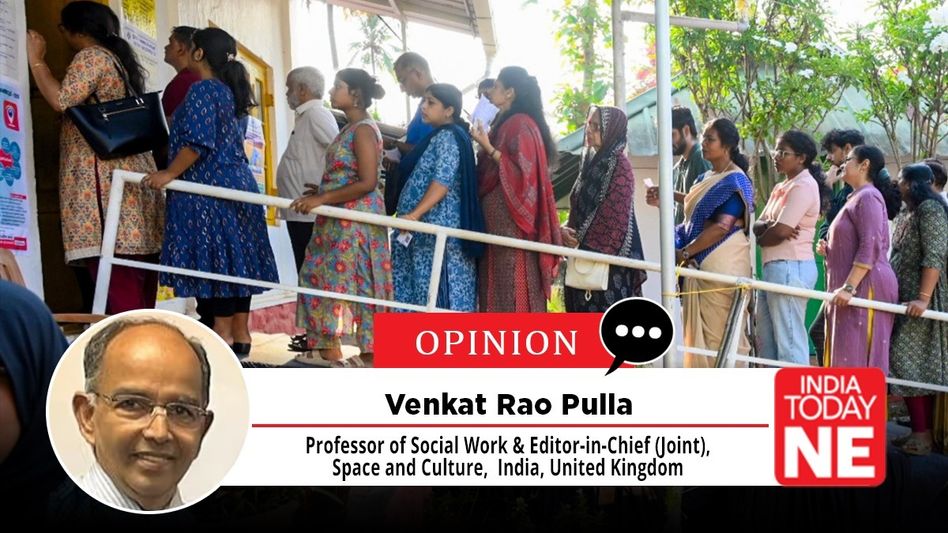

- May 17, 2026,
- Updated May 17, 2026, 3:42 PM IST

The 2026 Keralam Assembly election delivered a verdict that national media processed in a single news cycle: UDF wins 102 seats, LDF collapses to 35, BJP makes historic gains with 3 seats. Orderly democracy in action. Roll the graphics. Move to the next story. But of course, we have a CM nominated amidst much bickering.
But buried inside those numbers is a story that no prime-time anchor bothered to decode, and that most editorials in Maha Bharat did not confront: clearly, the structural political irrelevance of Keralam's Hindu majority.
Fifty-four-point seventy-three percent. That is the Hindu share of Keralam's population as per the 2011 Census, a figure that researchers project has already slipped further since. And yet, in the 2026 election, the party most explicitly representing Hindu political consolidation won three seats. Three. Out of 140.
Is this a mystery? No, it is a mechanism. And understanding it requires humility and courage to say the plain truth: that Keralam's Hindus have been politically outmanoeuvred, demographically pressured, and even institutionally weakened, and this has been happening silently for quite some time.
The Numbers That Should Alarm Every Indian
Let me begin with facts from the Census of India — not ideology, not conjecture.
In 1901, Hindus constituted approximately 68.5 percent of Keralam's population. Christians were 13.8 percent. Muslims were 17.5 percent.
By 2011, about 110 years later, Hindus had dropped to 54.73 percent. Muslims had risen to 26.56 percent. Christians stood at 18.38 percent.
That is a loss of nearly 14 percentage points for Hindus over eleven decades. Of that loss, 9.6 percentage points accrued to Muslims and 4.3 to Christians. But the trajectory matters more than any single snapshot.
Between 2001 and 2011 alone, the Muslim population of Keralam grew by 12.8 percent. Hindus grew by 2.2 percent. Christians by 1.4 percent. The gap between Muslim and Hindu growth rates in a single decade was more than tenfold.
Now look at the child population data, the most reliable leading indicator of future demographic direction. In the 0–6 age group counted in the 2011 Census, Muslims constituted 36.74 percent of Keralam's children despite being only 26.56 percent of the total population. Their share in this age bracket had jumped from 31.08 percent in the previous decade, in 2001. The Census recorded 14.4 children per hundred Muslims, compared to only 8.93 per hundred Hindus.
By 2019, the most recent vital statistics available, Muslims accounted for 44.4 percent of all live births in Keralam. Hindus, at 54.7 percent of the population, accounted for only 41 percent of births. Muslims had already overtaken Hindus in total annual births in the state sometime around 2015.
Projections by the Centre for Policy Studies, Chennai and Delhi, based on official census and birth registration data, suggest that Hindus could fall below 50 percent of Keralam's population as early as 2031.
In North Keralam's Malabar region specifically, the Hindu share has already fallen from 69.1 percent in 1901 to 50.7 percent in 2011, a loss of over 18 percentage points, 14 of them since 1951.
Keralam's Hindu majority is not a political reality. It is a fading statistical residue.
And the above numbers are not manufactured by Hindu nationalists. They are the Government of India's own census figures — the very data on which demographers work.
Surely, the demographics provide context.
The whole electoral machinery is where Hindu irrelevance becomes operationalised.
The 2026 result handed 102 of 140 seats to the UDF. Congress won 63. The Indian Union Muslim League won 22 seats.
The arithmetic is not subtle.
IUML is the fulcrum on which Keralam's new government rests.
And lo and behold, IUML has its lineage directly to the All-India Muslim League, the political vehicle that demanded, and achieved, the partition of British India along religious lines.
After Partition, it reconstituted itself in India as the Indian Union Muslim League in 1948. Its ideological journey since then has been debated extensively.
What is not debatable is its function in Keralam's contemporary politics.
It controls the political representation of a numerically growing, electorally consolidated Muslim community, and it uses that leverage to extract governance influence disproportionate to its population share.
Historically, when UDF has governed Keralam, IUML has held ministries covering education, minority affairs, and northern Keralam development portfolios with long-term civilisational consequences.
The party maintains an extraordinary 80 percent strike rate in converting contested seats to victories, a figure that reflects the iron discipline of its voter base, not electoral accident.
Now add Keralam Congress (M), a party with deep roots in the Christian community heartlands of central Keralam, to the coalition picture.
Christians, at 18.38 percent of the population, voting in highly consolidated patterns through community networks anchored in churches and institutions, form another non-fragmented bloc within the UDF matrix.
Plain Maths:
Muslims at 26.56 percent plus Christians at 18.38 percent equals nearly 45 percent of Keralam's population.
When combined, it is no longer a minority bloc in voting, possessing substantially higher consolidation power over Hindus.
A fragmented Hindu majority of 54 percent, split across Congress, CPI(M), minimal BJP, caste parties, regional loyalties, and personality cults, is electorally weaker than two cohesive minority communities voting strategically.
This is not democracy malfunctioning. It is democracy working exactly as designed — rewarding political organisation and punishing political fragmentation.
The problem is that one community has been permitted to organise collectively around religious identity, while another has been told that doing so is communalism.
Secularism is a One-Way Street
The word secular is perhaps the most weaponised term in Indian political vocabulary. And nowhere is it deployed more selectively than in conversations about Keralam.
IUML fields candidates explicitly as the political arm of Keralam's Muslim community. It campaigns on minority welfare, minority education policy, and minority institutional protection.
Nobody calls this communal. In fact, it is celebrated as democratic minority representation.
Keralam Congress (M), deeply embedded in Christian community networks, similarly draws on church influence, Christian institutional loyalty, and community consolidation.
Nobody calls this communal.
The Hindu in Keralam is hardly a political formation, does not vote on the basis of Hindu cultural identity, and is afraid of asking for temple rights.
A little voice interpreted as demographic anxiety is immediately branded Hindutva, labelled a threat to Keralam's pluralism.
The Hindus, who are 54.73 percent of the population, cannot translate their numerical weight into proportionate political power, because no party can consolidate Hindu votes without being immediately destroyed in secular media portrayals that seem to govern political legitimacy in the state.
The South Indian Question — Laboratory or Vanguard?
It is fashionable to speak of Keralam as a model state.
High literacy. Low infant mortality. Strong public health. Remittance economy. Gender indicators that outperform the national average.
All of this is true and worth celebrating.
But there is another model that Keralam represents — one that political scientists in Delhi should be studying with considerably more urgency than they currently are.
Keralam is a model of what happens when a Hindu numerical majority is politically fragmented for long enough that minority blocs become the decisive arbiters of electoral outcomes.
When that happens, governance priorities shift.
Whoever controls the margin controls the agenda.
What begins in Keralam does not stay in Keralam. What consolidates in Tamil Nadu does not stay in Tamil Nadu.
The southern laboratory has national implications.
The NDA's three seats in the 2026 Keralam election represent a breakthrough.
For a state where the party had only one MLA in its entire legislative history before this election, winning three constituencies is measurable progress.
But let us be honest about what three seats in a 140-member House means.
The pace matters.
Demography does not pause while political organisation slowly catches up.
Every election cycle that passes without Hindu political consolidation in Keralam is an election cycle in which demographic and institutional advantages compound for other communities.
Yet another question which BJP's Keralam unit must eventually confront is how Hindutva, as a pan-India ideological framework, translates into Keralam's specific civilisational context.
Keralam's Hindu traditions are not generically Hindu. They are Shaiva, Vaishnava, and folk, deeply rooted in the Sree Narayana movement, the SNDP, the traditions of Ayyappa and Guruvayur, the Namboodiri heritage, and the ancient Syrian-influenced landscape of central Keralam.
These multiple strands constitute the fabric of Hindu Keralam.
The BDJS — the Bharath Dharma Jana Sena, rooted in SNDP — represents exactly the kind of locally rooted Hindu organisation that could, over time, provide a credible social foundation for Hindu political consolidation in Keralam.
The challenge is that SNDP represents the Ezhava community specifically, not Keralam's Hindus as a whole.
Nairs, Namboothiris, Scheduled Caste Hindus, OBC Hindus, and tribal Hindu communities all sit in different political orbits.
Without a platform that genuinely bridges these communities — not as a vote-bank exercise but as a social movement — Hindu political consolidation in Keralam will remain aspirational.
The question to be asked is: why is minority vote bloc consolidation in Keralam and Tamil Nadu treated as legitimate democratic participation, while any attempt at Hindu vote consolidation is immediately branded as divisive communalism?
Is this principle applied consistently, or only selectively?
The IUML ministers will hold portfolios covering education and minority affairs.
At what point does the Indian political establishment ask what the long-term civilisational consequences of this arrangement are?
They certainly do not affect the Muslims, who have every right to political representation.
But for the Hindu majority that is funding, through taxes and temple endowments, it is a fact that the state apparatus does not treat their interests symmetrically.
We know that Keralam's Hindu temples are under government administration through the HR&CE equivalent framework.
Church institutions and mosques are not.
Church-run schools receive government aid while remaining under ecclesiastical control.
Is this constitutional equality?
And if not, which party in Keralam's 2026 government will correct it?
The 2021 Census was delayed due to COVID.
Whenever it is allowed to be collected in Keralam and then published, any guesses about Keralam's religious demographics?
Will Keralam's government prepare to have a public conversation about what those numbers mean?
There is a comfortable silence that settles over India's educated, English-speaking political commentariat when these questions are raised.
The silence is dressed up as sophistication, a refusal to engage with what is dismissed as communal arithmetic.
Serious people, it is implied, do not count heads by religion.
The likes of Mr. Shashi Tharoor may not agree with counting Hindu numbers.
For him, it could just be a way of life or a culture.
But the IUML counts heads.
The Church counts heads.
Every coalition negotiator in Keralam counts heads before every election.
The only community that is told counting heads is beneath them is the Hindu majority.
I am not for Hindu supremacism, nor am I making an argument against the legitimate political participation of Muslim or Christian communities.
But I argue without apology: a democracy in which 54 percent of the population cannot exercise proportionate political influence because it has been told that doing so is communalism is a democracy with a structural dysfunction that will eventually produce consequences no one will be comfortable with.
The civilisational stakes in Keralam and Tamil Nadu are not abstract.
They are numerical, institutional, and temporal.
The question is not who won the 2026 Keralam election.
The question is what the winner's coalition structure tells us about whose interests will be represented, whose institutions will be protected, and whose demographic anxieties will be dismissed as communalism for another five years.
Keralam is like a lab experiment running for decades.
And the Hindu majority — patient, fragmented, philosophically pluralist, constitutionally loyal — has been, so far, the primary subject of the experiment.
Worth asking then: what do they get for being a democratic majority?
(The views expressed in this article are those of the author and do not necessarily reflect the views of India Today NE or its affiliates.)