Everything That’s Wrong with the Workplace in Randhawa’s Fine Shyt
Guru Randhawa’s Fine Shyt may be one of the most-watched depictions of an Indian office this month. That makes it worth asking what kind of office it depicts.

- Sep 09, 2026,
- Updated Sep 09, 2026, 2:51 PM IST

Guru Randhawa’s Fine Shyt may be one of the most-watched depictions of an Indian office this month. That makes it worth asking what kind of office it depicts.
Somewhere in India Inc this week, a company probably ran its annual gender sensitization or Prevention of Sexual Harassment (POSH) refresher. A reminder that the Internal Committee exists and how to reach it. Attendance was mandatory, engagement was minimal, and the deck may not be opened again until next year.
Fine Shyt, meanwhile, puts an office on screen for entertainment. Millions will watch it voluntarily, especially after the controversies and trolling on social media. Its aesthetic is unmistakably pitched at the youth withdance reels, fashion, luxury-brand shorthand, and a self-consciously camp corporate setting. Formal workplaces spend considerable effort communicating one idea about women at work, while popular culture can quietly rehearse another.
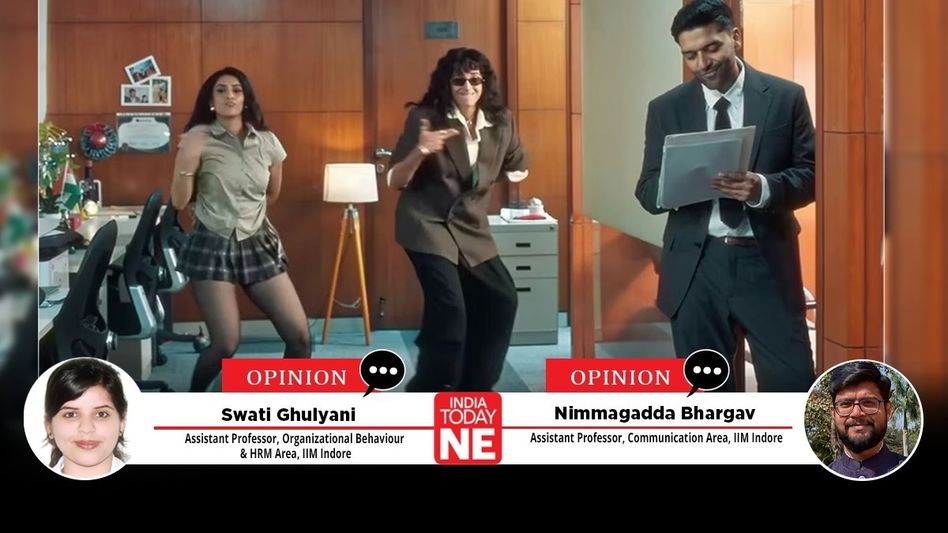
Here is the idea Fine Shyt rehearses. A woman can be physically inside a workplace yet remain visually outside the category of employee. The video does not merely sexualise women in an office. It removes work from the women it wants us to look at.
The props tell part of the story. Randhawa’s corporate character in the music video is rarely without an instrument of work like a landline, a mobile, a briefcase, and a pen. The women dancing around him hold none of these. No files, laptops, badges, or any signs that they might have arrived at the office to work. He acquires props; they acquire choreography.Similarly, when the video shifts to a football field, the man holds the ball while the women are given ways of being seen.
One of those women is from Silchar, Assam. Her presence is especially worth noticing in a region where politics of visibility and aesthetics in mainstream Indian pop culture have long mattered. But visibility alone should not be confused with inclusion. Putting a woman from a relatively underrepresented region in the frame is not, by itself, an inclusionary act if the role she occupies reproduces the same narrow terms on which the other women are made visible: as bodies to be watched rather than professionals allowed to work.
The women are hardly passive. They dance confidently, command attention, and appear at ease with their sexuality. In the idiom of a generation accustomed to expressing itself through reels and self-display, it is easy to read this as agency, perhaps even empowerment.But self-expression and representation are not the same thing. The issue is not that the women in Fine Shyt dance. It is that, inside an office, dancing is almost all they are permitted to do.
The contrast becomes even more uncomfortable when we consider who is recognised as anemployee. The office still needs people at desks, carrying folders, staffing reception, and moving in the background. Almost all of those roles are performed by Black women and men. They wear corporate suits and lanyards, sit at monitors, and carry the visual weight of making the set look like a functioning office.While the Black extras help produce the workplace, Indian women occupy the spectacular foreground. One group is choreographed for visibility and the other for labour. The point is not to infer what the makers intended by their casting, but to notice what the finished image asks of different bodies.
The lyrics reinforce the same logic more crudely. Women’s bodies and appearance are compared with luxury cars; even body parts become automotive features. Confidence and commodification coexist in the same representation. The women may own their movements, but the song still values their bodies through beauty, rarity, expense, and resemblance to luxury cars.
The office setting gives that familiar pop-song objectification a different significance. This is not a woman being admired at a party, on a street, or in a club. She has been placed inside a professional space, but almost everything that would make her legible as a professional has been removed.
Instead, she becomes a distraction within someone else’s working day. And, notably, the distraction fails. Randhawa’s character continues with his calls and work while women perform around him. This is not quite an office romance or even a story of mutual attraction. The spectacle simply runs in the background of a man’s productive day.Women’s clothes, bodies, and appearance have long been treated as potential distractions, shifting responsibility for attention from the person looking to the person being looked at. Fine Shyt packagesthat premise as office entertainment.
The video anticipates the objection. It opens with a disclaimer that what follows is camp and satire, and jokes that viewers should not attempt the routine at work lest HR object. Perhaps the office is deliberately absurd. But satire does not make production choices disappear. Someone still decided who would carry the folder and who would dance behind the desk. Someone chose the lanyard, and someone chose the pleated skirt. Someone decided who would populate the office as an employee and who would occupy it primarily as a spectacle. Even if the joke is entirely on the male protagonist’s corporate character, women still have to become workplace décor for that joke to work
The most revealing thing about this staged office, though, is that it requires no explanation. Nobody watching needs to be told why the man works while women decorate his working day. The arrangement is instantly legible. Psychology has a name for that legibility, the unconscious bias i.e. the automatic associations we carry about who “looks like” anemployee, a manager, a professional. It operates through what feels natural and ordinary. Few viewers will find anything odd about who holds the briefcase and who holds the choreography. That effortlessness is the finding.
Such associations are learned through repeated cultural impressions of who sits at the desk and who dances beside it, until the pairing begins to feel like common sense. This matters for younger viewers who encounter images of workplaces long before they enter one. Popular culture can become a form of anticipatory socialisation, an unsupervised internship in workplace norms. Every reel that hands men the briefcase and women the choreography adds one more repetition to the association, and repetition is how a stereotype becomes a reflex.
It has taken decades for workplace sexual harassment in India to be recognised not simply as a matter of individual misconduct but as a question of workplace conditions. From the Vishaka guidelines to the POSH Act and Internal Committees, the institutional message has gradually become clearer: women do not enter professional spaces as interruptions, temptations, or decorative items. They enter them as employees, as professionals.
Popular culture, however, does not have to deliver the same message. Nor should every music video be treated as a corporate training film or public interest message.
Companies can mandate POSH training. They can constitute Internal Committees and prescribe workplace norms. What they cannot easily regulate is the cultural imagination employees bring through the office door.
The formal Indian workplace has spent decades learning to see women as equals. Fine Shyt is a reminder of how easily popular culture can still fall back on regressive ways of imagining women at work.Empowerment cannot simply mean making women more visible, just as inclusion cannot simply mean putting a Northeast Indian woman in the frame. The more difficult question is what she can become in that representation once shebecomes visible. In this office, she is “allowed” to be looked at. The work, it seems, belongs to someone else.
Nimmagadda Bhargav and Swati Ghulyani are faculty members in Communication and Organizational Behaviour & Human Resource Management Areas, respectively, at the Indian Institute of Management Indore. Views expressed are personal.