
From Hellholes, With Love and Receipts
When a sitting president amplifies the word “hellhole” to describe India, the polite response is silence. The honest response is arithmetic

- Apr 24, 2026,
- Updated Apr 24, 2026, 11:47 AM IST

A political commentator called India a "hellhole." The President of the United States thought it worth sharing with the world.
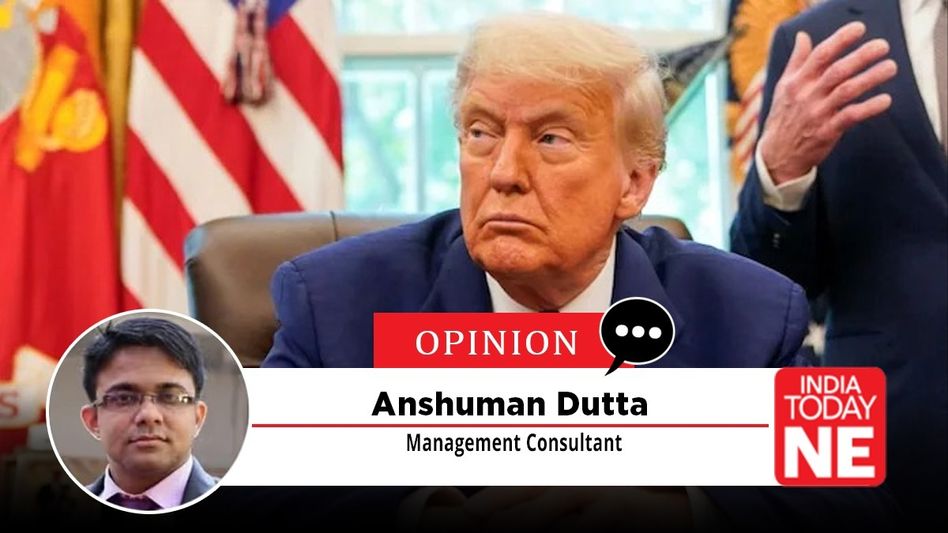
There is a particular kind of arrogance that doesn’t know it’s being watched. On April 23, President Donald Trump reposted a transcript on Truth Social in which political commentator Michael Savage referred to India and China as “hellhole” countries in the context of birthright citizenship. The President of the United States, the leader of a nation that has built its identity on the promise of meritocracy and open doors, found that sentiment worth amplifying to millions.
So let's take a moment, respectfully, to look at what this particular hellhole has contributed to the country that just insulted it.
Let us not answer with outrage. Outrage is easy, and it changes nothing. Let us answer instead with something far more uncomfortable for the accusers: facts.
Satya Nadella leads Microsoft, as CEO, a company worth over $3 trillion. Sundar Pichai leads Alphabet, the parent of Google, worth over $2 trillion. Arvind Krishna chairs IBM. These are not inherited thrones. They were earned, in boardrooms and product cycles and decades of relentless competence by men who left a so-called hellhole and chose to build in America.
One might ask: if India is a hellhole, what does that say about the country whose most consequential companies are being run by Indians?
Five million (5M) Indian Americans constitute roughly 1.5% of the United States population. They contribute 5 to 6% of all federal income taxes, approximately $250 to $300 billion annually, according to a report by Indiaspora and BCG. In the cold language of fiscal contribution, the Indian-American community is punching at four times its demographic weight.
That's not a rounding error. That's nation-building, done quietly, without fanfare.
They co-founded 72 of America’s 648 unicorn companies. They own approximately 60% of all hotels in the United States, including, in a detail history will enjoy with quiet irony, several that carry the Trump name on their marquee.
Indian companies have invested $80 billion into the United States and employ over 400,000 American citizens. In 2023, Indian professionals accounted for over 72% of all H-1B visas issued, a visa category reserved, by design, for workers whose skills America cannot source at home.
These are not the numbers of a hellhole. These are the numbers of a civilisation that showed up, worked harder than expected, and asked for very little in return.
Here is the detail that transforms this from insult to farce.
The United States, at this precise moment in history, needs India more than it has needed any partner in a generation. As Washington seeks to decouple from China, as it rewires its supply chains and repositions its strategic assets across the Indo-Pacific, India is not a peripheral option, it is the central one. The IMF projects India will account for 18% of total global growth by the end of this decade. Goldman Sachs estimates the Indian economy will be the world’s second-largest by 2075.
India is the counterweight, the manufacturing alternative, the democratic anchor in a region increasingly contested by authoritarianism.
And the administration courting this indispensable ally just called its homeland a hellhole.
One wonders what the diplomats in the South Block are making of this. Probably not much because India has learned, across five thousand years of civilization, not to be rattled by the loud opinions of those who will eventually come asking for something.
This is the hellhole that keeps your hospitals staffed, your software running, your taxes funded, and your hotels full.
What “Hellhole” Actually Means
Words like “hellhole” are not descriptive. They are political. They are deployed to dehumanise, to reduce complex civilisations to one-syllable dismissals that make cruelty feel like common sense.
But consider the definition, if we are honest about it: a hellhole is a place that people flee because it offers nothing, no future, no dignity, no possibility. Is that India? A nation with a 7% GDP growth rate, a space programme, a pharmaceutical industry that supplies 20% of the world’s generic medicines, a democracy of 1.4 billion people, and a cultural legacy that predates the existence of the country now insulting it?
Or is “hellhole” simply what we call places whose success we cannot easily explain places that produce people who outperform, outwork, and outlast expectations in systems that were never designed to include them?
India does not need to answer this. The data answers it. The CEOs answer it. The $300 billion in tax contributions answer it. The 60% of American hotels answer it. The doctors in American hospitals, the engineers in American labs, the professors in American universities, they answer it every single day, without a press release.
What the Indian-American community and India itself deserves is not sympathy. It is accuracy. And accuracy demands that we say plainly: the hellhole has been building your future while you were busy naming it.
We have been called worse. We built more anyway.
We didn't come to take. We came to build, and the receipts are public.
India doesn't need a defence. The data does that just fine.
Written with respect for the American people, and zero apology for where we come from.
MORE NEWS












Copyright©2026 Living Media India Limited. For reprint rights: Syndications Today
