
How Chief Minister Dr. Himanta Biswa Sarma is shaping Assam's future
Today’s Assam is confident, ambitious, and visibly changing, not only in statistics, but in roads, bridges, airports, industries, and households. Under Prime Minister Narendra Modi’s leadership at the Centre and Chief Minister Dr. Himanta Biswa Sarma’s execution in Dispur, the Northeastern state has undergone one of the most significant turnarounds in recent Indian state politics.

- Feb 17, 2026,
- Updated Feb 17, 2026, 8:51 PM IST

When I first began travelling to Assam over two decades ago, the mood was cautious. The state had enormous cultural richness and natural beauty, but development felt uneven. Infrastructure projects moved slowly. Investors were hesitant. Conversations often revolved around instability and missed opportunities.
In 2026, looking at the journey so far, the transformation is unmistakable.
Today’s Assam is confident, ambitious, and visibly changing, not only in statistics, but in roads, bridges, airports, industries, and households. Under Prime Minister Narendra Modi’s leadership at the Centre and Chief Minister Dr. Himanta Biswa Sarma’s execution in Dispur, the Northeastern state has undergone one of the most significant turnarounds in recent Indian state politics.
If earlier we grew up learning “A for Apple, B for Ball, C for Cat,” today the symbolism has changed. It feels like “A for Assam” and “C for Chips”, semiconductor chips from Jagiroad.
Peace First, Development Faster
The foundation of Assam’s transformation has been stability. For decades, insurgency and law-and-order concerns affected investor confidence and slowed economic progress. That atmosphere has changed significantly.
Peace accords with various groups have mainstreamed former conflict zones. The government’s firm approach to law and order, including a sustained war against drugs, has reshaped public perception. Large-scale seizures of narcotics in recent years signal aggressive enforcement and administrative intent.
Crime rates have declined, public confidence has improved, and governance now projects firmness. Stability has created the conditions for economic acceleration.
Fastest Growing Major State
The numbers reflect this change.
Between FY20 and FY25, Assam’s Gross State Domestic Product at constant prices rose by 45 percent, from Rs 2.4 lakh crore to Rs 3.5 lakh crore. The state’s GSDP reached Rs 6.43 lakh crore in 2024–25, growing at 7.94 percent, significantly above the national average.
This makes Assam India’s fastest-growing major state economy in the period under review.
For observers who have tracked the state’s journey, this shift is not accidental. It reflects focused governance, faster project execution, and policy clarity.
Jagiroad and the Semiconductor Moment
Perhaps the strongest symbol of this new confidence is the Rs 27,000 crore Tata semiconductor assembly plant at Jagiroad.
A state once discussed in the context of unrest is now part of India’s semiconductor mission. The project signals industrial seriousness and long-term vision.
When Chief Minister Sarma attended the World Economic Forum in Davos (the first Assam Chief Minister to do so), it was not merely ceremonial. It positioned Assam as an emerging investment and manufacturing destination.
The message was clear: Assam is open to high-technology industry.
Welfare With Scale: Orunodoi Model
Economic growth has been accompanied by welfare expansion.
The Orunodoi scheme, now providing Rs 1,250 per month through Direct Benefit Transfer to nearly 38 lakh women, has strengthened household purchasing power. It injects thousands of crores annually into the grassroots economy.
Combined with more than 1.5 lakh government jobs provided in recent years, this has strengthened both rural and urban confidence.
The state’s budget increasingly reflects a pro-people orientation, balancing welfare with capital expenditure.
Guwahati’s Visible Transformation
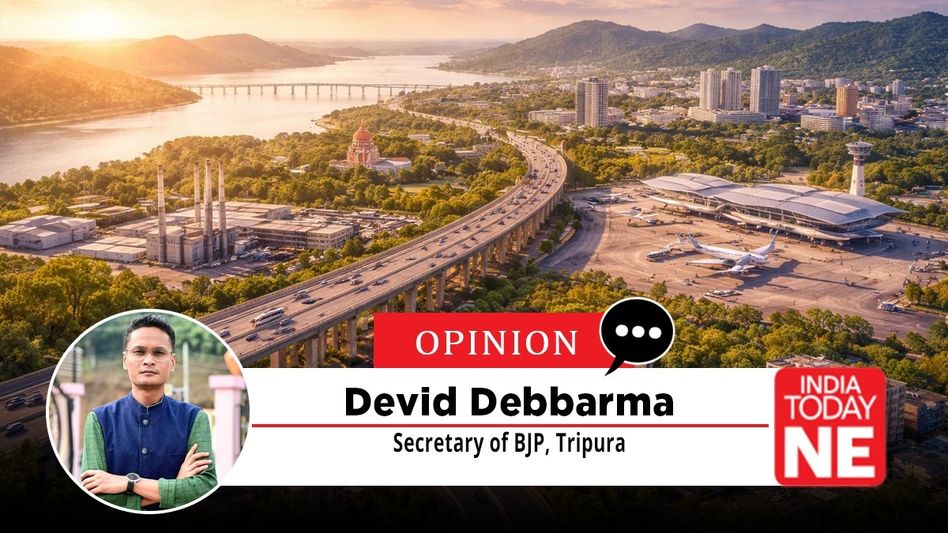
The change is perhaps most visible in Guwahati.
New flyovers have reduced congestion. The Gateway of Guwahati project and the rejuvenated Uzanbazar riverfront park have improved urban aesthetics. Infrastructure upgrades in Khanapara and other major junctions reflect planned urban expansion.
The Integrated Traffic Management System (ITMS) has modernised traffic regulation. Smart policing has enhanced security management.
The expansion of Lokpriya Gopinath Bordoloi International Airport, inaugurated by Prime Minister Modi, signals ambition. Guwahati is positioning itself not merely as a regional city, but as a competitive urban centre in India.
Connectivity Across the Brahmaputra
Infrastructure expansion extends beyond the capital.
The Dhola–Sadiya Bridge (Bhupen Hazarika Setu) remains one of India’s longest river bridges, transforming connectivity across the Brahmaputra. The Kumar Bhaskar Varma Bridge further strengthens regional movement.
Majuli is better connected and more protected. Charaideo’s heritage structures are receiving attention. Sivasagar’s historical complexes are preserved alongside urban upgrades.
In Dibrugarh, the new Chief Minister’s Secretariat signals administrative decentralisation. Kokrajhar, Chirang, and other districts have seen an infrastructure push and improved services.
From Nagaon and Bongaigaon to Hailakandi, Karimganj, and Dima Hasao, road projects, housing schemes, and drinking water connectivity have expanded steadily.
Nearly 59 lakh rural households now have tap water connections under the Jal Jeevan Mission. Rural housing delivery under PMAY has been executed at scale.
Education, Health, and Institutions
AIIMS Guwahati has strengthened access to tertiary healthcare. New medical colleges across districts have reduced the need for out-of-state treatment. IIM and other institutions are strengthening higher education capacity.
Per capita income has risen to over Rs 1.5 lakh, reflecting growing economic strength.
The services sector is expanding, while agriculture and allied sectors continue to contribute significantly.
Cultural Assertion and National Visibility
Development in Assam has also been cultural.
Bihu, Jhumur, and Bagurumba dance performances in the presence of Prime Minister Modi (including large-scale cultural gatherings) have projected Assam’s heritage nationally.
Batadrava Than redevelopment, Majuli’s spiritual circuits, and Sivasagar’s historical restoration reflect a blend of culture and infrastructure.
Assam is presenting itself as both modern and rooted.
Governance Style: Delivery and Speed
Chief Minister Himanta Biswa Sarma’s governance style has been defined by speed and visibility. Regular inspections, quick decisions, and direct monitoring of departments have created a performance-driven administrative environment.
Under Prime Minister Modi’s broader national direction, Assam’s cabinet has aligned state policies with central initiatives, accelerating project execution.
The result is a state that appears decisive and forward-looking.
Competing With Prominent Indian Cities
Assam’s ambition today is not limited to regional positioning.
With a semiconductor plant, a growing services sector, improved highways worth thousands of crores, a data centre at Amingaon, and expanded airport infrastructure, the state is aiming to compete with prominent Indian cities.
The idea is not to defeat others, but to compete confidently.
Atal, Avichal, Agragami Assam
After travelling repeatedly over the last 10–15 years, the contrast is clear.
The Assam of the past was hopeful.
The Assam of today is assertive.
It is firm (Atal) in its direction.
Steady (Avichal) in governance.
Forward-moving (Agragami) in ambition.
Under Prime Minister Narendra Modi and Chief Minister Dr. Himanta Biswa Sarma, Assam has moved from the margins of uncertainty to the centre of opportunity.
The story is no longer about potential.
It is about performance.
And for anyone who has watched this journey closely, the transformation is undeniable.
MORE NEWS












Copyright©2026 Living Media India Limited. For reprint rights: Syndications Today
