In the name of religion, cow politics and Muslim question
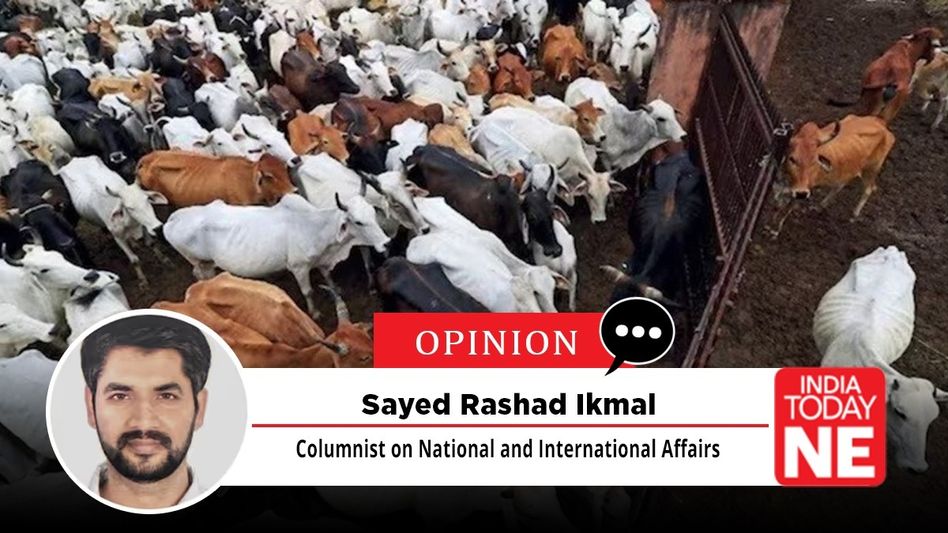
The debate on the issue of cow slaughter has once again taken centre stage in Indian politics with the approaching festival of Eid-ul-Zuha, a festival observed by Muslims in which the sacrifice of animals takes place.

- May 26, 2026,
- Updated May 26, 2026, 5:11 PM IST

The debate on the issue of cow slaughter has once again taken centre stage in Indian politics with the approaching festival of Eid-ul-Zuha, a festival observed by Muslims in which the sacrifice of animals takes place.
What was once projected primarily as an issue of religious sentiment and cattle preservation has increasingly evolved into a political instrument through which Muslims are culturally marginalised, socially surveilled, and politically othered in the name of protecting Hindu identity.
A significant section of Indian Muslims has consistently expressed willingness to respect laws prohibiting cow slaughter, bringing an end to a custom that has witnessed the intimidation, harassment, and lynching of Muslims. The debate, therefore, is no longer confined merely to faith or dietary practices; it has become deeply intertwined with questions of citizenship, nationalism, and cultural conformity.
Cow protection laws in India emerged from a complex intersection of religion, agrarian economics, and constitutional politics. During the framing of the Constitution, several members of the Constituent Assembly demanded a complete ban on cow slaughter, arguing that the cow occupied a sacred place in Hindu society and remained central to India’s rural economy through agriculture, milk production, and manure. Others, including Ambedkar, cautioned against embedding religious sentiment within the constitutional framework of a secular republic.The eventual compromise found place in Article 48 of the Directive Principles of State Policy, which urges the state to prohibit the slaughter of cows and other milch and draught cattle. Importantly, cow protection was not included as a Fundamental Right, thereby leaving the matter to legislative discretion rather than religious absolutism.
When the Constitution came into force in 1950, the responsibility for enacting such laws was left to individual states because animal husbandry falls under the State List. Consequently, India never adopted a uniform national law on cow slaughter. States such as Uttar Pradesh and Gujarat introduced stringent prohibitions, while Kerala and several northeastern states permitted regulated slaughter. Over the decades, however, the issue gradually moved beyond cattle preservation and became deeply tied to identity politics and majoritarian mobilisation. Court judgments that initially justified cow protection largely on economic grounds later expanded the argument to include cultural morality and animal welfare. In contemporary India, cow protection laws remain among the most politically charged legal questions, positioned at the intersection of religion, secularism, minority rights, and vigilantism.
For critics, the transformation of the cow from an economic asset into a political symbol reflects how religious sentiment is increasingly being used to shape public morality and define the boundaries of acceptable citizenship.Political theorist Kancha Ilaiah, in his book Buffalo Nationalism: A Critique of Spiritual Fascism, argues that “cow nationalism” reflects a caste-centred social order in which upper-caste Hindu symbolism is elevated as the marker of nationalism and cultural purity. By contrasting the sacred cow with the buffalo, an animal associated with labouring and agrarian communities, Ilaiah critiques how religion and nationalism can reinforce caste hierarchy and social exclusion. His argument also connects cow politics to the policing of food practices and cultural legitimacy among Muslims, Dalits, and Bahujan communities.
Also Read: Politics on posters: The contested space of religion in India
India today does not have a uniform national law banning cow slaughter. While many states impose complete bans or severe restrictions, others continue to permit regulated slaughter under specific conditions. This uneven legal landscape demonstrates that cow protection in India is shaped not only by religion, but also by regional politics, food culture, and economic realities.The larger question, however, remains unresolved: if cow slaughter is projected as essential to preserving Hindu identity and national culture, why does the issue remain selectively enforced across states? If states such as Uttar Pradesh and Gujarat justify stringent restrictions in the name of protecting Hindu sentiments, why do several northeastern states and Kerala continue to permit regulated slaughter without provoking similar political outrage? The inconsistency reveals that cow politics often functions less as a uniform ethical principle and more as a politically mobilised cultural issue.Even prominent Muslim cleric Arshad Madani has publicly urged the Union government to declare the cow as India’s national animal and enact a uniform law through Parliament if the matter is genuinely about national sentiment rather than selective political mobilisation.
What is even more troubling is the manner in which cow protection has increasingly legitimised vigilante violence and parallel moral policing. Over the past decade, several Muslims and Dalits have been lynched, assaulted, harassed, or publicly humiliated merely on suspicion of transporting cattle or consuming beef. Cow vigilante groups operating under the banner of “Gau Raksha” have frequently assumed quasi-policing roles, often functioning with social and political impunity.The politics surrounding cow protection has also travelled beyond traditionally sensitive Hindi-speaking states and is now making inroads into regions such as Odisha and West Bengal, where regulated cattle slaughter historically existed without becoming a major site of communal confrontation. Significantly, this shift has become more visible alongside the growing political expansion of the Bharatiya Janata Party in these regions.States that were earlier governed by regional parties such as the Biju Janata Dal in Odisha and the All India Trinamool Congress in West Bengal largely witnessed a comparatively accommodative approach toward traditional Eid-ul-Zuha practices within the framework of existing state laws. However, the political discourse around cow protection has intensified in recent years, transforming what was once a regulated legal matter into an emotionally charged cultural issue.
Reports from several districts indicate that local police officials and administrative authorities have held meetings with Muslim community leaders ahead of Eid, warning against cow slaughter and cautioning about arrests in the event of violations. While the state may justify such measures as preventive administration aimed at maintaining public order, critics argue that these actions often create an atmosphere of selective surveillance directed disproportionately at one community.Simultaneously, vigilante organisations associated with cow protection have expanded their visibility through rural patrols, highway monitoring, and public mobilisation campaigns. The cumulative effect is the creation of a climate in which religious observance increasingly comes under social suspicion and political scrutiny.
This reflects what may be described as the “gerrymandering of culture”, a process through which cultural practices are selectively redrawn into markers of nationalism and loyalty. Beef consumption is framed not merely as a dietary choice but as a test of patriotism. Eid sacrifices become politicised spectacles. Muslims are increasingly portrayed as outsiders to the cultural nation. The issue is no longer about cattle preservation alone; it is about determining who belongs within the imagined boundaries of the Hindu nation.
The contradiction becomes sharper when viewed alongside India’s economic realities. India has consistently remained among the world’s largest exporters of bovine meat, while millions of people, including Dalits, OBCs, Muslims, pastoral communities, and leather workers remain economically dependent on the cattle trade.
Yet the burden of cow protection laws and vigilante violence falls disproportionately upon these vulnerable communities.This selective morality exposes the deeper political character of cow politics. The issue is no longer merely about protecting an animal held sacred by many Hindus; it has increasingly become a mechanism through which cultural conformity is demanded and political loyalty assessed.
The tension, therefore, is ultimately between constitutional India and cultural nationalism. A secular democracy cannot endure if constitutional guarantees are subordinated to the cultural practices of the majority. When faith-based sentiment begins to override individual freedoms and equal citizenship, democracy gradually slips into the terrain of majoritarian moral policing.
(The views expressed in this article are those of the author and do not necessarily reflect the views of India Today NE or its affiliates.)