
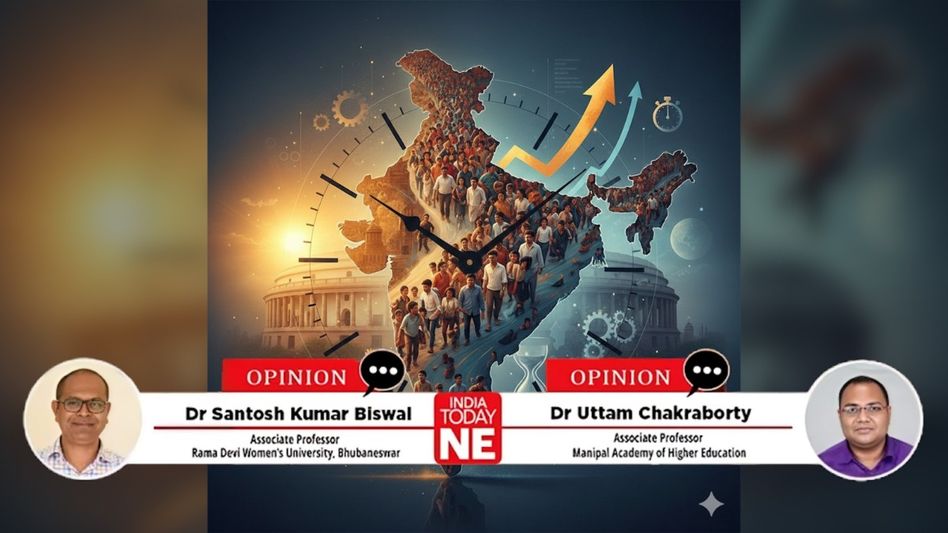
India’s demographic dividend is on a clock: What can budget do with it
India's demographic dividend is a time-sensitive opportunity for growth. The budget must prioritise education, healthcare, and jobs to capitalise on this advantage.

- Jan 29, 2026,
- Updated Jan 29, 2026, 11:28 AM IST

India prefers to refer to the young people in this country as a demographic dividend. The country is set to drive growth in the world with the median age being below 30 and millions joining the labour pool annually, making it unique to drive global growth. However, dividends do not come automatically. They are to be earned. At the current rate of job creation relative to the growth in the labour force, the so much trumpeted demographic advantage that India enjoys may soon turn into a demographic disadvantage judged by the underemployment, informality, and social strains. There are three areas that require urgent and concerted effort as the next Union Budget is drawn, namely manufacturing and MSMEs, the gig and platform economy, and a profound reform of skills and education.
Manufacturing and MSMEs
Manufacturing has long been expected to absorb India’s surplus labour, especially from agriculture. Large factories are capital-intensive; micro and small firms dominate the landscape but struggle to scale. The result is that there are too many tiny enterprises and too few job-rich, mid-sized firms. Here, the budget may focus less on headline incentives and more on the plumbing that helps MSMEs grow. Access to affordable credit remains uneven despite years of schemes. Delayed payments by large buyers choke cash flows. Compliance costs can add up to a heavy burden for firms with thin margins. Cluster-based support, common facilities, and simpler, predictable regulation can make a tangible difference.
Equally important is linking the MSMEs to global value chains. Trade logistics, quality certification, and export financing are not glamorous, but they are decisive. If India wants labour-intensive manufacturing covering textiles, food processing, and electronics assembly to create jobs at scale, the budget can reward employment generation, not just capital expenditure. Incentives that nudge firms to hire, train, and formalise workers could tilt the balance.
The Gig and Platform Economy
To millions of young Indians, the gig and platform economy has become the work default point of entry. Ride-hailing, food delivery, and logistics, content creation, and freelance digital services have flexibility and can be onboarded in a short time. The industry takes up labour and indicates the digital capabilities of India. However, there are issues in the sector. Majority of gig workers do not have social protection such as health insurance, pensions, paid leaves, and redressal measures. Volatility of incomes is high, management is under the covers of algorithms, and classification wars continue. In this juncture, the upcoming budget can establish a ground of safeguards. Flexibility and dignity can be balanced by means of portable benefits, contributory social security, platform co-funding, and clear data-sharing norms. Digital public infrastructure, identity, payments, and credentials can be publicly invested in to ensure that the benefits are portable across both platforms and jobs.
As a result, the Indian gig economy will be able to ascend up the value chain, i.e., not to local delivery, but to international online services. It will demand specific assistance in digital competencies, language education, and international market connections. An economy with a gig that simply moves around low-skilled jobs will not be a payoff; an economy in which it can allow one to advance can.
Skills and Education Reform
There has been continuous lamenting by employers about shortages at the time of graduates failing to secure employment. In the meantime, the pace of technological transformation is transforming job requirements at a quicker rate than the rate at which the curricula are being adjusted. In this context, the budget needs to go deeper than minor modifications. Firstly, it needs to enhance the relationship between schools and employers’ education institutions and place-based apprenticeships, co-designed courses and result-based funding. Secondly, skilling must be stackable, modular and lifelong.
Equity matters as well. Women still have a very low rate of participation of labour not by choice but as a result of safety concerns, lack of care and inappropriate work arrangements. Without skills and education policies that are sensitive to these barriers half of the demographic dividend will remain untapped. Childcare, transport and flexible education options are not social follies, but economic imperatives.
New Budget and New Hopes
The demographic window is not permanent all the time. The cost related to lost growth and social unrest was very high for countries that could not provide enough productive employment opportunities to their youth. There is yet time, but little time in India. The budget to come cannot in itself resolve the jobs issue. However, it is able to establish priorities and signals. Emphasis on job-intensive manufacturing and MSMEs, a progressive and proactive approach to the gig economy, and genuine investment in skills and education would be an indicator that India knows the game.
(Chakraborty is an Associate Professor in TAPMI Bengaluru Campus, Manipal Academy of Higher Education. Biswal is an Associate Professor, Department of Journalism and Mass Communication, Rama Devi Women’s University, Bhubaneswar.)
MORE NEWS












Copyright©2026 Living Media India Limited. For reprint rights: Syndications Today
