Killing Spree Continues in Manipur: The Constitution or the Gun—Who Really Governs?
There is no question that Manipur is an integral part of India and a state governed by the Indian Constitution. Yet one question increasingly demands an answer: why is constitutional law and order so conspicuously absent in Manipur?

- Oct 10, 2026,
- Updated Oct 10, 2026, 11:57 AM IST

There is no question that Manipur is an integral part of India and a state governed by the Indian Constitution. Yet one question increasingly demands an answer: why is constitutional law and order so conspicuously absent in Manipur?
Manipur, a northeastern Indian state bordering Myanmar along a porous international border stretching approximately 398 kilometres, covers an area of 22,327 square kilometres and has a population of approximately three million (thirty lakhs). It formally merged into the Indian Union on 15 October 1949, following the signing of the Manipur Merger Agreement by Maharaja Bodhachandra Singh, the then King of Manipur, on 21 September 1949. Until then, Manipur had been a princely state under British paramountcy in British India.
Corruption, nepotism, armed militancy, relentless violence and lawlessness have become deeply intertwined in Manipur. The problem is particularly evident in the hill areas, including areas where Kuki militant groups operate under the Suspension of Operations (SoO) arrangement with the Government of India and the State government of Manipur, formalised in 2008. This arrangement represents a peculiar form of militancy management, in which armed groups are brought under a formal framework while serious concerns persist over compliance, enforcement and accountability.
Illegal taxation, extortion, highway blockades, diversion of development and welfare funds, electoral interference, booth rigging, killings, violence and other unlawful activities attributed to Kuki SoO groups continue to raise serious concerns about law and order and the authority of the state—all while these groups receive regular government funding in the form of stipends and logistical support.
Kuki armed groups operate predominantly in Thadou-inhabited areas, where they wield influence resembling that of parallel authorities within a mafia-like system, exercising coercive power over civilian and political life with virtually no visible accountability or meaningful consequences. Such impunity raises serious questions about the nexus between armed groups and elements of the establishment that enables this system to persist.
Their influence extends beyond armed activity through civil-society organisations accused of operating under militant influence. Whenever a political agenda demands mass mobilisation, civilians are pressured to participate in protests, demonstrations, village guard duty and highway blockades. Those who refuse or are unable to attend risk intimidation, punishment or financial fines. Ordinary people living in areas under the influence of Kuki militants have become increasingly fed up with the situation but remain helpless, as these armed groups continue to operate with the support of government authorities and institutions, as well as powerful politicians and security agencies.
The Kangpokpi-based Committee on Tribal Unity (CoTU), widely regarded as a proxy for the Kuki National Front (KNF) and the Kuki Revolutionary Army (KRA), has repeatedly issued public mobilisation notices and diktats compelling civilian participation. The KNF and KRA are among the groups associated with the Unified Command of Kuki militant organisations, comprising both SoO and non-SoO groups, which is headed by KNF Home Secretary Jangboi Kipgen. Despite these repeated mobilisation directives, government intervention appears conspicuously absent, raising serious questions about civilian freedom, accountability and the authorities’ willingness to prevent armed influence from extending into civilian political life.
Such coercion strikes at the fundamental rights and civil liberties guaranteed by the Indian Constitution. When civilians are pressured to serve political agendas under threat of punishment, civil-society activism becomes a tool of coercion, raising a fundamental question: can participation truly be called voluntary when refusal carries a penalty?
This leaves little room for the civil liberties and fundamental human rights guaranteed by the Indian Constitution. The pattern is particularly evident wherever Kuki militant groups, regardless of their size, are present. Unlike underground insurgent groups that confront government security forces, Kuki SoO armed groups do not. However, serious concerns persist over their conduct, particularly their violence and coercion against unarmed civilians.
Manipur has more than 50 armed militant or insurgent groups, about 40 of them Kuki-branded, including roughly 22 Kuki SoO groups and other non-SoO organisations, excluding the Zomi and Hmar militant groups. These groups have historically pursued different objectives—from separation from India to separation from Manipur or greater autonomy within it—and most have been organised along ethnic lines.
Yet the nature of militancy in Manipur has not been uniform. Meitei and Naga insurgent groups fighting for sovereignty largely operate underground, with many proscribed by the Indian government, while others operate under formal ceasefire agreements. By contrast, Kuki armed militant groups operating under the SoO framework with government support, far from resembling an insurgent revolutionary movement, operate openly in civilian areas; their leaders live in mansions, lead lavish lifestyles, and increasingly function as armed political and electoral vote-bank groups. They are also linked to proxy organisations outside the SoO framework, including Kuki National Army-Burma (KNA-B), KNF (Nehlun), UKNA, and several others with ‘Kuki’ attached to their names.
This distinction matters because Manipur was not always in its present condition.
When Manipur Had Relative Peace
For several years before 3 May 2023, Manipur experienced a relative decline in insurgent activity and a degree of normality not seen for decades. During roughly six years of BJP rule under Chief Minister N. Biren Singh, who took office on 15 March 2017, strikes and bandhs became less frequent, extortion and violence declined, and armed militancy came under greater pressure. People enjoyed greater freedom of movement and a semblance of stability.
It was not perfect, but it felt as though Manipur was governed by law rather than by the gun.
Biren Singh’s government took difficult decisions and pursued policies concerning land and forests, the war on drugs, illegal poppy cultivation, environmental protection, development, indigenous identity and public safety. Two significant initiatives were the introduction of the Inner Line Permit (ILP) system and the recommendation to remove the ambiguous “Any Kuki Tribes” (AKT) entry from Manipur’s Scheduled Tribes list. The AKT was created and listed in 2003 for political reasons.
The Manipur Inner Line Permit Guidelines, 2019, regulated the entry and stay of people not recognised as indigenous persons or permanent residents. Manipur Gazette No. 309, dated 23 September 2022, subsequently defined indigenous persons of Manipur under the amended framework, including the Meitei/Meetei, Meitei Pangal, Scheduled Tribes, Scheduled Castes, and their descendants.
Some viewed the legal mechanism as discriminatory against other Indian citizens. For many in Manipur, however, it served as a protective measure—or, as some might call it, “protective discrimination”—intended to safeguard indigenous communities, their land and resources, and their cultural identity from uncontrolled demographic change.
A comparable principle applies in parts of Indigenous Australia. In the Anangu Pitjantjatjara Yankunytjatjara (APY) Lands in South Australia, where I previously worked for the South Australian Government, approved permits are required for non-local, non-Indigenous visitors, including government employees. Such arrangements recognise the special cultural and land rights of Indigenous communities.
In February 2023, Biren Singh's government also formally recommended removing the AKT entry from Manipur's Scheduled Tribes list, following Cabinet decisions in October 2018 and January 2023. Its position was that recognised tribes were already separately listed and that removing the ambiguous category would not deprive them of their existing constitutional status.
The recommendation reflected concerns about indigenous identity, cross-border migration, demographic change, land and resources, and border security. Together, the ILP regime and the government’s move to remove the AKT category formed part of Biren Singh’s broader approach to safeguarding the people of Manipur, protecting their indigenous identities and preserving Manipur’s indigenous character within India’s constitutional framework.
His government also helped bring a faction of the United National Liberation Front (UNLF), one of Manipur's major banned insurgent organisations, into a tripartite peace agreement with the Government of India and the state government on 29 November 2023. Meanwhile, it sought to enforce the ground rules governing Kuki armed militant groups under the SoO arrangement.
The former chief minister, N. Biren Singh, was widely regarded as a reformist, a man of action, and a decisive, pragmatic leader willing to make politically difficult decisions and implement them. No other political leader in Manipur had articulated and pursued such a clear stance on protecting the state’s interests, its people, indigenous identities, land and territorial integrity as N. Biren Singh.
His policies inevitably met resistance from those who disliked peace and Biren Singh’s leadership, particularly Kuki political leaders and militant organisations that had grown accustomed to political influence and substantial concessions under what is described as a culture of Kuki appeasement.
From Relative Peace to Endless Violence
Then came 3 May 2023. The violence that erupted in the Kangvai area of Churachandpur district spread across Manipur, destroying much of the relative normality that had preceded it. My own family home in Imphal was completely burnt down on 4 May 2023, forcing my family to flee for safety. This was not an abstract political crisis for me; it was a personal experience of the destruction and displacement inflicted on ordinary people.
Many people in Manipur believe the violence was not merely spontaneous and that powerful political interests may have benefited from the collapse of peace. Biren Singh became a major political target, and thousands of innocent civilians saw their lives devastated. Some elected representatives simultaneously demanded his removal as Chief Minister and a separate administration carved out of Manipur. The convergence of these demands raises serious questions about whether the turmoil was pre-planned, deliberately exploited, or used to advance vested interests at the expense of peace, stability, and innocent lives. In a democracy, an elected government must be challenged or replaced through constitutional means—not through violence.
Paolienlal Haokip, the Saikot MLA, a prominent advocate of the AKT category and a politician strongly associated with the Kuki National Organization (KNO), has built his political profile by harping on Kuki radical, separatist and supremacist narratives. He has been a vocal proponent of a separate political and administrative arrangement for Kukis and has played a leading role in the movement. In a July 2023 interview with the Press Trust of India, reported by The Indian Express, he advocated reorganising Manipur into three Union territories. In a subsequent interview with The Wire in February 2025, he reiterated his demand for a separate political and administrative unit, arguing that even the appointment of a Kuki Chief Minister would not resolve the issue.
Alongside other hardline, ultra-radical Kuki political figures and militant organisations, so-called civil-society bodies such as the Kuki Inpi and Kuki Students’ Organisation (KSO), and church groups and leaders serving as centres of Kuki indoctrination and radicalisation, he has helped keep the Kuki supremacist agenda and the demand for a separate administration at the centre of Manipur’s political debate.
His political statements and social-media rhetoric have drawn criticism for promoting Kuki supremacist and inflammatory narratives. While some supporters regard him as a Kuki hero who will fulfil their dreams and deliver the “promised land”, others argue that his political agenda incites violence, fuels Kuki radicalisation, promotes extremist ethnic exclusivity, deepens ethnic divisions and threatens the state’s territorial integrity.
Interestingly, after the 2022 election, Paolienlal, a first-time MLA, bid for the post of Deputy Chief Minister under N. Biren Singh but failed to secure a ministerial berth or political appointment, let alone a deputy chief minister—a major setback to his political ambitions. He publicly acknowledged bidding for the position, saying he advocated a model with one Chief Minister and two Deputy Chief Ministers representing the Meitei, Kuki, and Naga communities. Such a model would institutionalise the allocation of executive power along ethnic lines, potentially enabling him to claim the Kuki share of power.
Instead, under the new Chief Minister, Y. Khemchand Singh, who took office on 4 February 2026 with the support of Paolienlal and other Kuki MLAs and is widely viewed as an appeaser of Kuki militant groups, one of the Deputy Chief Minister’s posts went to Nemcha Kipgen, the Kangpokpi MLA, whose husband heads the Kuki National Front (KNF), a group operating under the Suspension of Operations (SoO) arrangement.
It was said that Nemcha Kipgen was given the Deputy Chief Minister’s post to strike a deal with armed Kuki SoO militant groups—specifically, the KNF—to reopen the Imphal–Kangpokpi stretch of the national highway. If so, this raises a fundamental question: are national highways in Manipur controlled by militant groups rather than by the sovereign Government of India and the Manipur state government?
The situation becomes even more absurd when a disproportionately large number of government security personnel are deployed along this very stretch, while Kuki SoO militant groups reportedly collect illegal taxes from vehicles as much as ₹10,000 per truck per trip. This type of illegal taxation happens in other stretches of national and state highways throughout Manipur, where militant groups operate. If the government needs to negotiate with militant groups to keep a national highway open while such collections continue, what does that say about the authority of the state and the effectiveness of its security deployment?
Accommodating Kuki political demands while concerns over SoO-linked militancy and related violence remain unresolved presents a significant contradiction. Rather than addressing the underlying problems of armed-group influence and political coercion, such political arrangements risk reinforcing ethnic divisions and creating further fault lines.
More dangerously, they risk sending the message that guns, ethnic violence and armed militancy are effective means of securing political power and getting political demands met. Such a precedent could intensify competition among rival groups and individuals to establish or expand their armed influence in pursuit of political leverage, further undermining democratic principles, constitutional authority and the rule of law.
This model of ethnic power-sharing risks turning political accommodation into a mechanism for capturing and consolidating power, potentially fuelling conflict both between and within communities or groups. It also runs counter to Manipur's pluralistic character as a multi-ethnic society and state, home to more than 30 communities, including the indigenous Thadou and others whose political representation and interests cannot be reduced to a narrow, divisive and exclusive three-way ethnic division.
Whatever the motivations behind these political developments, their consequences have been devastating. Manipur’s experience since May 2023 shows the grave danger of letting armed militancy, ethnic bargaining, and political ambition overshadow constitutional governance. When violence appears to deliver political gains, it threatens not only the state’s fragile peace but also the principle that political power must derive from democratic processes and the Constitution—not the gun.
The Killing Spree Continues
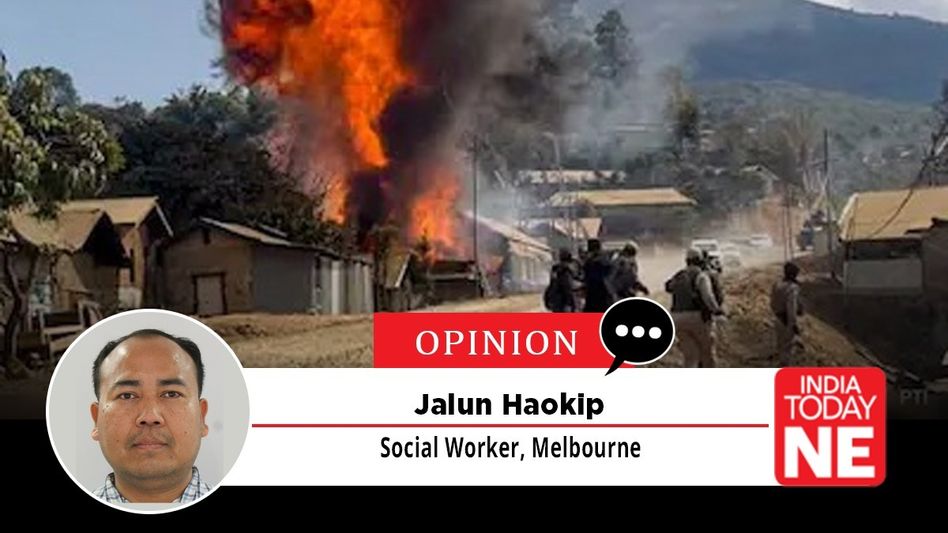
And the violence did not end with the Kuki-Meitei conflict. The subsequent Kuki-Naga conflict, which escalated after the 13 May 2026 killings of three Thadou church pastors and six Naga civilians in Kangpokpi district, triggered another cycle of killings, village destruction and displacement. More than 50 innocent people have reportedly been killed in recent months, while houses and villages have been burned and civilians displaced.
The latest reported victim was 71-year-old Hemjang Haokip, who was found dead in a jungle in Kangpokpi district on 4 October 2026 after reportedly being abducted and his house set on fire the previous day. Kuki groups blamed Naga militants, including NSCN (IM), for the killing. The incident followed the killing of four Naga civilians near the Myanmar border on 24 September, which the Naga side blamed on the Kuki National Army-Burma (KNA-B), describing it as a cross-border terrorist attack.
The pattern is familiar: one side blames the other, retaliation follows, and unarmed civilians pay the price, while perpetrators appear to escape accountability despite the deployment of tens of thousands of security personnel, including the Indian Army. The situation has become almost farcical when security forces attempt to arrest militants suspected of serious crimes, including murder, only to be confronted by human shields, often comprising women, forcing the operation to be abandoned without an arrest.
Such repeated episodes raise troubling questions about whether these operations genuinely aim to apprehend suspects or are merely predictable, seemingly rehearsed exercises that end without results. More disturbing still is the question of what happens afterward: who is held accountable, and why do those responsible so often appear to evade justice?
Where Is the Accountability?
The killing of three Thadou Baptist Association India leaders on 13 May 2026—Rev. Vumthang Sitlhou, Rev. Kaigoulun Lhouvum and Pastor Paogoulen Sitlhou—illustrates the troubling lack of clarity surrounding these crimes.
Social media rumours linked the case to the 2 October arrest of 42-year-old NSCN (IM) cadre Chekneichung Chiru, alias Achung Chiru. However, the claim, which appeared to originate from a Kuki-aligned Facebook page, was not supported by the police report on his arrest. Police reported that he was arrested with Rs. 1.5 lakh in cash, but did not connect him to the Thadou pastors' killings. The National Investigation Agency (NIA), which has taken over the investigation, has also made no public statement linking him to the murders.
An unofficial source claimed that Achung Chiru was a civilian collecting tax for or in the name of NSCN (IM). On 3 October, the organisation issued a clarification stating that it had no knowledge of him and no role in the killings. It had also rejected an earlier accusation by Kuki Inpi Manipur, which blamed the organisation for the ambush less than two hours after the attack.
Attention has also fallen on Kuki SoO militant organisations operating in the area. The Kuki Revolutionary Army/Kuki National Organization operates there and maintained a reported “tax collection gate” on a road near the ambush site, close to an Indian Army/Assam Rifles post. The KNF also operates in the wider area, and its Home Secretary, Jangboi Kipgen, heads the Unified Command of Kuki militant groups, a unified command structure for all SoO and non-SoO groups.
These organisations have been publicly accused of involvement in the killings of the three Thadou Christian leaders, yet none has publicly acknowledged involvement or issued a clear denial of responsibility for the killings.
Of course, denial does not prove innocence, and silence does not prove guilt, just as accusation does not prove guilt. But when civilians are brutally murdered, and competing allegations are allowed to circulate without a transparent investigation establishing who was responsible, that silence becomes another reason to demand answers.
The fundamental question remains: who is being held accountable?
A Counter-Insurgency Strategy Cannot Become a War on Civilians
The peace-loving Thadou community, which has not even a single armed organisation of its own, has repeatedly found itself caught in violent conflicts involving Kuki and other armed groups. These include the Kuki-Naga conflict (1993–97), the Kuki-Zomi conflict (1997–98), the Kuki-Meitei conflict that began in 2023, and the current Kuki-Naga violence. Earlier, in 1992–93, Thadou people in Assam were also directly targeted in Kuki aggression against the community, further underscoring the recurring vulnerability of Thadou civilians amid armed ethnic conflicts.
There are strong allegations, and they appear increasingly credible, that Kuki armed groups have been used by powerful political or security interests to sustain communal polarisation in Manipur for narrow political purposes. It is an open secret, widely believed in Manipur, that Kuki militant organisations have been supported or used by elements within India's political and security establishment as a counterweight to Meitei and Naga insurgent movements demanding independence from India.
My concern is not counter-insurgency itself, which the Government of India and its security forces are responsible for conducting directly and lawfully. My concern is when counter-insurgency becomes entangled in a proxy war fought through armed ethnic groups. If Pakistan’s use of proxies against India is rightly condemned, any strategy involving elements of the Indian establishment using armed proxies within India’s own sovereign territory would raise an equally grave, if not graver, concern. If such a strategy has been pursued in Manipur, it risks deepening ethnic divisions, empowering militant organisations and turning communities against one another, while innocent civilians pay the price.
India has faced insurgencies in various parts of the country, including Kashmir, where Pakistan and other foreign powers have supported militant movements. Yet Manipur has repeatedly experienced a particularly destructive combination of insurgency, ethnic mobilisation and communal violence, pitting communities and groups against one another and leaving innocent civilians to bear the brunt. The scale of this recurring ethnic polarisation and intercommunal violence—unparalleled elsewhere in India—raises serious questions about the political and security dynamics shaping Manipur’s prolonged turmoil and cycle of violence.
In what has become a routine exercise, the government condemns the killings, terror attacks and violence, announces ex gratia payments and promises to bring the perpetrators to justice. But where is the action? Where is the accountability? And where is the justice for the victims and their families? What the victims' families deserve is not speculation or competing allegations, but a transparent investigation, credible findings and justice.
Constitution or Gun: Who Must Enforce the Rule of Law?
Manipur's tragedy is ultimately India's responsibility. If government policies have failed, they must change. Armed groups that violate agreements must face consequences, and political or civil-society leaders who obstruct peace or incite unlawful conduct must be held accountable in accordance with the law.
The porous India–Myanmar border must be secured against armed infiltration, drug and arms smuggling, and other illicit activities. Cross-border movement must be regulated through authorised crossings and effective legal controls. Most importantly, if government arrangements allow armed organisations to exercise coercive power over civilians, those arrangements must end immediately.
The people of Manipur do not need political games, armed groups or endless cycles of violence and retaliation. They need peace, development, security and equal protection under the Constitution. Manipur's crisis is India's responsibility to resolve through its constitutional institutions and laws. Its people are entitled to the same protections as citizens anywhere else in the country.
The Constitution cannot exist merely in name or be applied selectively. It must be upheld fully and consistently in every part of the Republic of India.
No armed organisation—whether operating inside or outside the SoO framework, and whether politically useful to those in power or not—can stand above the law. No political objective can justify the killing of civilians, and no counter-insurgency strategy can substitute for constitutional governance.
The government and the institutions entrusted with upholding the Constitution must protect civilians, enforce the Constitution and the rule of law, investigate crimes impartially, and hold perpetrators accountable. The government must act decisively, not selectively or according to political convenience, but in accordance with the law and the Constitution.
The question is simple: Is Manipur governed by the Constitution—or by the gun?
The writer, Jalun Haokip (MSW), is a Melbourne-based native of Manipur with professional experience in social work across mainstream and Indigenous Australian communities. He currently works as a family violence practitioner within the Victorian Government in Melbourne.