Maharaja Bir Bikram: The Architect of Modern Tripura
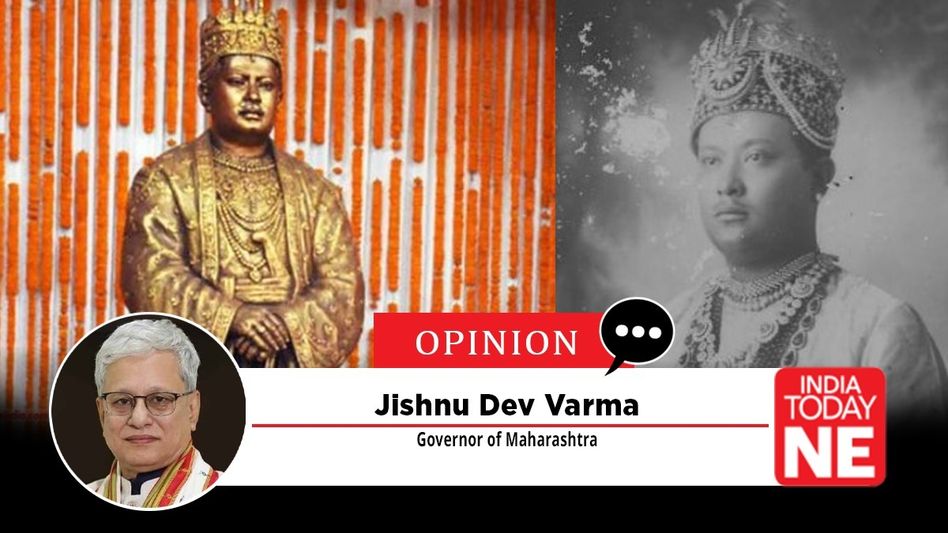
Maharaja Bir Bikram (19 August 1908 – 17 May 1947) has a place in history as an able administrator and the chief architect of modern Tripura. His tours took him to distant lands, and from there he picked up many ideas that he wanted to implement in his state.

- Aug 19, 2026,
- Updated Aug 19, 2026, 1:05 PM IST

Maharaja Bir Bikram (19 August 1908 – 17 May 1947) has a place in history as an able administrator and the chief architect of modern Tripura. His tours took him to distant lands, and from there he picked up many ideas that he wanted to implement in his state.
He was a farsighted king who was able to adapt to the changes that were sweeping across the globe and knew that if his kingdom was to flourish, change was not only necessary but inevitable. India was about to gain its independence from British colonial rule. He recognised the fact that, under these circumstances, if the monarchy was to survive, it had to become constitutional.
In 1941, he gave Tripura its first written constitution. The objective of the constitution was to “inculcate in them (people) civic ideals of self-help, co-operation and devotion to the state.” In the proclamation, he further stated, “That the governing and the governed in this ancient state may now join hands in a new spirit of co-operation.” Bir Bikram wanted modern thought to be the guiding spirit to bring about happiness and prosperity to Tripura. An outstanding feature of this constitution was the reservation of seats in the legislature for minorities, backward communities and labourers.
He was a ruler who was much ahead of his times, for he believed that the hallmark of a civilised society was not to be found in the rule of the jungle based on the survival of the fittest. He sought to establish a rule of law that ensured the welfare of the weakest in society.
Bir Bikram was deeply involved in town planning. He designed the main town square, which was known as Kaman Chowhumani after Connaught Place in New Delhi. The main bazaar, which was known as Maharajgunj Bazaar, was also planned by him. It was his dream to establish an educational institution of excellence in Tripura along the lines of Oxford and Cambridge. He built an institution by the name of Vidyapattan in Agartala, which meant the ‘foundation of knowledge’, but did not live long enough to see his dream become a reality.
Bir Bikram lived for only thirty-nine years; he was born on 19 August 1908. It was on 19 August 1927 that he formally ascended to the throne at the age of twenty in the presence of the Governor of Bengal, Mr Jackson. As the last ruler of the Manikya Dynasty, he ruled for nineteen eventful years.
He knew that his people had an interdependent relationship with their forests and realised that, with the changes that were approaching, there was an urgent need to protect them. In 1939, he reserved 530 square miles of forest for them, and in September 1943, he went on to reserve 1,950 square miles of plain lands for his indigenous hill people in order to encourage them to carry out settled cultivation.
In 1943, there was a severe famine in Bengal, and once again the ruler of Tripura rose to the occasion. Bir Bikram ordered that food grains should be sufficiently stocked in the godowns to meet the challenge. A central food godown was set up at Agartala and smaller ones in the subdivisions. At the time of this famine, food grains were distributed at cost price. Some state officials suggested to the Maharaja that the prices be marginally increased to meet the distribution costs, but he replied, “In my hand I hold the Raj Danda (sceptre) and not the measuring scales.” Numerous famine-stricken people from what was then East Bengal received food grains from these godowns set up in Tripura.
Bir Bikram, the last ruler of the Manikya Dynasty, was brilliant, for he foresaw the transformation that was approaching and brought about many changes and development in his kingdom. He did this in the face of the enormous turbulence that swept across India and Tripura.
Maharaja Bir Bikram was a young king, and the effervescence of youth could be seen in his work to build a modern state as well as in his musical compositions, where his heart spoke.
His musical compositions on Holi — the Springtime Festival — are full of youthful vigour and are sung even today.
I tried to translate into English what Rabindranath said in one of his speeches: “The royal insignia of Tripura bears the Sanskrit inscription — ‘Kila Bidubirata Sarameikam’ — Know that valour is the essence. These words are very true. Parliament is not complete in itself, so is commerce not an end in itself; it is valour that is the ideal. It is valour that transcends countries, time and personalities and manifests itself in many ways. Some are valiant in their scholarship, some in their sacrifice; some are valiant in enjoying life, while others in following the path of truth.”
These profound words of the poet best explain the true spirit of Tripura through the ages.
(The views expressed in this article are those of the author and do not necessarily reflect the views of India Today NE or its affiliates.)