Manipur: All Roads Lead to the Manipur Legislative Assembly
The northeast region of India remains geographically vulnerable and is often described as the underbelly of development, lagging behind even some corners of India’s capital. In Manipur, the Constitution safeguards tribal communities and their land under Article 371C since 1971. However, the Hill Areas Committee (HAC), empowered by Article 371C, is dismissed as ineffective by many tribal communities.
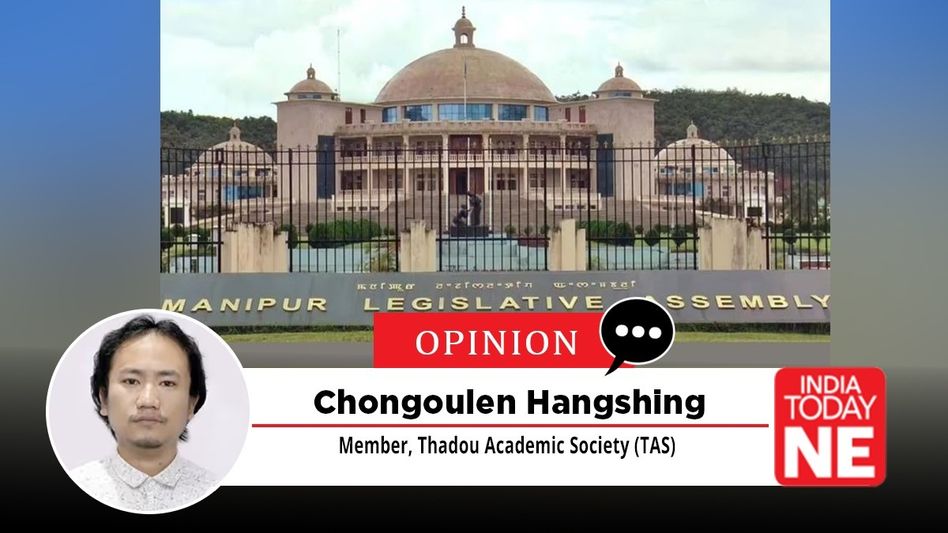

- Mar 07, 2026,
- Updated Mar 07, 2026, 12:06 PM IST

“In Manipur, all roads — peaceful or paved in blood — lead back to the Manipur Legislative Assembly.”
The northeast region of India remains geographically vulnerable and is often described as the underbelly of development, lagging behind even some corners of India’s capital. In Manipur, the Constitution safeguards tribal communities and their land under Article 371C since 1971. However, the Hill Areas Committee (HAC), empowered by Article 371C, is dismissed as ineffective by many tribal communities.
The push for the Autonomous District Council Bill 2021 (ADC Bill), which sought greater autonomy, ignited fresh tensions between the hill tribes and the valley dwellers. Since 2023, Manipur has dominated headlines due to violence, with innocent people bearing the brunt.
Colonial Identification: A Blunder and a Recipe for Unrest
The British colonisers arbitrarily grouped diverse communities together for administrative convenience — a legacy now rejected by many tribes. Such grouping is widely opposed by various tribal communities, as it was done without theconsent or knowledge of the communities they blanked as one, placing distinct tribes under generic labels. This blanket categorisation continues to sow seeds of discord.
The Thadou Inpi Manipur (TIM) has outright rejected the colonial term “Kuki,” calling it a misidentification. It asserts: “The Thadou tribe is a distinct indigenous identity; the term ‘Kuki,’ as used today, is not an ethnic identity.” TIM Secretary Michael Lamjathang echoed this view at a public meeting held at THAU Ground in Imphal, organised by the Coordinating Committee on Manipur Integrity (COCOMI) in January 31. He clarified that Thadou, Paite, Hmar, and Vaiphei are not Kukis.
Even from a colonial perspective, the term “Kuki” could only apply if all Zo ethnic groups united under one banner in Manipur — a scenario that does not exist today. This raises the question: who are the self-proclaimed “Kukis” in Manipur?
Popular Government and the Exploitation of Public Sentiment
The practice of elected representatives being chosen by central party leaders to serve as Leader of the House reflects a visible lack of political maturity among some Manipur politicians.
The unrest that erupted following the formation of the popular government in Manipur was confined to specific constituencies — particularly in areas represented by MLAs who were denied cabinet berths by the Bharatiya Janata Party (BJP) central leadership.
It is misleading to portray these pockets of unrest as statewide opposition to the newly formed government under the Hon’ble Chief Minister Y. Khemchan and Deputy Chief Ministers Nemcha Kipgen and Losii Dikho.
The “Kuki-Zo” protest against three BJP legislators — Deputy Chief Minister Nemcha Kipgen, LM Khaute, and NgulsanglurSanate — appears politically motivated, as all seven BJP legislators are part of the newly formed popular government.
Also Read: What Manipur crisis reveals about power, neglect and prolonged unrest
Whatever the case may be, protests against the formation of the government can only be symbolic and directed toward the seven BJP MLAs. Saitu MLA Mr. HaokholetKipgen is an independent elected representative, while Saikul MLA Mrs. KimneoHangshing and Singhat MLA Chinlunthang Zou belong to the Kuki People’s Alliance (KPA), which withdrew support from the N. Biren Singh-led NDA government in Manipur.
However, all ten Zo tribal MLAs — whether from the BJP or the opposition — remain fully or partially part of the Manipur government and continue to receive its benefits. Singling out and branding only three MLAs as traitors reflects political ignorance and a deliberate attempt to mislead the public. Such false narratives, driven by the pursuit of sympathy or personal gain, risk creating serious confusion and unrest among the masses.
The BJP holds an absolute majority in the Manipur Legislative Assembly, with 37 out of 60 seats.BJP legislators who posture themselves as separate from the government while refusing to resign are being hypocritical. Such posturing exploits public sentiment, particularly among less politically informed voters, and deepens divisions for electoral gain.
The Usurpation of Violence and the Shadow of Manipur’s Elections
Undoubtedly, Manipur was at its zenith before the violence that erupted on May 3, 2023. Arms looted from the Manipur Police Training College (MPTC) at Pangei alone totalled 4,537 weapons, along with approximately 6.32 lakh rounds of ammunition. Overall, the number of looted arms is estimated to be around 6,000 — equivalent to the arsenal of a military brigade.The violence has evolved into a structured system facilitating militant recruitment, coercing and luring educated individuals into taking up arms. The strength of militant groups has reportedly tripled, transforming emotionally driven youths into an organised threat.
The state must adopt a balanced and strategic approach to reintegrate these educated young recruits into society to prevent a deeper security crisis. Without intervention, they could evolve into a significant internal security threat for India. The state must recognise that it is not dealing solely with illiterate foot soldiers, but also with educated individuals capable of outmanoeuvring politicians and bureaucrats alike.
The involvement of armed groups and their cadres in Manipur’s democratic elections is well documented. The 13thManipur Legislative Assembly election, scheduled for 2027, may follow past precedents in which militant organisations issue “recommendations” to national and regional political parties, endorsing proxy candidates for party tickets. They may also attempt to influence voting through intimidation, coercion, and even violence.
Seventy-nine years after India’s independence, many people in Manipur — particularly tribal communities in the hills — still cannot vote without fear. Their fundamental and constitutional rights is still a distant dream.
Indian democratic elections has become one of the main reasons for factionalism among the revolutionary groups in Manipur, blurring lines between insurgents and mercenaries.
In the hills, peace will prevail only when the state addresses injustices and protects the rights of the people. Until then, the powerful shadow of militancy will persist, and the hills will continue to echo with unrest.