Manipur: What’s beneath the violence
The conflict in Manipur is a ladder for opportunists and a reaffirmation of the status quo of the elite class that has been withering away.
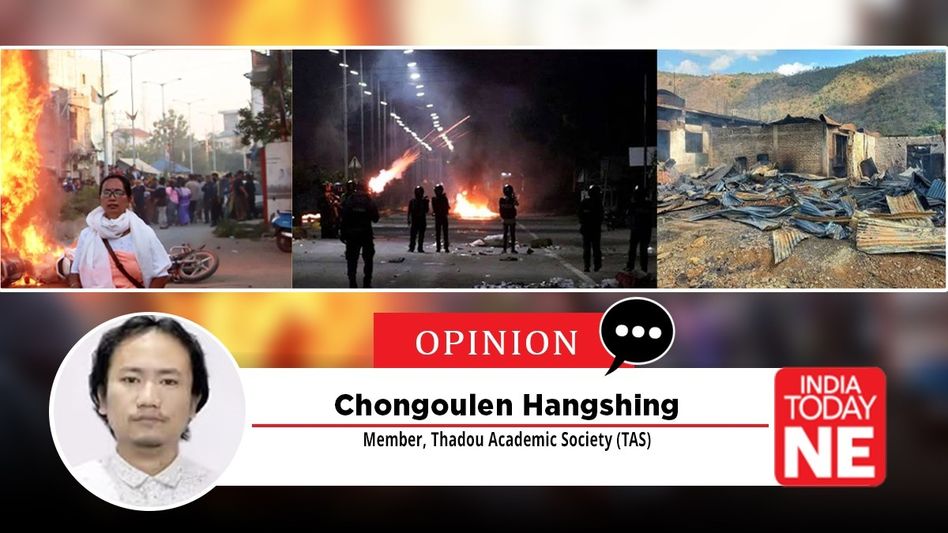

- Oct 24, 2026,
- Updated Oct 24, 2026, 3:04 PM IST

Manipur's violence is not an aberration. It is a structure.
For over three years, the state has been trapped in a cycle of ethnic polarisation, displacement, and institutional collapse. What is projected to the outside world as an ethnic conflict between communities is, on the ground, something far more calculated. The violence is not simply an ethnic conflict; rather, it reflects the failure of the government in power, the struggle for cabinet berths, and efforts to set the stage for the next MLA election. It has been given an ethnic colour to grant impunity to the new class that has emerged from the violence.
The conflict serves the interests of this new class, while the rest of us are manipulated in the name of exclusive community unity. The majority, who do not belong to this class, are left to fend for themselves—and they are the ones who suffer the most.
This violence is sustained by the new class that earns fame, power, influence, authority, and wealth from it. Beneath the visible violence, a system has been firmly established by this class to avoid accountability and to derail peace for as long as possible. Peace, in this system, is not profitable. Polarization is.
The division of Manipur on ethnic lines has created an invisible but invincible wall. Until that wall is broken down, there can be no normalcy, no justice, and no viable path to resettle the more than 60,000 Internally Displaced Persons (IDPs) to their ancestral homes.
Multi-Ethnic or Tri-Ethnic State?
The Constitution of India categorised the people of Manipur into two categories: the plain dwellers and the hill people. The hill people are officially classified by linguistic criteria, and the Constitution of India recognizes 34 Scheduled Tribes in the state of Manipur, besides the Meitei and Meitei-Pangal communities. Yet in public discourse, this diversity has been forcibly reduced to a binary: Naga or Kuki.
These terms are not ancient ethnic truths; they are modern political replicas of two power blocs, much like the Cold War. Recognized Scheduled Tribes are coerced to align with one bloc or be branded as enemies of both.
Take the smaller tribes. For administrative convenience, colonial writers grouped tribes like Anal, Chiru, Chothe, Kom, Purum, etc., as 'Old Kuki'. Today, these tribes most commonly identify as Naga, and some assert their own distinct, recognized identity based on their settlement and history. These tribes have even asserted that they have never been Kuki and never considered or identified as such. Their identity has become a political choice dictated by survival, not heritage.
If the Indian State had exercised its constitutional authority to protect the individual — as guaranteed by the Constitution — these smaller tribes would not have been left to fend for themselves. In the hill districts, the law exists on paper, but political grouping is the formidable reality. The village chiefs, the village authorities, and the Civil Society Organisation (CSO) leaders are mere vessels of the armed groups that often hold more power than the elected MLA and the Deputy Commissioner. This is how the elite class retains its authority — by making the state almost irrelevant.
How Colonial Records Are Misinterpreted and Misused
Much of today's ethnic assertion relies on a selective reading of colonial records. British officers and ethnographers, with little linguistic or cultural understanding, named and grouped different communities under one umbrella for easy identification, taxation, and control. They wanted to be the first to classify, not necessarily to understand.
Today, those same imprecise records have become a bone of contention. They have become an instrument for the elite class to mislead poor, often uneducated tribal villagers with the emotional idea of oneness and a single ethnicity.
The utopian political map and political goal articulated on the basis of a linguistic survey is sold to the youth, who die believing in it. Their families gain nothing. Their leaders, however, gain fame from national media, power over their people, influence in Delhi, authority to give verdicts, and wealth from the conflict economy.
What began as identity politics has now become a lucrative business. Nationalism, when stripped of accountability, becomes a business model where human suffering is the raw material and hatred is the fuel.
Understanding Thadou, Any Kuki Tribe (AKT), and the Kuki Nation
This confusion is best illustrated by the tribes themselves.
The merger of Manipur into the Indian Union subsequently led to the recognition of tribes on the basis of their language.
The Thadou tribe has always been the single largest tribe in Manipur since the 1881 Indian census, with a population of over 2 lakhs as per the 2011 Census.
Even in the midst of the conflict at its peak, a difference of opinion emerged within the Thadou tribe when Thadou Inpi Manipur (TIM) asserted and declared that Thadou is not Kuki, while Kuki militant-controlled Thadou Inpi-GHQ asserts that the Thadou tribe is within the Kuki fold, and the Any Kuki Tribes (AKT) claims to be Kuki alone. 'Any Kuki Tribe' (AKT), on the other hand, was recognized much later, with its final inclusion coming in 2003-2011, with a recorded population of around 28,000 in 2011. This raises a fundamental, uncomfortable question that is rarely asked in public: where was this population of 28,000 concealed before the recognition of AKT?
It must be noted and clearly understood that they speak the same dialect, they have the same surnames, and they have the same customs and culture as Thadou tribe.
The conflict will soon be shaped as a confrontation between the Thadous who declared that Thadou is not Kuki and the other two on the opposite end.
The theory of a unified Kuki nationhood seeks to bring all non-Naga tribes of Manipur under one banner. But this consolidation has never historically happened. The smaller tribes have their own distinct languages, customary laws, and histories. So when the term 'Kuki' is used as a monolithic political identity, we must ask: Who are these Kuki? Is it an ethnicity, a political construct, or a convenient umbrella for negotiation with the state?
For the elite, ambiguity is useful. The larger the population they can claim on paper, the greater their influence in negotiations. Without clarity on this, any political solution built on this term will remain fragile.
The Kangaroo Court: Justice Denied
In the remote areas of Northeast India, a parallel justice system operates — the kangaroo court. It has no legal binding, but its verdict is final.
This is not the case in Nagaland and Mizoram, where Articles 371A and 371G of the Constitution grant special provisions and regional autonomy. There, no Act of Parliament can override:
1. Religious or social practices of the Nagas/Mizos
2. Naga/Mizo customary law and procedure
3. Administration of civil and criminal justice involving decisions according to customary law
4. Ownership and transfer of land and resources
In Manipur, tribal customary practices do not enjoy such constitutional protection. Yet, paradoxically, the kangaroo court takes precedence over the Indian judiciary. Why?
Because the tribal populace is not aware of their legal rights, cannot afford lawyers, and cannot afford to let a case drag on for years in court. A poor farmer cannot leave his field for a court date that gets adjourned 20 times. So he goes to the village chief or the village council or the CSO, which delivers instant — often biased — justice.
This is the core of the trust deficit and the core of elite control. When the majority of disputes are settled outside the court, faith in the rule of law dies. And when faith in the rule of law dies, the elite's authority becomes absolute.
Beneath the Violence: A Parallel Government
The May 3rd, 2023 violence did not just burn houses; it replaced the state.
Today, there is a parallel government operating in both the valley and the hills, replacing most state mechanisms. This parallel government is fuelled and run by the elite through the capitalisation of human rights violations, displacement, and, above all, hatred against the other community.
It makes one wonder, is the Indian state unaware of the existing parallel government in Manipur, or is it allowing it to function, or is the Indian state too weak to eradicate it?
Relief materials are taxed. Movement of goods is controlled. Information is weaponized. Internally Displaced Persons (IDP) camps have become vote banks and fundraising tools. Every checkpoint is an economy. Every press release is a performance for Delhi and for foreign donors. In this economy, peace is a threat, because peace would dismantle the influence of this new class and, alongside them, their fame, power, income, and wealth would die down with it.
The First Steps to Peace
“There can be no peace without a neutral state. And there can be no neutral state without a neutral police force.”
Today, there are invisible community lines drawn within the Manipur Police itself. The police headquarters is located in Imphal, a valley dominated by the Meitei community, and almost all top brass posts are held by officers who can safely reside in the valley. For officers who identify as Kuki in the hills and for a Meitei who cannot enter the hills, the uniform no longer represents the state. It represents a community.
That perception — whether true or not — is reality. And perception is what fuels distrust.
It must be stated clearly that escorting civilians with state and central forces across areas inhabited by one community cannot be termed as a peace initiative. It is a political stunt.
Peace is not a convoy of 20 vehicles with 100 armed personnel escorting 10 civilians for a photo-op and a press release. That is not normalcy; that is the militarization of everyday life. It is a show to claim that "movement has started" while the ground reality remains unchanged.
True peace can only be achieved when an individual can freely travel through areas dominated by another community without needing an armed escort — when a Meitei can drive through Churachandpur to go to Mizoram and the Imphal-Dimapur road without fear, and a Kuki person can travel through Imphal to go to the sole airport and government hospitals in Imphal without fear. When an individual can go to the valley or hills without being stopped at the buffer zone — the de facto line between the hill and the valley of Manipur.
Until a person can travel freely, live freely, and trade freely without the protection of guns, there is no peace. There is only managed conflict.
Therefore, the first step towards peace is not dialogue between Delhi and the same elite class. The first step is for the Government of Manipur to prove that the Manipur Police is just that—the Manipur Police, not a force compartmentalised into Meitei Police, Kuki Police, Naga Police, Thadou Police, Zomi Police, Hmar Police, Mizo Police, Meitei Pangal Police, and so on, based on the community to which its officers belong. The police must function impartially and effectively, upholding the law without ethnic or communal bias.
Manipur Chief Minister Khemchand Singh recently stated that all people of Manipur should identify themselves as Manipuris. But does he lead by example? No, because his own government effectively has three chief ministerial positions, with two of them held by deputy chief ministers: one for the Meiteis, one for the Nagas, and one for the Kukis.
When Khemchand became the new Chief Minister, some MLAs were referred to as “Kuki MLAs” during an Assembly session rather than by the names of the constituencies they represent. This suits the agenda of separatist armed groups formed along community lines to serve the interests of the elite class under the guise of community.
This is why not only are armed groups in Manipur divided along ethnic lines, but even the government itself is divided along the same lines.
Is this a deliberate strategy to keep Manipur divided forever by pitting communities against one another, with each fighting to emerge as the winner and assert supremacy over the others? In reality, no community truly wins, because everyone suffers—except the few elites who prey on ordinary people.
The second step is accountability. The new class who have built careers on this violence — who have properties in Guwahati, Delhi, and beyond while their people live in IDP camps — must be made accountable. The financial trail of this conflict must be thoroughly investigated.
The third step is to allow people to travel freely without fear, trusting that the Manipur police can protect them and their property anywhere in Manipur.
The fourth step is to bring back the law. Mobile courts, legal aid camps, and fast-track tribunals must reach the hill districts. When a tribal person can get justice from a court within months, the kangaroo court — and the elite authority behind it — will automatically lose its power.
Manipur does not need another peace package or another escorted convoy. It needs to dismantle the banana state; it needs its state back.