Political Rivalry Needs Restraint
The quality of a democracy is revealed not merely by the freedom its politicians enjoy to challenge one another, but by the substance of their arguments and the standards they uphold while doing so. Political leaders must be free to disagree fiercely, expose failures and question even the most powerful occupants of public office.

- Oct 26, 2026,
- Updated Oct 26, 2026, 2:01 PM IST

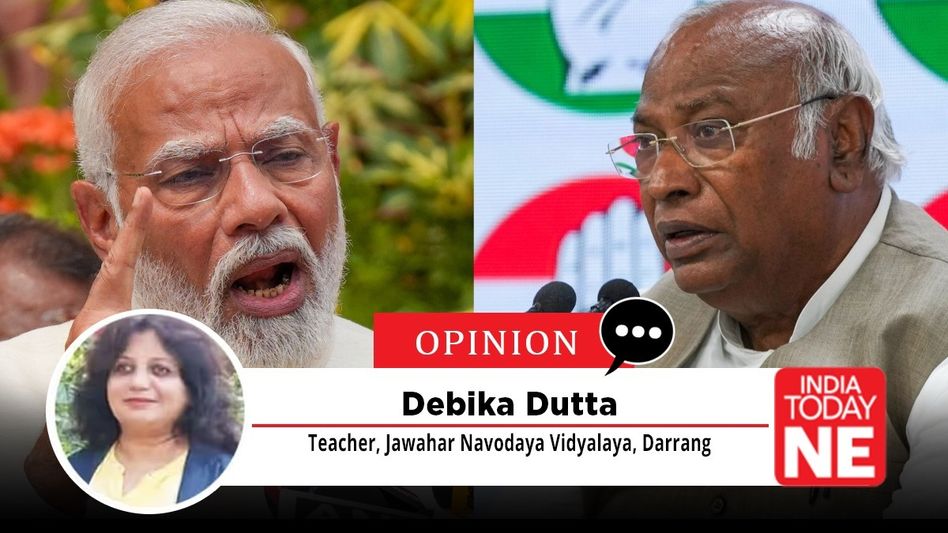
The quality of a democracy is revealed not merely by the freedom its politicians enjoy to challenge one another, but by the substance of their arguments and the standards they uphold while doing so. Political leaders must be free to disagree fiercely, expose failures and question even the most powerful occupants of public office. But when personal jibes eclipse political arguments, democracy loses something more valuable than decorum: the opportunity for meaningful public scrutiny. The controversy surrounding Congress president Mallikarjun Kharge’s remark about Prime Minister Narendra Modi’s father at a public gathering in Patna on October 25 brings this distinction into sharp focus. It raises a question that transcends party loyalties: can political leaders demand public trust while treating restraint as optional?
Kharge made the remark, “Modi ka baap bhi jayega,” after an audience member interrupted him, insisting that Modi would not go anywhere. The BJP condemned the statement and demanded an apology. The Congress defended its president, citing the circumstances of the exchange and offering an interpretation of the reference to the Rashtriya Swayamsevak Sangh (RSS). The context deserves consideration; political statements should not be judged by isolating words from the circumstances in which they were spoken. Yet context cannot become an all-purpose defence that absolves a senior leader of responsibility for his language. The pertinent question is whether the response was worthy of the office and experience of the person who made it.
Provocation is hardly unfamiliar in Indian politics. Public meetings are charged with emotion, supporters interrupt speakers, and rival parties compete to dominate the news cycle. But seasoned politicians cannot claim the privileges of leadership while disclaiming its responsibilities whenever tempers rise. A heckler does not acquire the authority to dictate a leader’s language. Nor does an interruption deprive an experienced politician of the ability to respond with wit, firmness or a compelling counterargument. The capacity to retain composure under pressure is not an ornamental quality in public life; it is a test of political judgement.
Kharge, as Congress president, has every democratic right to question Prime Minister Modi’s policies, promises and record of governance. Indeed, the Opposition would fail in its constitutional role if it hesitated to scrutinise the government. Employment, inflation, economic inequality, agricultural distress, public expenditure and the delivery of welfare programmes demand sustained examination. Questions about institutional accountability and the implementation of government commitments must be pursued relentlessly. But these are precisely the subjects that deserve the Opposition’s energy. If the Congress believes the government has failed the people, it must establish that failure through evidence, challenge the official account and present credible alternatives. A serious political indictment should stand on the strength of its facts, not the sharpness of its insults.
This is where political rhetoric must be judged by a more demanding standard. A provocative remark may excite a gathering, generate headlines and delight committed supporters. But applause is not proof of an argument’s merit, and a viral sound bite is no substitute for political persuasion. The Opposition’s responsibility is not simply to express hostility towards the government; it is to demonstrate why particular policies deserve rejection and why its own alternatives merit public confidence. Personal rhetoric may command attention for a moment, but it can also allow substantive questions of governance to disappear from public discussion. When the insult becomes the headline, the argument often becomes the casualty.
The Congress’s explanation of the exchange should be heard, but explanation must not be confused with automatic justification. If Kharge intended to refer to the Prime Minister’s ideological association with the RSS, that intention is relevant to interpreting his words. It does not settle whether the expression was appropriate. A leader can challenge an ideological position, question an organisation’s influence and contest its political philosophy without making a personal reference to a parent. There is no shortage of forceful language available to a politician determined to challenge an opponent’s ideas. Choosing a personal retort instead invites legitimate questions about judgement that cannot be answered merely by pointing to the provocation that preceded it.
The reference to family also exposes a distinction that democratic politics should preserve. A Prime Minister’s decisions, public statements and administrative record are legitimate subjects of rigorous criticism. Family members who hold no public office should not be drawn into political confrontation merely because of their relationship with him. Family background neither validates a government’s policies nor establishes their failure. Invoking a parent contributes nothing to the examination of employment, economic performance, public welfare or administrative accountability. Political criticism acquires substance when it remains focused on the exercise of public power and the responsibilities attached to it.
The BJP, however, must not mistake this controversy for a licence to claim exclusive ownership of political decency. Its condemnation of Kharge’s remark will carry greater credibility if the same standard governs the conduct of its own leaders. No party can reasonably demand restraint from its opponents while excusing comparable excesses within its own ranks. Selective outrage is not a defence of democratic values; it is partisan convenience. Equally, the Congress cannot dismiss every objection to its president’s language as politically motivated. Both parties must distinguish legitimate criticism from personal abuse, even when doing so is inconvenient to their immediate political interests.
This principle must never be misused to silence the Opposition. The government cannot demand respect as a substitute for accountability, nor can it treat every sharp criticism as an affront to the Prime Minister or the nation. Democratic institutions are strengthened by uncomfortable questions, adversarial scrutiny and competing interpretations of public policy. A government confident in its record should be prepared to defend it. An Opposition confident in its arguments should be prepared to substantiate them. The objective is not to eliminate political confrontation but to ensure that confrontation serves the public interest rather than degenerating into a contest of personal affronts.
The consequences extend beyond the leaders involved. Political speech establishes expectations for party workers, influences public conversations and shapes the example presented to younger citizens. When insults become routine, supporters may begin to mistake hostility for conviction and aggression for strength. Reasoned disagreement then appears less exciting than personal denunciation, while substantive questions are crowded out by the latest verbal controversy. For a country as diverse as India, this is an impoverishing direction. Our democracy requires robust disagreement precisely because our society contains different convictions, identities and political aspirations. That diversity must be negotiated through argument and institutions, not through the normalisation of personal abuse.
The Patna controversy should therefore be judged by a standard larger than the immediate contest between the Congress and the BJP. Kharge has the right to challenge Modi’s political record, and the BJP has the right to question the propriety of Kharge’s words. The Congress is entitled to explain the circumstances in which the remark was made. None of these rights removes the responsibility to exercise sound judgement in public life.
India does not need a politics without sharp edges. It needs a politics in which sharp criticism is backed by substance, public authority is subjected to scrutiny, and political leaders accept responsibility for the language they use. Elections will change governments, controversies will fade, and political fortunes will rise and fall. The quality of democratic life, however, depends on the standards that survive these changes. A leader’s strength is not measured by the personal sting of a retort, but by the force of the argument that remains after the applause has died down. That is the standard the Congress should uphold, the BJP should uphold, and every political party seeking the trust of India’s citizens must be prepared to meet.