Rahul, Priyanka and Manu: A Tale of Two Siblings
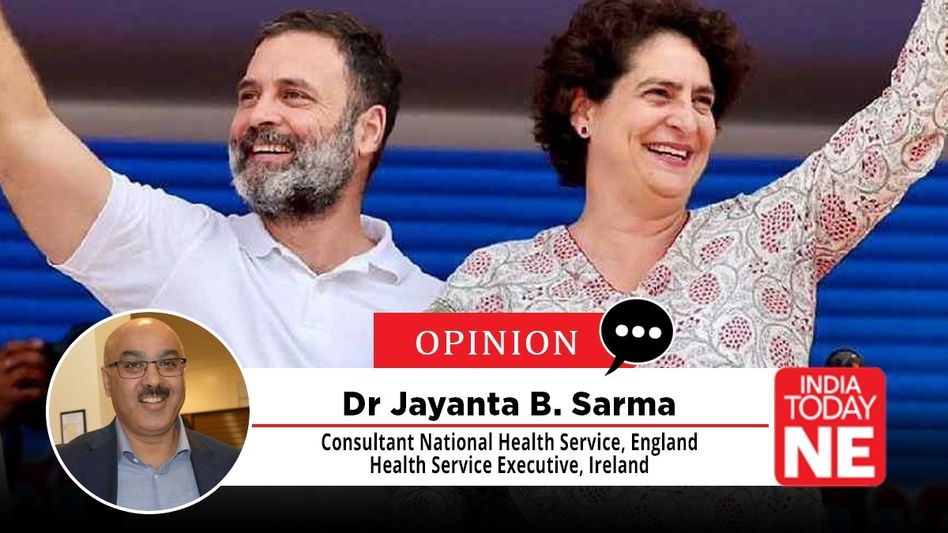
Rahul Gandhi has shown a seriousness that deserves recognition. His long marches, direct interactions with people, and growing confidence in defending constitutional equality have made him a more significant political figure than the caricature he was often made out to be.

- Aug 27, 2026,
- Updated Aug 27, 2026, 4:27 PM IST

I want Rahul Gandhi to succeed.
It's not just that I agree with him, or that I think the alternative should be dismissed. Indian democracy needs a strong opposition, and after many attempts, Rahul Gandhi has shown a seriousness that deserves recognition. His long marches, direct interactions with people, and growing confidence in defending constitutional equality have made him a more significant political figure than the caricature he was often made out to be.
That's exactly why we should now hold his words to a higher standard.
At a recent interaction with young women in Pune, Rahul Gandhi invoked the Manusmriti. In his rendering of its prescription, a woman is successively subject to her father, husband and sons and must never be independent. He called those words shameful and offered his alternative:
“You belong to nobody, except yourself.”
He went further. Women should “break the cage” and “smash patriarchy”. He argued that daughter, wife and mother may be legitimate identities, but cannot constitute a woman’s entire identity.
There is much here with which it is difficult to disagree.
Women must enjoy equality before the law. They must have equal access to education, property, employment and political power. Violence against women, coercive marriage, discrimination and restrictions upon women’s mobility remain serious problems. And the glass ceiling is hardly an Indian invention. Across much of the world, women still encounter unequal professional advancement, disproportionate caring responsibilities and the familiar penalty associated with motherhood.
What does it really mean to say that a person “belongs to nobody except yourself”?
Nobody Owns Priyanka
Rahul doesn’t deny the importance of relationships. In fact, he recognises a woman’s ties to her father, brother, husband, and son. So it wouldn’t be fair to say he wants a society where people are completely disconnected from each other.
The most generous way to interpret his slogan is clear:
No relationship gives another human being ownership over you.
There’s not much debate about that idea.
Modern Indian women are not legally chattels. India’s constitutional order recognises them as citizens and persons in their own right. Where trafficking, forced marriage, unlawful confinement or coercive control occurs, these are grave violations requiring law and enforcement.
But that’s a different fight from the one Rahul seems to be taking on.
He’s making a bigger point. He talks about a mindset that still exists—an invisible patriarchy that limits women’s dreams, shapes their identities, and decides what society thinks is right for them.
That is a legitimate argument.
It also raises an interesting question that hits close to home for Rahul Gandhi.
Her name is Priyanka.
One Household, Two Siblings
Rahul Gandhi and Priyanka Gandhi Vadra offer a real-life example to think about.
They were born just eighteen months apart. They had the same parents, shared the same remarkable political background, went through the same family tragedies, and grew up in the same political environment.
No one can honestly say Priyanka wasn’t exposed to politics, or that she lacks political skill. For years, Congress workers and political observers have talked about her instincts, communication skills, and how she reminds them of her grandmother Indira Gandhi.
We don’t have to decide if Priyanka is better than Rahul. It’s enough to say that it’s not a ridiculous idea.
Still, their lives turned out very differently.
Rahul remained unmarried. He entered Parliament at 33. He became Congress general secretary, vice-president and eventually president. He contested election after election. He succeeded, failed, resigned, travelled, experimented, reinvented himself, undertook enormous political marches and ultimately became Leader of the Opposition.
Priyanka married Robert Vadra in 1997, had two children, and spent much of her adult life outside official political roles.
But she was not absent from politics.
For years, she campaigned for her family, worked with Congress members, took part in elections, got involved in party matters, and stayed connected to her family’s political life. Even before she became a general secretary or ran for office herself, she was already a well-known figure in public and political circles.
That difference is important.
Her involvement in politics didn’t start at 52, but her independent career in elections and institutions did.
She did not assume a formal Congress leadership role until January 2019, when she was appointed general secretary for eastern Uttar Pradesh, and she entered the Lok Sabha after winning the Wayanad by-election in November 2024.
So Rahul had something politically priceless:
time to grow.
In fact, he had something even more valuable:
time to make mistakes.
Priyanka was involved in politics during those years too, but she didn’t have the same long experience as the main electoral figure.
Why?
Perhaps She Chose It
That’s the obvious answer, and it might even be true.
Maybe Priyanka wanted marriage and motherhood, and maybe Rahul didn’t. Maybe she simply didn’t want the political career others expected for her. We shouldn’t assume that a woman’s choice to marry and have children is proof that she was oppressed.
But here Rahul runs into a problem with how he defines the issue.
Modern patriarchy, as generally understood by those who use the term structurally, does not require somebody issuing orders.
The father need not say, “You may not do this.”
The husband need not forbid anything.
The brother need not assert authority.
The woman herself may sincerely choose the conventional path.
Structural patriarchy is said to work in more subtle ways—through expectations, socialisation, different opportunity costs, and different ideas about what makes a successful life for a daughter versus a son.
If that’s true, then saying “Priyanka chose it” isn’t the end of the story.
It’s just the beginning.
Could Priyanka Have Lived Rahul’s Life?
There’s a simple way to show the problem.
Imagine reversing the biographies.
Rahul marries at 25, has two children, describes himself partly as a homemaker, remains outside frontline electoral politics for decades and enters Parliament at 52.
Priyanka remains unmarried. She enters Parliament at 33, becomes the family’s principal political heir, is elevated through the Congress organisation, suffers repeated electoral setbacks, receives years in which to find herself politically, undertakes national marches and eventually becomes Leader of the Opposition.
Nothing in Indian law prevents that alternative history.
But would Indian society have found both of those life stories equally normal?
If not, then we’ve found what you might call a gendered social expectation.
Not slavery.
Not ownership.
Not necessarily oppression.
And not necessarily Manu.
But something.
This is where Rahul’s own family might show his point more clearly than the ancient text he criticised.
And Yet Priyanka Never Really Left Public Life
Another twist actually makes this thought experiment stronger, not weaker.
Priyanka didn’t just vanish into private life and then suddenly show up in politics later on. She stayed active in politics while also being a daughter, sister, wife, and mother.
And here an intriguing question arises.
Would the traditional relational imagination represented by Manu necessarily have objected to that?
Probably less than modern debates sometimes suggest.
The Manusmriti is undoubtedly hierarchical and denies women the kind of independent legal individuality modern constitutionalism requires. That cannot be glossed over. But neither is its model simply one of women being invisible or without responsibility inside social life.
The text tells male relatives to honour women, while also assigning wives substantial household responsibilities, including oversight of the accumulation and expenditure of wealth, religious observances and household management. The important qualification is that this authority is situated within a male-guardianship framework; it is not independent public or political authority.
From that point of view, Priyanka’s long years of visible, family-centred political participation are interesting. They do not resemble independent political authority in the modern constitutional sense, but neither do they fit a crude picture of a woman excluded from all influence beyond the walls of a private household.
A modernised Manu—an admittedly artificial figure forced to accept democracy, citizenship and women’s right to vote—could perhaps accommodate much of that life-course more easily than Rahul’s rhetoric suggests: marriage, motherhood, continuing ties to the natal family, public visibility and influence exercised for years within a family-centred political role. The point is not that the historical Manu endorsed women as independent politicians; he did not provide us with such a model.
The more defensible point is narrower: he might recognise Priyanka’s earlier life as highly accomplished within a relational and familial order, even though her later status as an independently elected parliamentarian would require a fundamental departure from his hierarchy.
That does not rehabilitate Manu.
It shows the problem with seeing the historical difference as simply:
Manu = women imprisoned in private life
Modernity = women entering public life.
The real difference goes much deeper. It’s about independent status, authority, and whether relationships set the limits of a woman’s life.
Priyanka’s life story makes this simple version more complicated.
What Would Manu Actually Find Strange?
Let’s try a slightly playful thought experiment.
This isn’t about guessing what the real Manu would have approved. Once you add constitutional equality and democracy, his world has already changed completely.
The real question is this:
How much of Priyanka’s actual life-course, as distinct from her modern legal status, departs from the relational pattern Rahul has chosen as his foil?
Show this imaginary modernised Manu the Gandhi siblings.
The daughter marries, has children, maintains strong relationships with her natal family, raises a family, participates for years in public and political affairs largely through a family-centred role, and in mature adulthood becomes an elected parliamentarian in her own right.
The son remains unmarried into his fifties, produces no descendants and devotes his adult existence overwhelmingly to an individual political vocation.
Which of these life stories would seem more unusual to people from a traditional society?
Possibly Rahul’s.
Priyanka’s legal equality and independent political role would definitely require major changes to Manu’s ideas. But much of the structure of her earlier life—as daughter, wife, mother, influential family member and participant in public political activity tied to the family—is less alien to a relational social order than Rahul’s words might make it seem. Her eventual independent electoral authority is precisely where the analogy reaches its limit.
That does not vindicate Manu.
It shows how oversimplified the contrast between Manu and the modern woman can be.
The Jīvanmukta Problem
There is also something philosophically peculiar about:
“You belong to nobody except yourself.”
Rahul plainly does not mean that human beings should cease to have relationships. His own fuller statement makes that clear.
But when slogans are treated as universal truths, they take on deeper philosophical meanings.
People do belong—not as property, but through their relationships.
A parent has obligations towards a child. Marriage generates reciprocal claims. Friendship creates loyalty. Citizenship creates duties. Political office creates obligations. Rahul himself belongs, in this ordinary human sense, to an extraordinary web of relationships: Nehru, Indira, Rajiv, Sonia, Priyanka, Congress, Rae Bareli, Parliament and the political inheritance that made his own public life possible.
A person who belongs only to themselves starts to seem like someone floating outside normal society.
Indian philosophy has imagined something a bit like this kind of radical freedom: jīvanmukti, or liberation while living.
But it treated this as an extraordinary spiritual achievement.
But even this comparison doesn’t really work for Rahul. The jīvanmukta isn’t about celebrating the individual who says, 'I belong to myself.' Instead, it’s about going beyond attachment to 'I,' 'me,' and 'mine.'
So any philosophical criticism needs to be specific.
Rahul’s slogan is perfectly intelligible as emancipatory rhetoric:
Nobody owns you.
It only becomes a problem if self-belonging is turned into a complete theory of human freedom.
Most people are neither possessions nor completely independent from others.
They are people who live within relationships.
The Real Patriarchy Is Harder to Find
Still, there’s a modern idea of patriarchy that deserves serious attention.
Its question isn’t:
Who owns the woman?
It is:
Who pays the greater price for departing from what society expects of their sex?
A young Indian man and woman might have the same legal rights. But marriage can affect their careers in different ways. Parenthood might change their work lives in different ways. Staying unmarried can have different social effects. Families might support their ambitions differently, even if no one is trying to discriminate.
That is a much more difficult phenomenon to investigate.
This happens everywhere.
The glass ceiling exists far beyond Hindu civilisation. Motherhood penalties, unequal caring responsibilities and female underrepresentation in senior leadership occur in societies that have never encountered Manusmriti. Therefore Manu cannot become a universal causal explanation for every contemporary gender disparity.
India definitely has its own history of patriarchy. But today’s gender relations in India come from a much more complex mix of things—religion, caste, community, economics, colonialism, Victorian values, education, urbanisation, biology, family structure, and modern capitalism, to name a few.
Saying 'Smash Manu' isn’t a substitute for understanding how all these factors work.
The Test Rahul Sets for Himself
None of this demonstrates that Rahul Gandhi is hypocritical.
That would be the simplest answer, but also the least interesting one.
Everything publicly visible suggests considerable affection and respect between Rahul and Priyanka. No evidence shows that Rahul prevented his sister from pursuing anything. Nor is there evidence that Priyanka considers herself a casualty of patriarchy.
In fact, Rahul could give a very reasonable response.
He might say:
“Priyanka proves my point. She was a daughter, sister, wife and mother without being reduced to any of those identities. She participated in politics throughout and eventually entered Parliament in her own right.”
That’s a strong answer.
But it still leaves one question:
Why eventually?
Why was Rahul the elected political actor at 33 and Priyanka at 52?
There might be a purely personal reason.
Perhaps Priyanka considered every alternative and freely chose exactly the life she lived. Perhaps she repeatedly preferred campaigning without seeking office. Perhaps her priorities differed essentially from Rahul’s.
Any real discussion about patriarchy has to consider these possibilities. Otherwise, the theory can’t be tested—anything a woman chooses could just be called proof of patriarchy.
But Rahul himself asks Indians to recognise a patriarchy subtle enough to operate without obvious coercion.
Women can internalise expectations. Families can love daughters profoundly while unconsciously expecting different things from them. Apparently free choices can still be guided by various social costs.
Fair enough.
Then those same ideas have to apply to his own family too.
How do we know Priyanka did not conform?
How can we be sure that Rahul’s unusual freedom to stay unmarried, childless, and try different things in politics was just as available—socially, emotionally, and within the family—to his sister?
Perhaps it was.
And if there’s good evidence that Priyanka had the same chances, chose not to take them, wasn’t treated differently because she was a woman, and entered politics when she wanted, then the argument for patriarchy in their case would be much weaker.
We have to keep that possibility in mind.
Otherwise, we’re not really testing the argument.
We’d just be confirming what we already believe.
Sincerity or Politics?
I hope Rahul Gandhi becomes a stronger political alternative to Narendra Modi.
That’s why it’s even more important to examine his ideas closely.
India doesn’t need another leader whose supporters shield him from tough questions. It needs leaders whose ideas can stand up to real scrutiny—even when applied to themselves.
I have little reason to doubt Rahul Gandhi’s sincerity when he speaks about women’s equality. His underlying argument—that millions of women’s ambitions remain constrained by gendered expectations—is substantial and deserves attention.
What concerns me is the gap between how sure he sounds and how precise his thinking really is.
“Smash the patriarchy” is exhilarating.
“Women belong to nobody except themselves” sounds liberating.
Quoting Manu supplies an ancient villain.
Politics thrives on this kind of clarity.
But real life is rarely that clear.
The harder job is telling the difference between protection and control, relationships and ownership, duty and subordination, voluntary habits and internalised conformity, and real structural inequality versus differences that come from personal choices.
Rahul Gandhi wants Indian women to question inherited assumptions.
Good.
Then Rahul Gandhi should be open to having his own assumptions examined in the same way.
And there may be no better place to start than with two siblings born just eighteen months apart in India’s most famous political family.
One married, became a mother and remained politically active for decades before entering Parliament at 52.
The other remained unmarried, entered Parliament at 33, became the family’s principal electoral politician, had decades in which to succeed and fail, and eventually became Leader of the Opposition.
Priyanka and Rahul.
One family. Two siblings. Two very different lives.
Neither life story proves patriarchy.
But if Rahul Gandhi wants India to see patriarchy that isn’t always obvious, he needs to explain how we’d know if it was present in his own family too.
And there is perhaps a final irony.
Priyanka’s life might not be as much of a rebellion against the relational world Manu represents as Rahul’s slogan suggests. She has been daughter, sister, wife, mother and a visible political participant for years before becoming a parliamentarian in her own right. The first set of roles can coexist quite comfortably with a traditional relational order; her equal legal status and independent electoral authority are the genuinely modern break from it.
That might not be a failure of freedom, but just another valid form of it.
The real modern question isn’t whether a woman avoids relationships.
It’s whether she has the same freedom as a man to decide what those relationships will cost her, what they’ll let her become, and when.
Until Rahul’s arguments get that precise, I see his rebellion as genuine politics—but politics where his moral certainty is a bit ahead of his philosophical reasoning.
And for someone who wants to offer India something better, that gap is important.
Author’s Note: Each essay begins with a question, observation, experience or public event worth examining beyond its immediate controversy. I determine the argument, structure and final prose, drawing on professional experience and research. I use AI as an editorial collaborator to research, develop structure, clarify, draft and edit until a piece accurately reflects my thinking and intent. The final wording and responsibility remain mine.