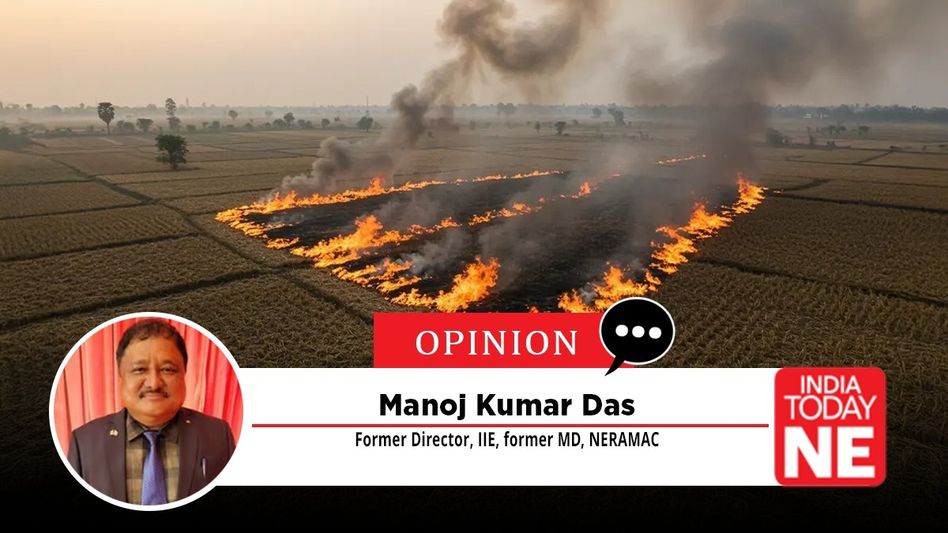
Stop burning the fields: Let straw become a source of wealth, not smoke
India's stubble-burning problem needs more than restrictions and penalties. Mechanised straw baling can turn agricultural waste into biofuel, fodder, manure, packaging material and rural employment.

- Nov 07, 2026,
- Updated Nov 07, 2026, 3:01 PM IST

Every winter, as Delhi wakes up to another morning under a blanket of smog, millions of people struggle to breathe. Children are unable to play outdoors, elderly people find it difficult to take their morning walks, and those suffering from respiratory ailments face even greater discomfort. There are days when the Air Quality Index crosses 500, making the simple act of breathing a health hazard.
The reasons behind Delhi's air pollution are many. Vehicular emissions, industrial pollution, construction dust and waste burning all contribute to the problem. But the seasonal burning of agricultural residue in Punjab, Haryana, western Uttar Pradesh and parts of Rajasthan adds to the crisis.
Year after year, we discuss the problem, hold meetings, announce schemes and appeal to farmers not to burn their fields. Yet, when the harvesting season arrives, the smoke returns.
Perhaps we need to ask ourselves a different question. Why should farmers burn something that can actually earn them money?
For a farmer, the period between harvesting paddy and preparing the field for the next crop is extremely short. Clearing the leftover straw takes time and money. The next crop cannot wait. Burning, unfortunately, becomes the quickest and often the cheapest option.
It is easy to blame the farmer. It is much more difficult, but far more useful, to create an alternative that works for the farmer.
I believe one practical answer lies in a simple technology: mechanised baling of agricultural straw.
Why burn what can be collected and reused?
In several advanced and middle-income countries, agricultural residues are collected, compressed into bales and transported for use in farming and industry. Instead of setting fire to the fields, farmers use machines to gather loose straw and convert it into compact bundles that can be easily stored and transported.
India can adopt and scale up this practice.
Modern agricultural balers can collect wheat straw, paddy straw and other crop residues and compress them into round or rectangular bales. Once collected, these can be transported to storage centres or directly to industries that need biomass as raw material.
The idea is not complicated. What we need is a system that makes it affordable and convenient for farmers.
A small farmer cannot be expected to buy an expensive baling machine. But a village cooperative, Farmer Producer Organisation (FPO) or local entrepreneur can own one and provide services to hundreds of farmers.
The government could support this through a 50–60 per cent capital subsidy, subject to appropriate ceilings, for balers and associated equipment. Custom Hiring Centres could be established at village and block levels so that farmers can hire machinery at reasonable rates.
There is also a case for allowing the import of advanced baling machinery at zero customs duty for an initial period of five years, particularly where suitable domestic alternatives are not readily available. At the same time, Indian manufacturers should be encouraged to develop affordable machines suited to our farming conditions.
The aim should be to make a straw baler as accessible to farmers as a tractor or a combine harvester.
Straw has a value. We simply need to unlock it.
What makes this proposal particularly attractive is that agricultural straw has several uses. It is not merely waste to be cleared from a field. It can become the raw material for a number of industries.
Bioethanol: Paddy and wheat straw contain cellulose and hemicellulose, which can be processed to produce second-generation bioethanol. With India pushing ahead with its ethanol blending programme, agricultural residues could provide an additional source of raw material for biofuel plants. This would also help reduce our dependence on imported fossil fuels.
Organic manure: Instead of burning crop residues and losing valuable organic matter, a portion can be converted into compost, enriched manure and soil conditioners. This can improve soil health and support more sustainable farming.
Animal fodder: Wheat straw is already widely used as cattle feed. Proper collection and storage can reduce wastage and help address fodder shortages. Selected crop residues, including paddy straw, can also be made suitable for livestock feed through appropriate treatment and processing.
Biomass and biofuel: Baled straw can be supplied to biomass power plants and industries for producing briquettes and pellets. These can replace a portion of conventional fuels used in industrial boilers and other applications.
Paper and packaging: This is an opportunity that deserves much greater attention. Agricultural residues can be processed into pulp for manufacturing craft paper, corrugated packaging, paperboard and biodegradable packaging products. At a time when industries are looking for alternatives to conventional plastic packaging, crop straw could become a valuable raw material.
There are also opportunities in particle boards, bio-based construction materials and mushroom cultivation.
Imagine the possibilities. What is currently burnt in a field could become fuel for an industry, fodder for cattle, manure for another farm or packaging material for a manufacturing unit.
This is the essence of a circular economy: one industry's waste becomes another industry's resource.
Farmers need a market, not just machinery
Providing machines is only the first step. If farmers are to adopt baling on a large scale, there must be someone willing to buy the collected straw.
This is where the government needs to play a facilitating role.
I would suggest a dedicated National Agricultural Residue Baling and Utilisation Scheme that brings farmers, machinery operators, cooperatives and industries together.
One important component could be the creation of village-level or block-level 'Straw Banks'. These would function much like grain collection centres. Farmers could bring their baled straw or have it collected from their fields. The straw could then be graded, stored and supplied to industries according to their requirements.
FPOs and cooperatives could manage these centres, creating another source of income for rural institutions.
The government could also facilitate long-term purchase agreements between farmer organisations and bioethanol plants, biomass power producers, paper mills and compost manufacturers. Such arrangements would give farmers and entrepreneurs confidence that there is a market for what they collect.
Transportation is another issue. Straw is bulky, and moving it over long distances can be expensive. Some initial transportation support may therefore be necessary to make the supply chain viable.
Most importantly, farmers who ensure that their fields are cleared without burning should receive a modest, performance-linked incentive. Environmental protection should not become an additional financial burden on those who are already struggling with rising cultivation costs.
A new opportunity for rural youth and entrepreneurs
There is another dimension to this idea that deserves attention: employment.
Every straw collection centre will need people to operate machinery, collect and transport bales, manage storage and coordinate supplies. Small enterprises can emerge around these activities.
FPOs, rural cooperatives and local entrepreneurs can become service providers. Young people in villages can find opportunities in machinery operation, logistics, biomass processing and the manufacture of value-added products.
This is particularly relevant in regions where agriculture remains the main source of livelihood but non-farm employment opportunities are limited.
India has successfully built large rural supply chains in other sectors. The dairy cooperative movement demonstrated how small producers can collectively access markets and create a national industry. Our experience in food processing, agricultural marketing and ethanol production also offers useful lessons.
Why cannot we apply similar thinking to agricultural residues?
Start where the problem is most serious
The programme could begin with the districts of Punjab, Haryana, western Uttar Pradesh and Rajasthan that experience significant crop-residue burning.
A proper assessment should first establish how much straw is generated, what machinery is required, where collection centres should be located and which industries can use the collected material.
The government could then set practical annual targets: how many tonnes of straw will be collected, how many farmers will benefit, how many collection centres will be established and how much burning will be prevented.
The Ministries of Agriculture and Farmers Welfare, New and Renewable Energy, Petroleum and Natural Gas, and Environment, Forest and Climate Change should work together rather than approaching the problem separately.
Industry must also come forward. Biofuel companies, paper manufacturers, packaging businesses and biomass energy producers should be encouraged to invest in collection and processing facilities.
At the same time, we must be careful not to remove all crop residue indiscriminately. Some residue needs to remain in the field or be managed through in-situ methods to protect soil health and maintain organic matter. The objective should be to find the right balance between industrial utilisation and sustainable farming.
Let us change the way we look at agricultural waste
We should acknowledge that stubble burning is only one part of Delhi's pollution problem. No single intervention will clean the air of the National Capital Region. A comprehensive strategy must also address vehicular emissions, industrial pollution, construction dust and waste management.
But that should not prevent us from acting decisively on a problem for which a practical alternative is available.
Our approach to farmers must also change. Repeated warnings and penalties cannot be the only answer. A farmer will willingly adopt a better practice when it saves time, reduces costs and provides an economic return.
The government has an opportunity to turn a recurring environmental problem into a new rural industry. Mechanised straw baling, supported by affordable machinery, village-level collection centres, transportation facilities and assured industrial markets, can make this possible.
The message should be simple: Why burn agricultural residue when it can produce fuel, fodder, manure, paper and employment?
Perhaps the next time we look at a field full of harvested straw, we should not see a problem waiting to be burnt. We should see an opportunity waiting to be harvested.
Delhi needs cleaner air. Farmers need better incomes. Rural India needs new enterprises and employment. A well-designed agricultural residue management programme can help address all three.
Let us move from burning straw to building an economy around it. The smoke that darkens our skies today could become the source of rural prosperity tomorrow.
ABOUT THE AUTHOR
Manoj Kumar Das is a public policy professional and senior development-sector leader with over three decades of experience in development finance, institutional management, entrepreneurship and rural economic development. He has held senior leadership positions in the North Eastern Development Finance Corporation (NEDFi), Indian Institute of Entrepreneurship (IIE) and North Eastern Regional Agricultural Marketing Corporation (NERAMAC). His work has covered agricultural value chains, Farmer Producer Organisations, bamboo development, skill development and livelihood promotion. He writes on public policy, sustainable development and inclusive economic growth.