
Straits of power: Hormuz and the architecture of energy security
While the election season in Assam, West Bengal, Kerala, Tamil Nadu and Puducherry continues to simmer, it remains paramount to understand the Hormuz hedge, the choke points and the new crude reality.

- Apr 03, 2026,
- Updated Apr 03, 2026, 12:02 PM IST

While the election season in Assam, West Bengal, Kerala, Tamil Nadu and Puducherry continues to simmer, it remains paramount to understand the Hormuz hedge, the choke points and the new crude reality.
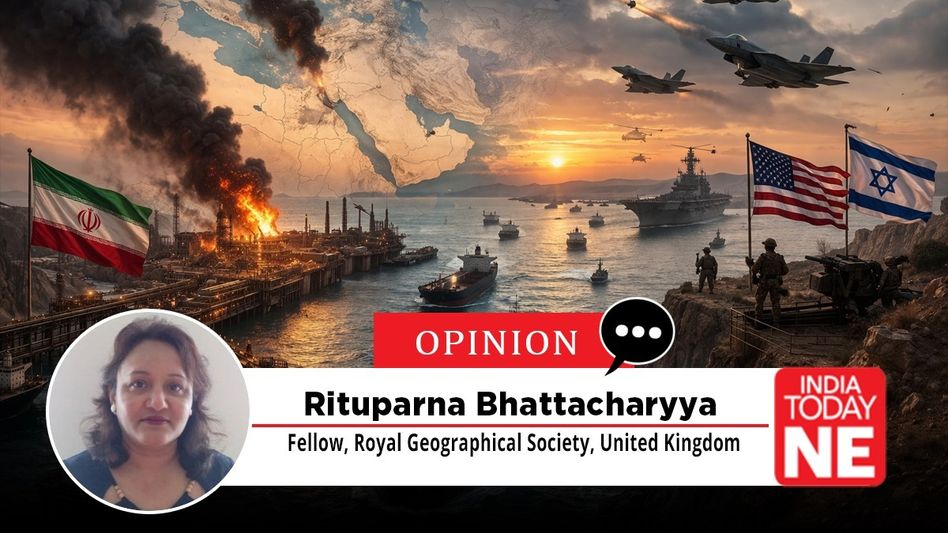
The turquoise waters of the Persian Gulf have long been the world’s most precarious counting house. But today, as the sun beats down on the jagged cliffs of the Musandam Peninsula, the silence in the Strait of Hormuz is deafening. Usually teeming with the rhythmic churn of super tankers, the world’s most vital maritime artery has become a "no-go zone," a casualty of a month-long conflict that has redrawn the map of global energy and pushed the Middle East to the precipice of total transformation.
At the centre of this storm lies a triad of volatility: the scorched earth of Kharg Island, the uncompromising "America First" doctrine of the Trump Administration, and a direct military confrontation between Israel and Iran that has finally stepped out of the shadows.
The Fortress in the Crosshairs: Kharg Island
Following the outbreak of hostilities between a U.S.-led coalition and Iran in February 2026, Kharg Island has been heavily fortified.If the Strait of Hormuz is the throat of the global oil trade, Kharg Island is its beating heart. Located just 25 kilometres off the Iranian coast, this coral outcrop handles over 90% of Iran’s crude exports. For decades, it was considered untouchable—a "red line" that, if crossed, would collapse the global economy. That taboo was shattered in March 2026. Following the initiation of Operation Epic Fury—a joint U.S.-Israeli campaign launched after a series of regional escalations, Kharg has been transformed into a smoking symbol of the new era. Iranian forces have reportedly deployed advanced surface-to-air missile (SAM) networks, electronic warfare units, and thousands of additional personnel to the island. Nevertheless, while U.S. President Donald Trump initially claimed to have "obliterated" only military assets on the island, the reality on the ground is more dire. Satellite imagery reveals sustained damage to loading terminals, and while some "dark" tankers continue to creep through Iranian territorial waters, the flow has slowed to a trickle.
The strategy is clear: Decapitation through De-petrolisation. By neutralising Kharg, the U.S. and Israel aim to effectively sever the financial lifeline of the Islamic Republic, aiming to force a domestic collapse or a total surrender at the negotiating table. So, President Trump has issued ultimatums to "completely obliterate" or "take" the island if the Strait of Hormuz is not reopened to international shipping. However, there are legal concerns. International law experts have warned that a full-scale attack on Kharg’s energy infrastructure could be classified as a war crime, given its dual-use nature and the catastrophic impact its destruction would have on the civilian population's access to power and water.
"Negotiating with Bombs": The Hegseth Doctrine
In Washington, the language of diplomacy has been replaced by the cadence of combat. U.S. Defence Secretary Pete Hegseth, the face of this more muscular Pentagon, recently stunned the international community with his candour. During a briefing on 31 March, Hegseth defended the relentless sorties over Iranian airspace, stating:
"We don’t want to have to do more militarily than we have to, but I didn’t mean it flippantly when I said in the meantime we’ll negotiate with bombs. Our job is to ensure that we compel Iran to realize that this new regime... is in a better place if they make a deal."
Hegseth’s "unpredictability" doctrine—sending thousands of Marines and 82nd Airborne troops to the region not as a static peacekeeping force, but as a mobile threat—reflects a total departure from the "strategic patience" of previous decades. The message to Tehran is blunt: The U.S. is no longer interested in containing the fire; it is prepared to burn the house down to rewrite the rules. Even Britain is sending more military personnel to the Middle East to bolster the defence of Gulf allies amid rising concerns over Iran’s hostile actions.
The Trump Tweet: "Go Get Your Own Oil"
While Hegseth manages the tactical pressure, President Trump is busy dismantling the old alliances of the 20th Century via social media. As global oil prices surge past $120 per barrel and U.S. gas stations see prices tick over $4 a gallon, Trump has signalled that the days of the U.S. Navy acting as a free security guard for global trade are over.
In a characteristic Truth Social post that sent shockwaves through London, Paris, and New Delhi, the President lashed out at allies who have been hesitant to join the military offensive:
“All of those countries that can’t get jet fuel because of the Strait of Hormuz... I have a suggestion for you: Number 1, buy from the U.S., we have plenty, and Number 2, build up some delayed courage, go to the Strait, and just TAKE IT. You’ll have to start learning how to fight for yourself, the U.S.A. won’t be there to help you anymore... Go get your own oil!”
This isn't just a tweet; it is a fundamental shift in the Petrodollar Pact. By telling allies to "get their own oil," Trump is effectively weaponising American energy independence. With the U.S. now a net exporter, the administration views the chaos in the Gulf as a market opportunity for American shale rather than a national security crisis.
Israel’s Shadow War Comes to Light
For Israel, the current situation is the culmination of a decade of warnings regarding Iran’s "Ring of Fire." Prime Minister Benjamin Netanyahu’s government, working in unprecedented lockstep with the Trump Pentagon, has moved beyond proxy battles in Lebanon and Syria.
The strikes on 01 March 2026, which targeted hardened ballistic missile facilities in 20 Iranian provinces, marked the most significant air campaign in modern history. With the reported death of Supreme Leader Ayatollah Ali Hosseini Khamenei in the opening wave, Israel is no longer fighting for deterrence; it is fighting for a New Middle East—one where the "Shiite Crescent" is permanently broken.
The Global Fallout: A World on Edge
The consequences of this "High-Stakes Hormuz" are being felt far beyond the Gulf:
• Energy Inflation: Brent Crude’s volatility is wreaking havoc on developing economies, including India (see below), which remains heavily dependent on Middle Eastern imports.
• Supply Chain Collapse: QatarEnergy’s declaration of force majeure on LNG (liquefied natural gas) exports has triggered a "grocery supply emergency" in the GCC (Gulf Cooperation Council,—Saudi Arabia, United Arab Emirates, Kuwait, Qatar, Bahrain and Oman) states, where food imports are stalled at the blockade.
• The China Factor: As Iran’s primary customer, Beijing is watching its energy security evaporate. The "dark fleet" that once bypassed sanctions is now being physically intercepted or deterred by the threat of "unpredictable" U.S. strikes.
For India, the "Hormuz Hedge" is not just a geopolitical shift; it is a direct hit to the kitchen table. As the world’s third-largest consumer of crude oil, India has long relied on the Persian Gulf—which provides nearly 60% of its fossil fuel imports—turning a regional conflict into a national economic emergency.
The impact on New Delhi is unfolding across three critical fronts: the economy, energy security, and the safety of the massive Indian diaspora.
The Economic Shockwave: Inflation and the Rupee
The most immediate impact has been felt at the petrol pumps from Mumbai to Mizoram. With Brent Crude hovering above $120 per barrel, India’s fiscal deficit is widening at an alarming rate. With elections in different states in the offing, the economic shockwave is only going to get worse.
• Retail Inflation: Transportation costs for essential goods have surged, leading to a "double-digit" spike in food inflation. The price of vegetables and grains has risen by 15-20% in the last month alone as logistics companies pass on fuel surcharges.
• Currency Depreciation: The Indian Rupee has hit record lows against the US Dollar. As India spends more dollars to buy the same amount of oil, the currency's value has eroded, making all other imports—from electronics to fertilisers, more expensive.
The Strategic Pivot: Seeking "New Crude"
President Trump’s "Go get your own oil" tweet was a pointed jab at nations like India. New Delhi has been forced to accelerate a radical shift in its sourcing strategy:
• The Russian Lifeline: India has further increased its intake of discounted Russian Urals, though the logistics of shipping through the Mediterranean and around the Cape of Good Hope (avoiding the volatile Suez/Red Sea corridor) have added significant "war risk" premiums to insurance.
• The American Buy-In: Taking Trump’s advice literally, Indian state-run refiners have signed multi-billion-dollar long-term contracts for U.S. Shale. While this pleases the White House, the "freight-heavy" nature of shipping oil from the U.S. Gulf Coast to Gujarat makes it a costly alternative to the short hop from the Strait of Hormuz.
• Strategic Reserves: India has begun tapping into its Strategic Petroleum Reserves (SPR) in Visakhapatnam, Mangalore, and Padur. However, these reserves are estimated to last only about 9 to 12 days, a terrifyingly short window if the Kharg Island outage becomes permanent.
The Human Cost: The Diaspora in Danger
Perhaps the greatest concern for the Indian government is the safety of the 9 million Indians living and working in the Gulf (the GCC countries).
• The Remittance Crisis: The Gulf accounts for nearly 50% of India’s global remittances. With the regional economy stalling due to the blockade, thousands of Indian blue-collar workers face job losses or "forced unpaid leave," threatening the livelihood of millions of families back home in Kerala, Punjab, and Uttar Pradesh.
• Evacuation Contingencies: The Ministry of External Affairs has reportedly put the Indian Navy and Air Force on high alert for a potential "Vande Bharat 2.0"—a mass evacuation of citizens if the conflict between Israel and Iran spills over into the streets of Dubai, Doha, or Riyadh.
India's Diplomatic Tightrope
The "Hegseth Doctrine" of negotiating with bombs leaves New Delhi in a precarious position. India enjoys a "Strategic Partnership" with the U.S. and a "civilisational bond" with Iran. However, the current administration in Washington has signalled that neutrality is no longer an option.
India’s External Affairs Minister recently remarked that "the era of 'free-riding' on others' security is ending," echoing Trump’s sentiment but with a tone of caution. India is now moving to deploy its own naval destroyers to escort Indian-flagged tankers through the Gulf of Oman, a move that proves India is finally taking the President's advice to "get its own oil" by providing its own protection.
The Bottom Line: For India, the battle for the Strait of Hormuz is a battle for its own middle class. Every day the Strait remains a "no-go zone" is a day India’s "Amrit Kaal" (Golden Age) ambitions are put on hold.
Conclusion: The End of the Old Guard
The Strait of Hormuz has always been a barometer for the world’s stability. In 2026, the barometer has shattered. Between Hegseth’s "bombs as diplomacy" and Trump’s "buy American or fight for yourself" ultimatum, the old-world order, where the U.S. guaranteed the flow of oil in exchange for global hegemony, is dead.
As the smoke rises over Kharg Island, the question for the rest of the world is no longer when the oil will flow again, but who will be brave (or desperate) enough to go in and take it. In the new Middle East, the only certainty is that the "Free Ride" is over.
(The views expressed in this article are those of the author and do not necessarily reflect the views of India Today NE or its affiliates)
MORE NEWS









Copyright©2026 Living Media India Limited. For reprint rights: Syndications Today
