Thadou: My Heritage, My Identity
I drew inspiration from the head of my sub-clan, “Mangvung”, (Late) Pu M. Sonjakhup Haokip, who carried the Thadou name with pride. He died a proud Thadou, and I continue his legacy by upholding the truth today.I am blessed to be a Thadou who understands the deep struggle of my tribe and stands up for my heritage when it needs me most.

- Apr 19, 2026,
- Updated Apr 19, 2026, 5:06 PM IST

I once took pride in identifying as both Thadou and Kuki. Like many, I never questioned my heritage deeply. That changed - As I learned the history of the Kuki identity, I could not accept it as my own, because my forefathers left me an indigenous heritage to be proud of. I drew inspiration from the head of my sub-clan, “Mangvung”, (Late) Pu M. Sonjakhup Haokip, who carried the Thadou name with pride. He died a proud Thadou, and I continue his legacy by upholding the truth today.I am blessed to be a Thadou who understands the deep struggle of my tribe and stands up for my heritage when it needs me most.
A Turning Point
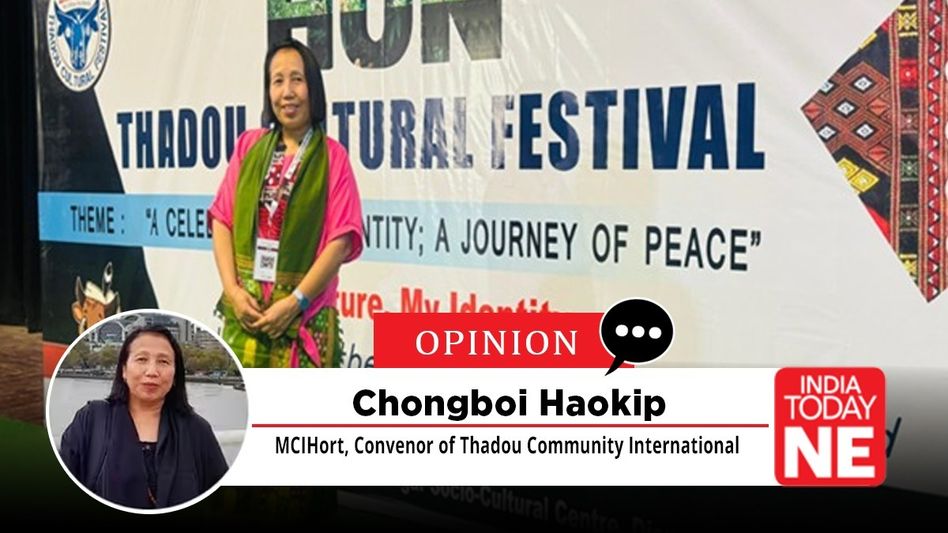
When Kukis persecuted Thadou leaders during the 2024 Thadou Hun celebration, I investigated the historical background of the term “Kuki.” I felt that it was not right for the Kuki community to suppress and persecute Thadou tribe leaders. As I learned more, I came to know that the derogatory term “Kuki” was coined not intentionally, but for administrative convenience. I found it hard to accept it as part of my identity/ heritage knowingly. Although I had unknowingly accepted before that incident, the events surrounding the 2024 Thadou Hun were my turning point in regard to my heritage.
With the Thadou community following their conviction, the 2024 Thadou Hun declaration affirmed that Thadou is not Kuki. In fact, there was never any formal declaration stating that Thadous are Kukis in Thadou tribe history. Therefore, when Kuki disowned our Thadou champions, Pu Michael Lamjathang Thadouand Pu James Thadou, it is not something to be ashamed of. On the contrary, it is a big relief because it confirms that we, the Thadous, are not Kukis.
The Weight of a Word
The term "Kuki" was first used by the British in 1777 — a colonial label applied loosely to hill tribes in what is now Bangladesh and Northeast India. It was never a name any of these communities chose for themselves. It was assigned from the outsideto a backward, hilly community, together for administrative convenience. I have come to find it deeply difficult to accept such a label as part of my heritage — especially once I understood its origins.
We live in the 21st century. History shows many communities reclaiming their original names. Calcutta became Kolkata, Madras became Chennai, and we can continue the list. These were acts of dignity, not symbols. Our kindred groups, the Mizos and Zomis, recognised this earlier and chose their own indigenous names.The Thadou people are simply doing the same. And when the 2024 Thadou Hun declaration affirmed that Thadou is not Kuki, it was not a declaration of separation — it was a declaration of truth and dignity of our heritage.
Rooted in Record - Truth triumphs alone!
The Thadou identity is not a modern invention, nor a political convenience. The Thadou people were officially recorded as such in Manipur's very first census in 1881 and formally recognised as a Scheduled Tribe in 1956. In Assam, the establishment of the Thadou Mauzadar institution by the Assam government in 1886, which continues to exist today, is our Thadou pride.This is not sentiment — it is documented history. Our identity is rooted in our language, our culture, our literature, and the living memory of our community. No external label can erase what has been recorded, celebrated, and lived for generations.
Thadou is a linguistically based tribe — it encompasses those who regard Thadou as their primary language and anchor of identity. Within the broad family of clans, such as the Haokips, individuals may align with different tribal identities depending on where they live and which community they have grown up alongside. This is not confusion — it is the natural, organic reality of human belonging. Many Haokips subscribe to the Thadou identity; many align with the Kuki tribal community, Mizo and Zomi identities. Identity, at its heart, is about community, not coercion.
Standing Up with Conviction
I am not putting these thoughts out of bitterness, but out of moral duty as a principled person on my beliefs. Yes, I do have one life, and I choose to spend part of it standing up for the heritage I belong to. When our Thadou champions were disowned by the Kuki establishment, many expected us to feel shame. Instead, it wasa confirmation of what history already told us: Thadou and Kuki are not the same. There was never any formal declaration in the Thadou tribe's history that Thadous are Kukis. The absence of such a declaration is itself a historical fact — one that cannot be wished away.
I am aware that some Thadous who have accepted the Kuki label do so under enormous social pressure — fear of being cancelled within their communities, fear of persecution, or the weight of years of conditioning. To them I say: your inner voice matters. The roots that connect you to this proud heritage have not withered. When you are ready and when you are safe, those roots will speak to you, and you are welcome back to where you belong. We are patient, and we will wait!
Multi Ethnic Communities in Manipur
I fully understand that holistic and sustainable development requires the inclusion of every ethnic community - would you have the same view? From my viewpoint - in a place as diverse as Manipur, with more than thirty distinct tribes and communities, reducing its complexity to a three-ethnic framework is misleading and harmful - Would it be good to know your thoughts on this? Such simplification ignores unique identities, languages, ecological knowledge, and cultural traditions and risks distorting representation and weakening equitable progress.
Case study: The Thadou are one clear illustration. Formally recorded as a distinct ethnic community since the 1881 census, recognised as a Scheduled Tribe since 1956, the Thadou possess their own language, literature, cultural patterns, and deep knowledge of the landscapes they inhabit. As affirmed by the Thadou Convention in Guwahati in 2024, the Thadou are not Kuki, not underneath Kuki, not part of Kuki — but a separate, independent people. In my view, when they are absorbed into a larger umbrella without their consent, their specific knowledge, their specific needs, and their specific voice in development planning disappear. The same is true of the Hmar, the Zomis, the Mizos and every other community whose identity and ecological knowledge the trio-ethnic framework renders invisible.
Manipur is a multi -ethnic state. The moment they allocated a Deputy Chief Minister to a Kuki and based on ethnicity, I thought that meant Manipur could end up claiming35 deputy chief ministers in future, as there are 36 ethnic communities.
Reflection - Peace as Our Inheritance
A dog barks at an elephant, yet the elephant keeps walking gracefully, undisturbed - have you ever heard of a popular saying in Thadou? This reflects the Thadou spirit with clarity on our stance. We, Thadous, value peace and mutual coexistence with other communities. We chose non-violence, dialogue, seeking justice, and truth-telling from the first day of the Kuki-Meitei conflict, and we will not change our stance. It is a strength rooted in clarity of purpose. We are the true sons and daughters of the soil and take pride in where we live, for example, being "Manipuri" in Manipur, and “Assamese” in Assam. What we want is simple: the best for the states where we live. Not domination and erasure of others, but simply the right to be known by our own name, to carry our own unique heritage, and to raise our children with pride in who they are.
Please respect the Thadou tribe's wish to be known by our indigenous identity “Thadou”, as the Mizos, Zomis,and Hmars are known by theirs. It is not a demand born of conflict, but it is a request born of dignity. We are Thadou and have always been Thadou. And with grace, truth, and the courage of a people who have endured much, we will continue to walk our own way — unbothered, unbroken, and at peace.
"Before I formed you in the womb I knew you, before you were born I set you apart…." — Jeremiah 1:5 NIV
Statement: I do not support illicit poppy cultivation. I support sustainable alternatives that strengthen society and help affected farmers in Manipur. I stand firmly behind the Manipur Government's "War on Drugs" campaign. As a strong, united community, we must work alongside government agencies that are helping farmers abandon illegal poppy farming. We, the people of Manipur, can eliminate unlawful poppy cultivation through collective effort. I call upon the entire Manipur community to unite as one team in this fight against illegal cultivation of poppy, working together to create sustainable livelihoods and a healthier future for all.
About the author: Chongboi Haokip, MCIHort, is an international development consultant specialising in agriculture, horticulture, trade facilitation and sustainable development. Email contact: chongboi4community@gmail.com. Join me on X @ChongboiUK and on Instagram @chongboiuk.Most of my articles are available at https://muckrack.com/chongboi-haokip.
Chongboi is the founding Convenor of Thadou Community International and the Convenor of the First State-Level Assam Thadou Hun 2025.