
The Case for Himanta’s Sankar–Madhav, Bose–Bordoloi Reset
Assam’s past keeps returning to the present, not as settled history but as a battlefield of memory, identity and power. From gods and warriors to language riots and cultural reconciliation, the question this story asks is simple yet unsettling: who gets to decide what Assam remembers—and what it is urged to forget?

- Jan 03, 2026,
- Updated Jan 03, 2026, 7:06 PM IST

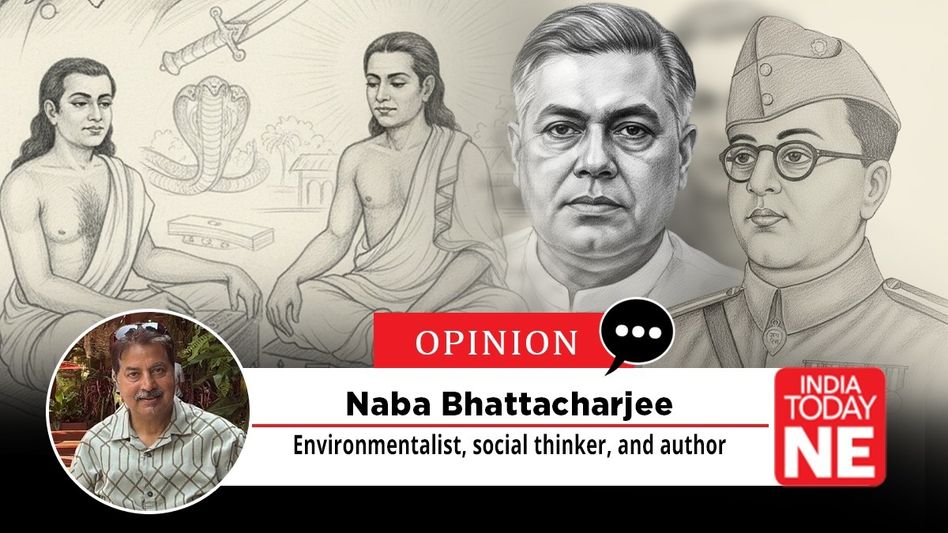
Hearing Chief Minister, Himanta Biswa Sharma’s address, online, in the State executive meet of BJP recently, while basking in the winter sun of Shillong, I found myself drawn into a moment of reflection. His adroit articulation on Assam being labelled as a land of Sankar-Ajan being inaccurate and a conjured narrative of vested interest was thought-provoking. He accepted that Ajan Fakir has meaningful contribution within his “own area”, whereas the philosophy of Srimanta Sankardev encompasses entire Assam and beyond. He attributed the linkage to a deep-rooted conspiracy and dissemination of fictional theories on Assam, adding that land of Sankar-Madhav has a more truthful legitimacy.
In the same breath, with his usual confidence, he dismantled a particular school of thought which believed that “Bagh” Hazarika was the main strategist in ensuring success of Lachit Borphukan in defeating the Mughals. He decried spread of such unsubstantiated and baseless claim, aimed at questioning the bravery and valour of the worthy son of Assam. The need for unity among Assamese Hindus and Bengali Hindus, overcoming the role of negative forces out to separate them was also stressed upon. Time only will reveal whether these perceptions highlighted by him shall find resonance with the general masses of Assam.
The third segment which was the sensitive subject of Assamese Hindu and Bengali Hindu relationship is covered here in some details. His logic was that they ought to be natural allies, when both communities worship the same Mother Durga, Maa Kamkhya and all other deities as per common rituals. Here too, he emphasised on the negative role of different forces inimical to the interest of Assam, which ensured at every stage to keep the two communities apart. Both communities shared a healthy relationship till the Sylhet referendum and partition. Assamese Hindus harboured a genuine apprehension of being rendered a minority in their homeland after westward migration to the state was far more than the eastward migration out of the state, after partition. The influx of migrants from East Bengal since the colonial period has led to a major demographic shift. This anxiety is often conflated with a broader anti-Bengali Hindu sentiment. The situation was largely aggravated during the Bangladesh liberation war when, allegedly, a large percentage of East Pakistanis who were given temporary shelter in the state did not return back.
The Bengali Hindus, both settled in the Brahmaputra valley for generations, since British rule, and those who were victims of partition, extricated overnight from their home of origin and given shelter in Assam, lived in anxiety of being increasingly classified as illegal immigrants. What was perplexing for Bengali Hindus was the growing proximity, following both the above-mentioned defining events, between a section of Assamese Hindus and Muslims of doubtful origin who were considered harmless “poor agricultural help”. Series of consequent strife and riots took place between both religiously aligned but linguistically separate communities.
While the conflict is often simplified as "Hindu Bengali vs. Hindu Assamese," the assumed role of immigrant Muslims acting as a catalyst to widen the divide led to a focal point for nativist and nationalist anxieties in the region. The most prominent reaction from both sides was the language agitation of 1960 and widespread riots all over Assam on the issue. What ensued was vandalisation, loot and destruction of lives and communities on a mass scale, with the Bengali-speaking Hindu population particularly bearing the brunt. Similarly, Bengali-speaking Hindus were targeted in the Guwahati upheaval of 1948, where the Muslim League extended full support to the planned attacks.
While the politicians couldn't heal the wounds of the 1960 riots, artists, musicians, dramatists, singers, and writers could. Leading this troupe of artists through the riot-torn countryside was Assam’s very own bard, Bhupen Hazarika and Bengali folk singer-songwriter Hemango Biswas. This was probably the only instance in the history of Independent India when a cultural intervention healed the wounds of division and brought an end to the widespread unrest. This positive initiative should also find prominence in the annals of Assam’s history.
The stressed relation between Assamese and Bengali Hindus since partition has been one of trust deficit and suspicion. Assam of 1938 included most of the present NE states and the Sylhet district of present-day Bangladesh. Both communities are believed to have worked with an understanding during the Assam provincial elections in British India during 1936-1937, leading to the formation of a Congress-led coalition with two major Muslim parties headed by Muhammed Saadullah as Prime Minister of Assam province. He subsequently resigned in 1938 to make way for the installation of a new government.
Gopinath Bordoloi, a bold, courageous man of integrity, committed to protecting the Assamese interest, emerged as the leader of Congress to head the alternate government. His installation was facilitated by the then Indian National Congress President, Subhash Chandra Bose, who came out with a strong statement against the Assam Governor Robert Reid, who delayed the taking over the reins of Assam government by Bordoloi. Bose remarked “… during my stay in Shillong, the Governor appeared to me to be still under the influence of Saadullah cum European party. He certainly did not treat Bordoloi as any other Governor would have treated a would-be Prime Minister”.
This aspect of the personal relationship between Bose and Bordoloi never found prominence ostensibly at the behest of Saadullah and the British combine, who thought it convenient to create further division among Hindu Assamese and Bengali communities to serve their interest. With rapid turn of events by 1940, Bose left the Congress, World War II started, Bordoloi resigned and Saadullah again formed the government in Assam, promising to help the British in the war.
The process of restructuring as advocated by Chief Minister of Assam could witness a realigned narrative in the form Sankar-Madhav philosophy; the Bose-Bordoloi union; Bhupen Hazarika-Hemango Biswas orchestra of harmony, aimed at strengthening the broad-based Assamese society.
MORE NEWS












Copyright©2026 Living Media India Limited. For reprint rights: Syndications Today
