The E20 Ethanol debate is about more than fuel—It's about how India governs
The West struggles to change. India struggles to change without disruption. Between them lies a predicament of modern governance.

- Jul 07, 2026,
- Updated Jul 07, 2026, 3:32 PM IST

The controversy began with petrol.
India’s rapid transition to E20—petrol blended with 20 per cent ethanol—has provoked an increasingly heated debate. Will older cars be damaged? Were they designed for the fuel? Will mileage fall? Is ethanol really environmentally beneficial when sugarcane cultivation consumes enormous quantities of water? Who benefits from the vast new market created by government policy?
Each question leads naturally to another. But eventually they lead somewhere far beyond petrol.
They lead to a peculiar characteristic of Indian governance.
India has an extraordinary capacity to decide upon a destination and begin moving towards it with remarkable speed. Demonetisation, GST, digital payments, sanitation, direct benefit transfers, renewable energy and now E20 have all, in different ways, followed a recognisable pattern.
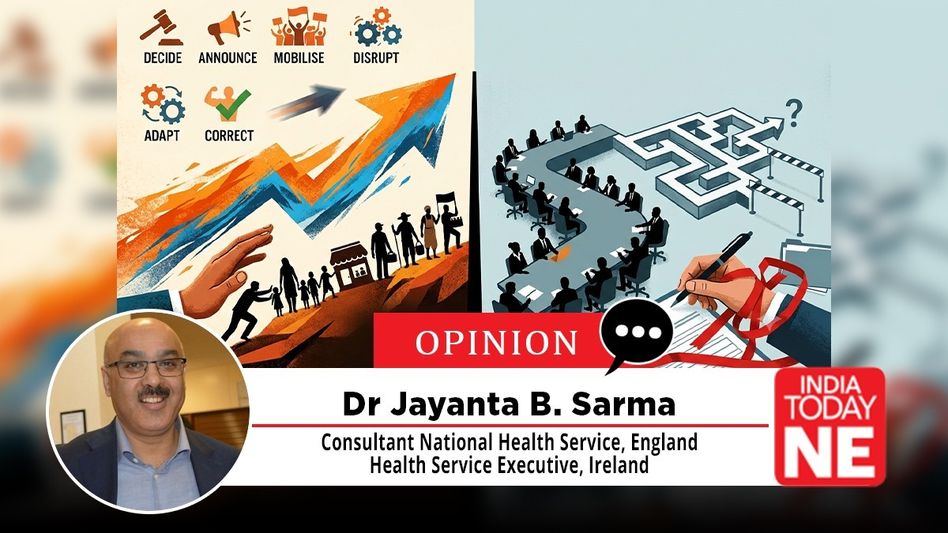
Decide. Announce. Mobilise. Disrupt. Adapt. Correct.
Sometimes the results are genuinely impressive. India can accomplish in five years what more deliberative societies might struggle to achieve in twenty. An enormous and diverse country can apparently be persuaded—or compelled—to move with astonishing speed.
This capacity understandably attracts admiration abroad and considerable pride at home.
Yet the journey is rarely smooth.
Citizens improvise. Businesses scramble. Bureaucracies reinterpret instructions. Courts intervene. Deadlines move. Rules are modified. Those with fewer resources struggle disproportionately.
Eventually, however, a new equilibrium emerges.
The disruption fades from collective memory.
The achievement remains.
And we conclude that the policy succeeded.
But there is another way of organising change.
Having spent much of my professional life as a doctor in Britain, I have encountered an almost opposite philosophy.
Western institutions are obsessed with change.
There is an entire vocabulary devoted to it: change management, transformation, stakeholder engagement, co-production, implementation science, quality improvement, behavioural change.
And, of course, there is the almost sacred figure of the “change agent”.
One sometimes feels that being called a change agent is to be elevated somewhere between an innovator and an angel.
The reverence is revealing.
Why do mature institutions require change agents?
Because change has become extraordinarily difficult.
Consider healthcare. Almost everyone agrees that substantial reform is necessary. Governments know it. Doctors know it. Managers know it. Patients know it.
Yet changing almost anything can require evidence gathering, consultation, stakeholder engagement, equality assessments, financial modelling, pilot programmes, evaluation, further consultation, implementation planning and management of resistance.
Then circumstances change.
Leadership changes.
Priorities change.
Another review is commissioned.
Ten years later, a new committee may rediscover the original problem.
It is easy to ridicule this.
But that would be unfair.
The elaborate machinery surrounding change represents, at least partly, one of the great achievements of modern liberal society.
The individual has acquired the right not to be casually moved by the state.
Workers have rights. Communities must be consulted. Environmental consequences must be considered. Minorities cannot simply be overruled. Governments may be challenged in courts. Professionals may question administrators. Evidence matters.
All this is immensely valuable.
But it has a price.
The West has developed an extraordinarily sophisticated science of managing change while becoming increasingly frustrated by its inability to change.
India sometimes appears to achieve change by ignoring much of that science.
Strangely, both systems are dissatisfied with themselves.
Western institutions envy India’s speed.
Indian citizens admire Western predictability.
The West dreams of transformation.
India dreams of an orderly transition.
Perhaps, however, we are describing the contrast incorrectly.
The difference may not be that the West changes slowly while India changes quickly.
It may be that the West negotiates change before implementation, while India negotiates change during and after implementation.
In Western societies, resistance is formalised.
It appears through consultations, professional bodies, trade unions, regulatory agencies, local governments, parliamentary committees, environmental assessments and judicial review.
Resistance is visible because the system has given it institutional form.
In India, the government may announce first.
Then the real negotiation begins.
State governments adapt. Bureaucrats reinterpret. Businesses discover workarounds. Citizens evade inconvenient provisions. Courts intervene. Deadlines are extended. Rules are selectively enforced. Informal arrangements emerge.
What appears from a distance to be decisive implementation may conceal an enormous process of subsequent improvisation.
India may not possess less resistance to change.
It may simply have moved resistance from before the decision to after it.
And this leads to an uncomfortable question.
When India survives a disruptive transformation, who deserves the credit?
The government?
Or society?
During sudden economic disruption, shopkeepers extend informal credit.
During digitalisation, children help elderly parents navigate unfamiliar systems.
When formal institutions fail, families mobilise.
Communities improvise.
Small businesses invent workarounds.
Citizens absorb uncertainty.
India possesses an extraordinary social capacity for adaptation.
Perhaps we sometimes mistake this for state capacity.
The state pushes.
Society catches.
The state pushes again.
Society improvises.
Eventually the country arrives somewhere new.
The government then points to the distance travelled as evidence of successful governance.
But two questions should be distinguished.
Did the government successfully implement the policy?
Or did society successfully survive the government’s implementation of the policy?
Five years later, the two may look remarkably similar.
There is also a class dimension to disruptive change.
Not everyone possesses equal capacity to adapt.
A large corporation can employ consultants to navigate a new tax system. A small trader may struggle.
An educated family can negotiate digital systems. An elderly person living alone may not.
A wealthy motorist can replace an old vehicle. Someone who has invested years of savings in a car cannot casually do so.
Rapid transformation therefore contains an unstated assumption:
Everyone has sufficient resources to adapt.
They do not.
This means that some celebrated transformations may carry an invisible subsidy.
The subsidy is paid by those whose losses, inconvenience, anxiety and wasted time are never measured.
The benefits of successful transformation eventually appear in economic statistics.
The transitional suffering often does not.
Yet the opposite problem exists in the West.
When every affected person must be consulted, every risk assessed and every objection accommodated, another cost disappears from view.
The cost of delay.
A healthcare system postpones reform.
Waiting lists gradually lengthen.
Infrastructure projects take decades.
Housing becomes progressively unaffordable.
Planning processes prevent construction.
Public finances deteriorate.
Productivity stagnates.
No dramatic catastrophe occurs.
There are no queues outside banks.
No sudden announcements.
No single moment of visible disruption.
Instead, millions experience the quiet consequences of stagnation.
India’s costs are often acute and visible.
The West’s costs are often chronic and dispersed.
As a doctor, the analogy is irresistible.
One system risks the complications of aggressive intervention.
The other risks allowing the disease to progress while repeatedly discussing treatment options.
Neither can automatically claim moral superiority.
There may also be something wrong with the way we understand resistance to change.
The vast literature of change management often assumes that people resist change because they are conservative, frightened, poorly informed or invested in existing arrangements.
Therefore the change agent must explain, persuade, engage, incentivise and reassure.
But perhaps people do not primarily resist change.
Perhaps they resist being changed by someone else.
The distinction is profound.
A doctor may enthusiastically adopt a new technique personally discovered at a conference yet resist an almost identical procedure imposed through a mandatory hospital protocol.
Why?
Agency.
Ownership.
Dignity.
Status.
The central problem of change may therefore not be speed.
It may be authorship.
Who gets to say, “We are changing”?
And who is told, “You must change”?
India’s mobilisation model frequently sacrifices authorship for velocity.
The Western model may preserve authorship so extensively that collective movement becomes painfully difficult.
The real predicament lies somewhere between them.
Perhaps, then, we have been asking the wrong question.
Should governments move quickly or slowly?
There can be no universal answer.
A better question is:
What happens if they are wrong?
Governments should be able to experiment. Indeed, in a rapidly changing world, experimentation may be essential.
Try something.
Observe the consequences.
Measure.
Correct.
Abandon if necessary.
Speed itself is not necessarily dangerous.
The real danger arises when three things come together:
Speed, certainty and irreversibility.
A government can move rapidly when failure is reversible.
It should move cautiously when failure may cause permanent damage.
This suggests a simple principle of governance:
Move rapidly where mistakes can be reversed. Move cautiously where they cannot.
Such a principle avoids both the worship of disruption and the worship of procedure.
There is, however, another problem.
Successful disruption teaches governments lessons.
Not always the right ones.
Suppose a government introduces an audacious policy.
Experts warn of chaos.
Chaos follows.
Society adapts.
Institutions improvise.
The worst predictions do not materialise.
Eventually some positive outcomes emerge.
What lesson does the political system learn?
It may not learn:
“We were fortunate that society proved resilient.”
It may learn:
“Experts are always too cautious.”
“Consultation is unnecessary.”
“Opposition is obstruction.”
“Disruption works.”
The next policy becomes more ambitious.
The timetable becomes shorter.
Dissent is dismissed more readily.
Eventually, a method that succeeded under one set of circumstances is applied where the consequences are disastrous.
This is the survivorship bias of governance.
We remember the bold transformations that worked.
We forget the abandoned schemes, hidden costs and people who failed to adapt.
Western societies suffer from the opposite version of the same problem.
Most Western safeguards arose for good reasons.
Unchecked governments have caused immense suffering. Experts have been disastrously wrong. Majorities have oppressed minorities. Industrial development has destroyed environments. Doctors have harmed patients. Corporations have exploited workers.
So societies created protections.
Regulators.
Ethics committees.
Consultations.
Appeals.
Impact assessments.
Judicial reviews.
Each generation learns from previous failures and adds another safeguard.
But almost nobody removes one.
Eventually, the institution begins to resemble an organism whose immune system has become so elaborate that it interferes with normal functioning.
There is an almost medical metaphor here.
India risks something resembling sepsis: an overwhelming systemic response that may achieve its objective while causing extensive collateral damage.
The West risks autoimmunity: protective mechanisms becoming so elaborate that they begin impairing the organism they were created to protect.
Neither represents health.
A civilisation’s strength, pushed beyond its useful range, becomes its pathology.
What, then, allows a society to move quickly without becoming coercive?
Perhaps the answer is trust.
Citizens can tolerate rapid experimentation when they believe certain things.
That the government has examined the evidence.
That uncertainty will be acknowledged.
That data will be published honestly.
That mistakes will be admitted.
That those harmed will be protected.
That policies will be corrected when evidence changes.
And that retreat remains possible when an experiment fails.
A high-trust society may therefore move quickly without abandoning democracy.
A low-trust society faces two unattractive alternatives.
Endless consultation because nobody trusts authority.
Or coercive mobilisation because authority does not trust consultation.
Perhaps speed and democracy are not necessarily opposites.
Trust may be the bridge between them.
The most mature government may therefore be neither the government that moves slowly nor the one that moves quickly.
It may be the government capable of saying:
“We do not know everything. But we must act. Here is the evidence. Here are the uncertainties. Here are the risks. Here is how we will measure the consequences. Here is how we will protect those who are harmed. And here is how we will reverse course if we are wrong.”
That requires something rarer than decisiveness.
It requires institutional humility.
Perhaps the deepest question, then, is not about India or the West.
It is about systems themselves.
How do intelligent people, behaving rationally within institutions, collectively produce either paralysis or recklessness?
An Indian bureaucrat may privately recognise the dangers of excessive speed.
A British health-service manager may privately recognise the absurdity of endless consultation.
Yet neither can easily alter the system.
Each behaves rationally within an institutional structure that has developed its own methods of survival.
India has historically survived through adaptation, improvisation and the capacity to absorb disruption.
Those strengths enter its philosophy of governance.
Western liberal societies survived abuses of power by developing procedures, safeguards and individual rights.
Those strengths enter theirs.
Eventually India becomes too comfortable with disruption.
The West becomes too comfortable with delay.
Each system becomes a prisoner of the qualities that once made it successful.
And this may explain the strange predicament in which we now find ourselves.
History is accelerating.
Artificial intelligence, climate change, demographic ageing, pandemics, migration, energy insecurity and technological disruption demand increasingly rapid decisions.
Western societies ask:
How can we move faster without sacrificing rights, legitimacy and protection?
India faces the opposite question:
How can we preserve our extraordinary capacity for mobilisation without repeatedly asking ordinary citizens to absorb the costs of transformation?
The answer cannot be permanent disruption.
Nor can it be permanent consultation.
A mature society must develop institutions capable of continuous adaptation: fast enough to avoid stagnation, cautious enough to recognise irreversible harm, humble enough to admit uncertainty and humane enough not to require citizens repeatedly to survive the ambitions of the state.
Which brings us back to E20 petrol.
Perhaps we began by looking for damage in the wrong place.
The engine may survive.
The aquifer may not.
The policy may succeed.
The citizen may pay.
The consultation may protect everyone.
The reform may never happen.
Between recklessness and paralysis lies one of the great unresolved problems of modern governance.
The challenge is no longer simply whether societies can change.
They must.
The challenge is whether we can reconcile the accelerating speed of history with the dignity of those who must live through it.
(Author’s Note: Dr Jayanta Biswa Sarma writes on politics, institutions, and society through the lenses of history, philosophy, and systems thinking, drawing on both Indian and Western intellectual traditions. Artificial intelligence tools may be used in preparing this article as research and editorial aids. All arguments, interpretations, and final editorial judgement remain the author’s responsibility)