The Fear We Learn to Carry: What Northeast Indians Face in India’s Cities
This account traces how racial slurs, suspicion and violence shape the lives of many Northeast Indians in Indian cities. It shows how repeated prejudice leaves families carrying fear even when no case is filed.
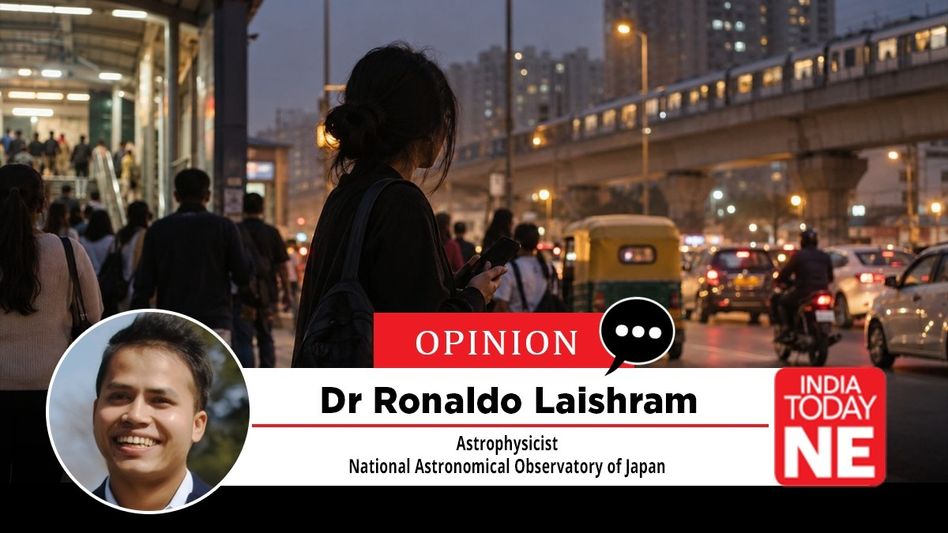

- Sep 29, 2026,
- Updated Sep 29, 2026, 12:12 PM IST

- Everyday slurs and stereotypes leave many Northeastern residents carrying lasting distress
- Families keep calling loved ones because past incidents never fully fade
- Many humiliating encounters go unreported, disappearing from records but not memory
There were evenings in Delhi when someone from my family would be late coming home.
My sister. A friend. Someone close to me.
I would look at the time, check my phone and send a message: Where are you? Everything okay? Sometimes, after a while, I would ask again.
I knew I was probably bothering them. And some amount of worry is normal. Anyone who loves someone worries when they are late. But underneath that ordinary concern was another kind of fear. It had built up quietly over the years, from things I had seen, things friends had experienced, stories I had read, and, in smaller ways, things I had experienced myself.
The staring. The racial words thrown casually on a street. The jokes about our eyes. The assumption that we must be Chinese, Korean, Nepali, anything except Indian. Comments about the food we eat, the clothes we wear, the way we look. Northeast women being sexualised through stereotypes that many people outside our communities may never even have had to notice.
Most days, nothing happens. But the mind remembers the days when something did.
After a while, fear does not always need an incident in front of you. Memory is enough.
The face that makes you foreign
One of the strangest experiences of being from Northeast India is having your belonging questioned inside your own country.
People have asked me where Manipur is. Some have asked which country I am from. I do not think not knowing where Manipur is makes someone racist. India is huge. There are things I do not know about other parts of the country too.
Curiosity is not the problem. The problem is when a face becomes a conclusion.
When somebody looks at you and decides where you belong before you speak. When “Chinese” becomes a joke. When the appearance of a Northeast woman comes with assumptions about her character. When food, clothes, hairstyles or facial features become permission for strangers to comment.
An IIT Delhi study of 224 Northeastern people living in the city found that more frequent experiences of being ignored or overlooked because of group identity were associated with greater distress. These are often the smaller acts that accumulate. A comment may last five seconds; what it teaches you can last much longer.
What never becomes a case
This is also why official numbers can never tell the whole story.
A racial insult on a street does not necessarily become an FIR. Neither does an obscene comment, a humiliating exchange with a landlord, somebody following a woman, or a group laughing at a person’s appearance.
People make a calculation. Is it worth reporting? Will anyone take it seriously? Will it become an even bigger headache? Can I just go home?
So they go home. The incident disappears from the statistics. It does not always disappear from the person.
That is also why the worry inside families can look excessive from the outside. Be careful. Don’t go alone. Call when you reach. Who are you with?
Sometimes the person receiving those calls gets irritated. I understand that too. But behind the irritation is often somebody sitting hundreds or thousands of kilometres away, imagining possibilities they wish they did not have to imagine. The fear is rarely built by one event. It is built by repetition.
A memory that did not begin yesterday
In January 2014, Nido Tania, a student from Arunachal Pradesh, was beaten in Delhi’s Lajpat Nagar after men mocked his hairstyle and hurled racist slurs at him. He died from his injuries. Four men were later convicted.
His death forced a national conversation that should already have been happening. The Union government subsequently constituted the M.P. Bezbaruah Committee to examine violence, discrimination and security concerns faced by people from the Northeast living elsewhere in India. It recommended changes in policing, law, accommodation, education and public awareness. More than a decade later, the reason for that concern has not disappeared. In February 2026, three women from Arunachal Pradesh in South Delhi alleged racial abuse and intimidation by neighbours; a couple was later arrested. Some incidents are words. Some become violence. But they enter the same memory.
And then, Oja Vikram
This September, Manipur lost Oja Chongtham Vikram Singh.
He was a musician and teacher who had lived in Delhi for years with his wife and son. On the night of September 6, he stepped outside his home in Kilokari after objecting to noise and disturbance nearby. According to police and reporting based on the FIR and CCTV footage, a group of men followed him towards his building and assaulted him. He later died from his injuries. Seven adults were arrested and a juvenile was apprehended.
Members of the Northeast community called for a thorough and impartial investigation, including examination of whether prejudice had played a role. Whether prejudice formed part of what happened remained an open question.
His death did not create the fear I am writing about. It entered a fear that was already there.
For a community that has watched these conversations return again and again, a new incident does not arrive on empty ground. It arrives with memory attached.
What the numbers tell us, and what they cannot
Delhi has taken institutional steps, including the Special Police Unit for North East Region, SPUNER, nodal officers, dedicated helplines and sensitisation measures.
But according to government data reported by The Indian Express, Delhi Police receives around 180 calls each month involving Northeastern citizens, roughly six a day. Nearly one in four concerns tenant disputes, many involving alleged ill-treatment by landlords.
Another Delhi Police dataset recorded 2,656 FIRs involving crimes against people from the Northeast between 2014 and April 30, 2026. In around 55 per cent, the accused remained untraced. These were not all racial crimes, but the figure still shows how often cases ended without those responsible being identified or apprehended.
And perhaps the most revealing number is the one India does not have. In March 2026, the Union Home Ministry told the Lok Sabha that national data on hate speech, racial slurs, harassment and discrimination against people from the Northeastern states is not maintained centrally.
What we do not count becomes very easy to underestimate.
What should not still be unfinished
The problem was recognised years ago. Recommendations were written. Some were accepted. Some mechanisms were created.
In January 2015, the Union Home Minister said the immediate recommendations of the Bezbaruah Committee had been accepted and announced that Sections 153C and 509A would be added to the Indian Penal Code to address racial discrimination and racial insults. By 2018, the proposal was still under examination. Those specific sections were never enacted in that form.
India has since replaced the IPC with the Bharatiya Nyaya Sanhita, which contains broader provisions dealing with enmity on grounds including race, place of birth, residence and language.
So the question is not whether nothing has been done. Things have been done. The harder question is whether the response has moved at the same pace as the problem.
Government cannot prevent every cruel word spoken on a street. But institutions decide what happens when prejudice becomes harassment or violence: whether complaints move forward, whether cases are properly investigated, and whether people believe the system is worth approaching.
Education matters just as much. NCERT says Northeast history and culture are included in its material, with newer textbooks and supplementary readers adding more. But information on a page and understanding in society are not the same thing.
When Indian citizens are still repeatedly mistaken for foreigners because of their faces, that work is clearly not finished. The goal should not simply be better statements after the next incident. It should be fewer families learning this fear in the first place.
The India I also know
There is another India in my own experience. Some of my closest friends are from outside the Northeast. I have met people across this country who cared for me deeply, welcomed me into their homes and never made me feel that I belonged any less than they did. I have experienced far more warmth than hostility. That is also India.
And that is why I do not think this conversation needs an enemy.
Sometimes prejudice survives because many good people never have to notice it. If nobody has questioned whether you belong to your own country, being called foreign may sound like a small joke. If your sister has never been sexualised because of a stereotype attached to her face, you may not understand why another family watches the clock differently when their daughter is late.
We can live in the same city and still carry very different calculations.
Some changes do not need a committee or a law. When somebody makes the joke, do not make the room safer for the joke by laughing. When someone genuinely asks where Manipur is, show them.
What belonging should mean
India’s diversity becomes real not in a slogan, but in ordinary life: when somebody who looks different sits beside us in a Metro coach, rents the room next door, joins our university, works at the next desk or cooks something unfamiliar in the neighbouring kitchen.
That is where belonging is tested.
People from Manipur, Nagaland, Mizoram, Meghalaya, Arunachal Pradesh, Tripura, Assam and Sikkim should not have to become less themselves to feel more Indian.
And when someone leaves the Northeast for another Indian city to study, work or build a future, the people at home should be able to feel what every family wants to feel: pride, hope and excitement, not an extra layer of fear.
A mother should not have to wonder whether her daughter will be treated differently because of her face. A father should not feel that sending his son away for an education also means preparing him for racial insults. A brother, sister, partner or friend should not have to quietly add somebody else’s prejudice to the ordinary worries of loving someone from far away.
There will probably always be evenings when I worry because somebody I love is late. That part is human. Families everywhere ask, Did you reach? Everything okay?
What I hope changes is the other fear, the one many Northeast families learned not because they wanted to, but because enough things happened around them that their minds began keeping count.
The phone will still be in my hand. Somewhere in the Northeast, another parent will probably still be holding one too.
No family should have to send someone they love into the rest of their own country with both hope and fear packed in the same bag.